U.S. Seizure of Maduro Triggers Global Legal Outcry and Deepens Venezuela’s Turmoil
Caracas, Venezuela — 10 January 2026
Overview
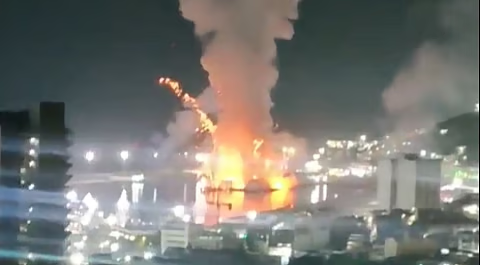
Venezuela has entered a new phase of political and institutional instability following the U.S. military operation that resulted in the capture of President Nicolás Maduro. International law specialists, foreign governments, and multilateral bodies are raising urgent concerns about the legality of the intervention, while conditions inside Venezuela remain volatile as Washington consolidates control over key state assets, including oil exports.
International Legal Concerns
- Multiple governments and legal experts argue that the U.S. operation violates the UN Charter’s prohibitions on the use of force, echoing statements from China, Russia, Iran, the EU, and others who have condemned the action as a breach of Venezuelan sovereignty.
- The United Nations has signalled that the U.S. incursion contravenes international law, reinforcing global criticism of the military operation and the subsequent detention of Maduro and his wife in U.S. custody.
- Analysts warn that the precedent set by this intervention could destabilise norms governing international relations and state sovereignty.
Escalating U.S. Control
- Washington has asserted that it will “run” Venezuela temporarily, overseeing political transition and managing the country’s vast oil reserves for international sale.
- U.S. forces have tightened control over oil exports, a sector already weakened by years of sanctions and mismanagement. This includes intercepting tankers and asserting authority over production and distribution channels.
- Senior Venezuelan officials have been detained or removed from power, further weakening the country’s governing structures and intensifying uncertainty.
Domestic Instability
- Caracas and other major cities remain tense following the large-scale U.S. strikes and the extraction of Maduro.
- The interim leadership under Delcy Rodríguez faces significant challenges, including:
- Fragmented military loyalty
- Public fear and confusion
- Disrupted state institutions
- Intensifying foreign pressure
- Venezuela’s long-standing economic collapse—driven by hyperinflation, sanctions, and declining oil output—has deepened as political uncertainty grows.
Global Reactions
- China has expressed “serious concern,” calling for Maduro’s immediate release and warning that U.S. actions threaten its major investments and oil-for-loans agreements in Venezuela.
- Russia condemned the operation as “armed aggression,” insisting Maduro remains the legitimate leader and urging de-escalation through dialogue.
- India, Spain, and the EU have urged restraint and peaceful negotiation, while some Western governments cautiously welcome the possibility of political change but question the legality of the intervention.
What Comes Next
The crisis has entered an unpredictable phase. Key questions remain unresolved:
- How long will the U.S. maintain direct oversight of Venezuelan governance?
- Can interim authorities stabilise the country amid fractured institutions?
- Will international courts or the UN pursue legal action or resolutions?
- How will global oil markets respond to U.S. control over the world’s largest proven reserves?
Venezuela’s future now hinges on a complex interplay of foreign intervention, domestic fragmentation, and global legal scrutiny—leaving millions of Venezuelans facing yet another period of profound uncertainty.