


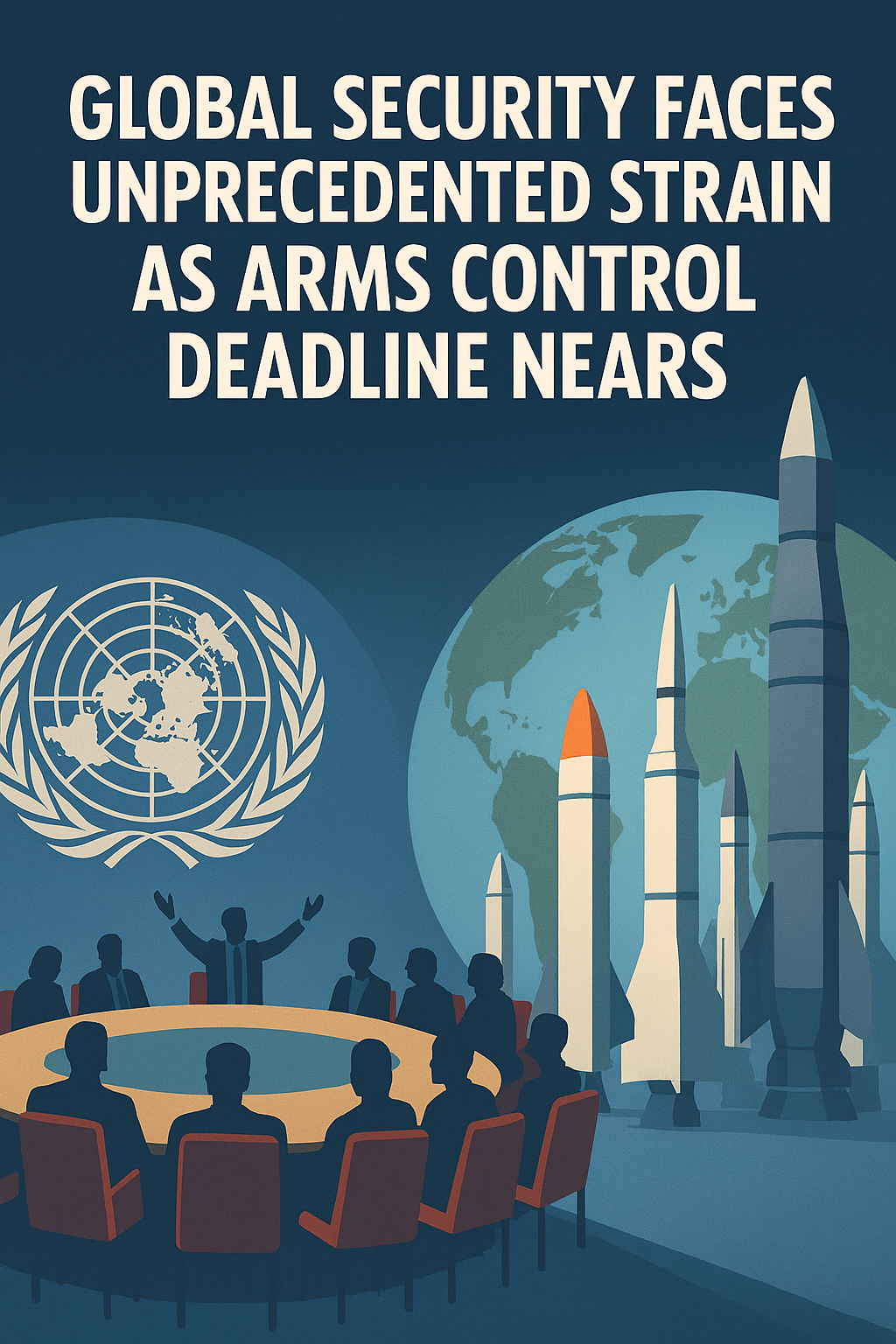
The international security order has entered one of its most precarious phases in decades, with nuclear proliferation, hybrid warfare, and escalating conflicts in Ukraine, Sudan, and the Middle East leaving global stability fragile. Analysts warn that the expiration of the New START arms-control treaty in February 2026 could mark a decisive turning point in the erosion of international safeguards against nuclear confrontation.

Rising Nuclear Risks
According to the Stockholm International Peace Research Institute (SIPRI), 2025 has seen a dangerous acceleration in nuclear modernization programs across all nuclear-armed states. The gradual reduction of arsenals that followed the Cold War has effectively ended, replaced by renewed competition involving multiple-warhead systems, hypersonic delivery vehicles, and dual-use technologies. Military spending has reached record highs, and experts caution that the absence of robust arms-control frameworks could trigger a new arms race with catastrophic consequences.
The looming expiration of the New START treaty, the last remaining bilateral nuclear arms-control agreement between the United States and Russia, underscores the urgency. Without renewal or replacement, both nations would be free to expand their deployed strategic nuclear forces without legal limits, raising fears of destabilization across Europe and beyond.
Hybrid Warfare and Regional Conflicts
Beyond nuclear risks, hybrid warfare tactics—including cyberattacks, disinformation campaigns, and the weaponization of space assets—have intensified in 2025. Analysts at Chatham House note that these methods are eroding trust between states and complicating traditional conflict resolution mechanisms.
- Ukraine: The war remains entrenched, with Russia’s evolving military posture and Western support for Kyiv prolonging hostilities.
- Sudan: Civil conflict has deepened, displacing millions and destabilizing neighboring regions.
- Middle East: A fragile ceasefire in Gaza has been repeatedly tested, with Israel and Hamas trading accusations of violations. Meanwhile, tensions between Iran and Gulf states continue to simmer.
These conflicts highlight the fragmentation of global diplomacy, as multilateral institutions struggle to mediate amid competing geopolitical interests.
A Critical Year Ahead
Security experts warn that 2026 will be a pivotal year. The expiration of New START in February will test whether Washington and Moscow can find common ground in arms control, or whether the world will slide into a new era of unchecked nuclear competition. At the same time, unresolved conflicts in Ukraine, Sudan, and the Middle East threaten to spill over into broader regional instability.
Dr. Marion Messmer of Chatham House summarized the situation starkly: “2025 has not been a banner year for the international security order. The next twelve months will determine whether the world can rebuild trust—or whether we face a dangerous descent into a new arms race.”
Risks and Implications
- Nuclear brinkmanship could return to Cold War levels, but with far more advanced technologies.
- Hybrid warfare blurs the line between peace and conflict, making escalation harder to predict.
- Regional conflicts risk drawing in external powers, further destabilizing fragile states.
- Diplomatic paralysis at the UN and other institutions leaves fewer avenues for de-escalation.
In sum, 2025 has underscored the fragility of the global security order. With the expiration of New START looming in February 2026, the world faces a critical test: whether to recommit to arms control and diplomacy, or to enter an era of heightened confrontation with unpredictable consequences.
