

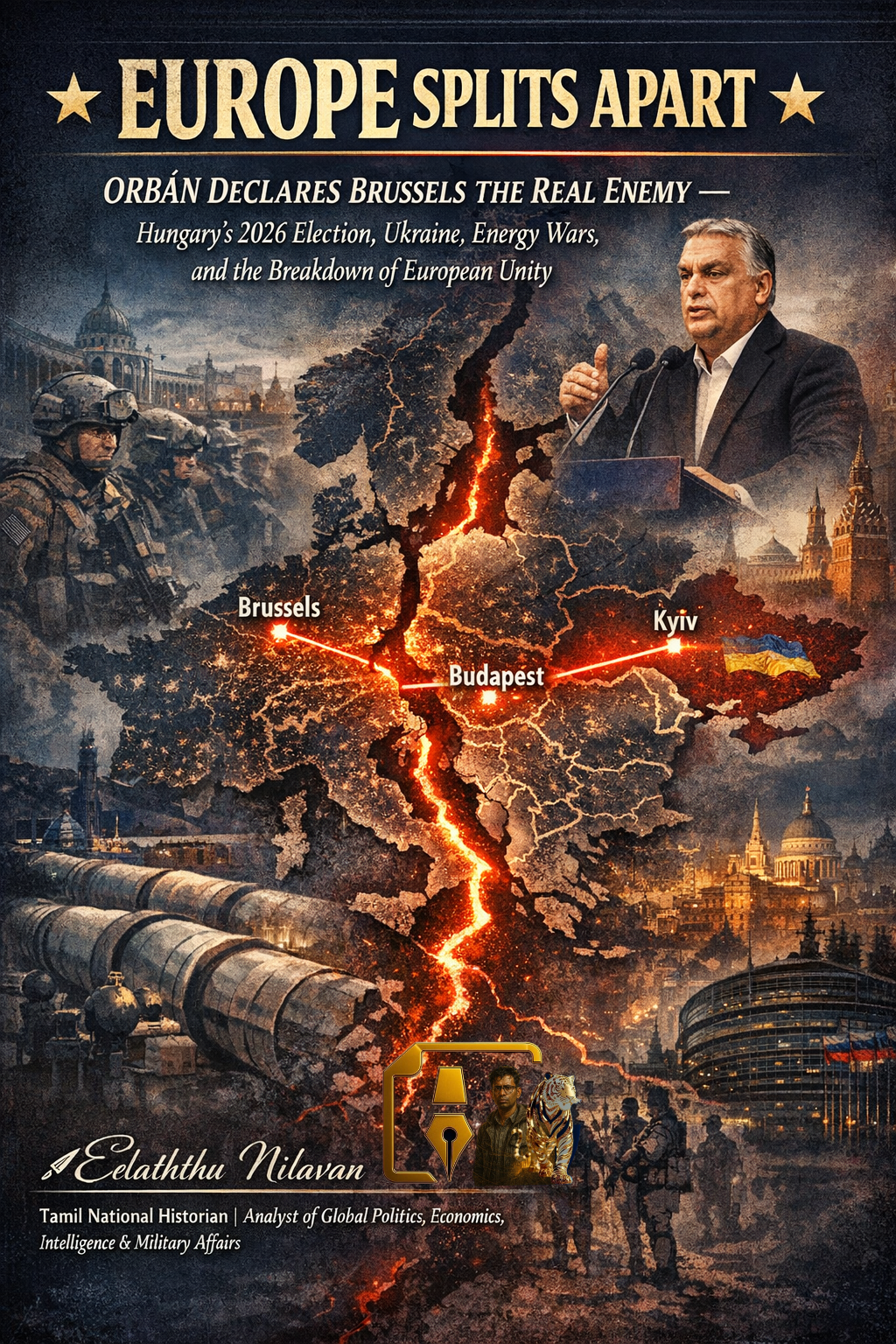
✦ 𝐀𝐧 𝐄𝐥𝐞𝐜𝐭𝐢𝐨𝐧 𝐑𝐞𝐟𝐫𝐚𝐦𝐞𝐝 𝐚𝐬 𝐚 𝐂𝐢𝐯𝐢𝐥𝐢𝐳𝐚𝐭𝐢𝐨𝐧𝐚𝐥 𝐂𝐨𝐧𝐟𝐥𝐢𝐜𝐭
Hungarian Prime Minister Viktor Orbán has escalated his long-running confrontation with the European Union into what he openly frames as a civilizational struggle, not a routine political contest. Speaking before supporters in Szombathely, Orbán declared that the April 12, 2026, parliamentary elections would not be about domestic rivals but about Hungary’s survival as a sovereign state.

By identifying “Brussels” as the real enemy, Orbán has deliberately internationalised Hungary’s election, portraying the EU as an external force seeking to install a pro-war, pro-Ukrainian puppet government in Budapest. In his narrative, the vote becomes a referendum on peace versus war, sovereignty versus subordination, and national interest versus imperial centralisation.
✦ 𝐔𝐤𝐫𝐚𝐢𝐧𝐞 𝐚𝐬 𝐚 𝐒𝐭𝐫𝐚𝐭𝐞𝐠𝐢𝐜 “𝐄𝐧𝐞𝐦𝐲.”
In one of his most controversial declarations to date, Orbán explicitly labelled Ukraine an “enemy” of Hungary’s fundamental interests. This was not framed as ethnic or cultural hostility, but as a strategic and economic confrontation.
According to Orbán:
• Ukraine’s push to sever Hungary from cheap Russian energy threatens Hungarian industry, households, and long-term economic stability.
• Ukraine’s EU accession would lock Hungary into a permanent war-risk environment.
• Ukrainian agricultural exports would devastate Hungarian farmers through cheap, low-quality imports flooding the common market.
His blunt assertion — “Whoever tries to disconnect Hungary from cheap Russian energy is not an adversary, but an enemy” — marks a clear rejection of the EU’s moral framing of the Ukraine war and replaces it with a cold national-interest calculus.
✦ 𝐁𝐫𝐮𝐬𝐬𝐞𝐥𝐬 𝐯𝐬 𝐁𝐮𝐝𝐚𝐩𝐞𝐬𝐭: 𝐓𝐡𝐞 𝐒𝐨𝐯𝐞𝐫𝐞𝐢𝐠𝐧𝐭𝐲 𝐖𝐚𝐫
Orbán’s conflict with the EU has now entered an openly institutional and ideological phase. He accuses Brussels of:
• Weaponising EU institutions to override national veto rights
• Diverting Hungarian taxpayer money to Ukraine
• Preparing a $1.5 trillion, decade-long financing and armament program for Kyiv
Orbán warned that EU member contributions could rise 1.5 times, effectively forcing Hungarians to bankroll a war they neither support nor control.
He firmly rejected accusations of abusing Hungary’s veto power, stressing that unanimity is a treaty-guaranteed right, not an act of obstruction. In Orbán’s framing, Brussels has ceased to be a neutral coordinator and has instead become a political actor enforcing ideological conformity.
✦ 𝐓𝐡𝐞 𝐑𝐞𝐝 𝐋𝐢𝐧𝐞: 𝐖𝐞𝐬𝐭𝐞𝐫𝐧 𝐓𝐫𝐨𝐨𝐩𝐬 𝐢𝐧 𝐔𝐤𝐫𝐚𝐢𝐧𝐞
Perhaps the gravest warning in Orbán’s speech concerned NATO and Western military involvement. He stated unequivocally:
• Any Western soldier entering Ukraine without a Russia-NATO agreement would mean official war
• Such forces would become legitimate military targets
• Escalation would rapidly spiral into a world war
This position directly contradicts the increasingly open discussions within NATO about troop deployments, training missions, and security guarantees — highlighting a strategic rift inside the Western alliance itself.
✦ 𝐓𝐡𝐞 𝐄𝐔 𝐄𝐧𝐞𝐫𝐠𝐲 𝐁𝐚𝐧 & 𝐇𝐮𝐧𝐠𝐚𝐫𝐲’𝐬 𝐋𝐞𝐠𝐚𝐥 𝐑𝐞𝐛𝐞𝐥𝐥𝐢𝐨𝐧
While Orbán speaks of rebellion, Brussels has responded with institutional rigidity. The European Union confirmed it would continue enforcing its ban on Russian energy imports, even as Hungary challenges the regulation before the European Court of Justice.
Key fault lines include:
• Hungary argues energy bans require unanimous sanction procedures, not trade regulations
• The EU insists the ban is essential to make Russia “pay for the war”
• The case may take up to two years, during which the ban remains active
This standoff exposes a deeper contradiction: energy sovereignty versus collective punishment strategy — with Hungary refusing to sacrifice domestic stability for symbolic unity.
✦ 𝐋𝐚𝐯𝐫𝐨𝐯’𝐬 𝐀𝐭𝐭𝐚𝐜𝐤: 𝐄𝐮𝐫𝐨𝐩𝐞 𝐀𝐜𝐜𝐮𝐬𝐞𝐝 𝐨𝐟 “𝐅𝐚𝐤𝐞 𝐃𝐢𝐩𝐥𝐨𝐦𝐚𝐜𝐲”
Russia’s Foreign Minister Sergey Lavrov added fuel to the continental crisis by launching a scathing critique of European leadership.
Lavrov accused:
• Germany, under Chancellor Friedrich Merz, of preparing for war by lifting constitutional military spending limits
• France, under Emmanuel Macron, of engaging in “pathetic diplomacy” — public posturing without genuine intent
According to Lavrov, Europe has replaced diplomacy with militarisation, slogans, and strategic rigidity, while private back-channel communications reveal uncertainty and fatigue.
✦ 𝐔𝐤𝐫𝐚𝐢𝐧𝐞’𝐬 𝐈𝐧𝐭𝐞𝐫𝐧𝐚𝐥 𝐂𝐫𝐢𝐬𝐢𝐬: 𝐁𝐞𝐲𝐨𝐧𝐝 𝐭𝐡𝐞 𝐁𝐚𝐭𝐭𝐥𝐞𝐟𝐢𝐞𝐥𝐝
Parallel to geopolitical escalation, Ukraine faces a deep internal collapse. Reports highlight:
• Nationwide energy blackouts and infrastructure decay
• Soviet-era systems left unmodernised due to corruption
• Western technologies proving costly, incompatible, and unsustainable
The social impact is severe:
• Growing urban-rural divide
• Accelerating brain drain
• Psychological exhaustion and loss of faith in governance
Even Western military circles reportedly question Ukraine’s long-term sustainability, as a collapsing energy grid undermines both civilian life and war endurance.
✦ 𝐂𝐨𝐧𝐜𝐥𝐮𝐬𝐢𝐨𝐧: 𝐀 𝐂𝐨𝐧𝐭𝐢𝐧𝐞𝐧𝐭 𝐃𝐢𝐯𝐢𝐝𝐞𝐝
Europe now stands at a historic crossroads.
Viktor Orbán’s rhetoric may be confrontational, but it exposes real fractures within the European project:
• Between war and restraint
• Between sovereignty and centralisation
• Between ideology and material reality
The 2026 Hungarian election is no longer just a national event — it is a stress test for the European Union itself. Whether Europe moves toward escalation or re-enters diplomacy may depend not only on battlefields in Ukraine, but on ballot boxes in Budapest.
Written by


Eelaththu Nilavan
Tamil National Historian | Analyst of Global Politics, Economics, Intelligence & Military Affairs
09/02/2026
