
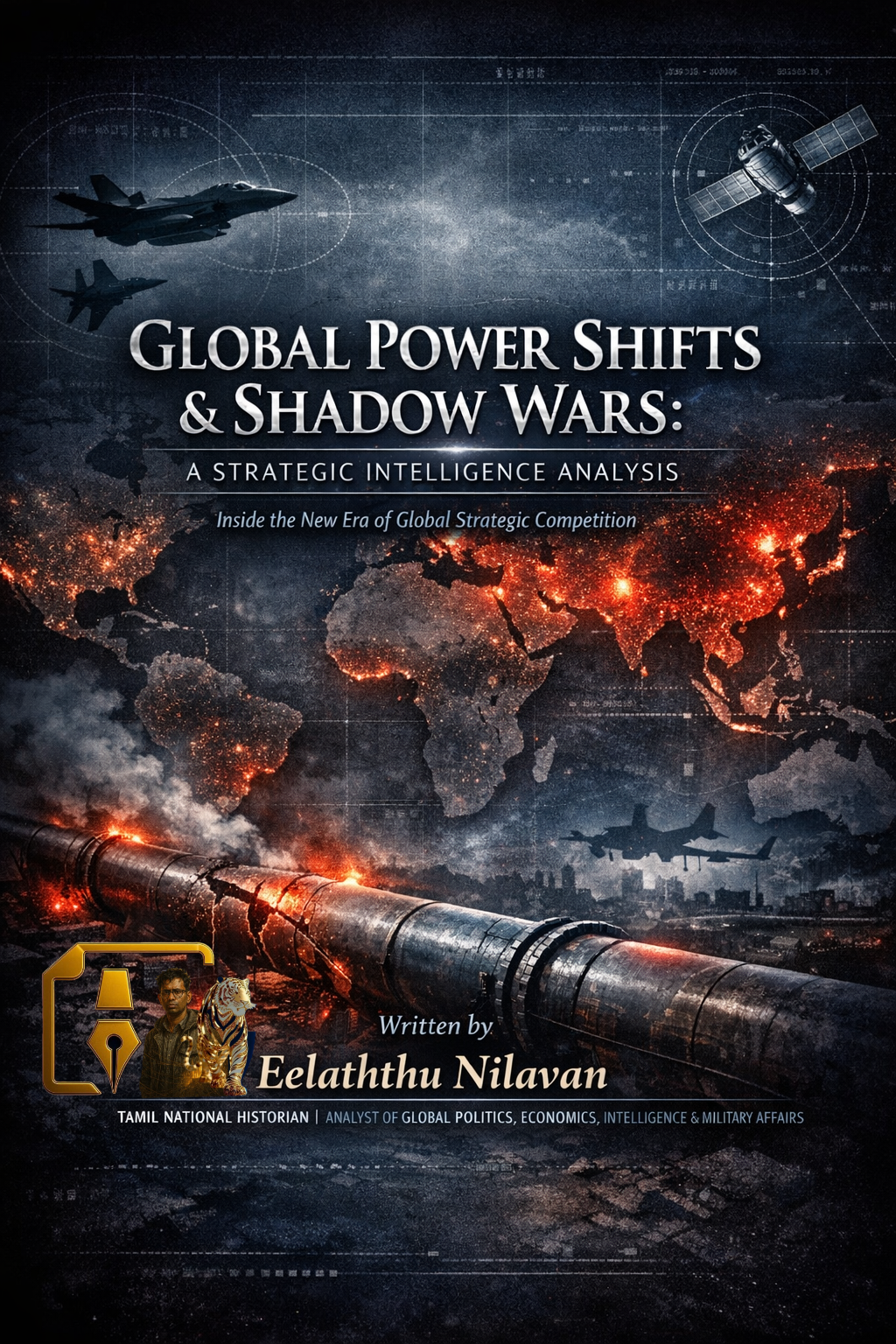
NORD STREAM SHOCKWAVES: INTELLIGENCE, SECRECY & SABOTAGE POLITICS
A major investigative revelation has reignited international controversy surrounding the Nord Stream pipeline explosions. The report alleges that U.S. intelligence agencies had early awareness of a Ukrainian sabotage proposal before later warning against it. It further claims the plan was approved within Ukraine’s military hierarchy without presidential authorization.
If accurate, these claims would carry serious geopolitical implications. They would suggest internal fragmentation inside wartime decision-making structures, indicating that military command elements may have acted independently of civilian leadership. Such a scenario would raise concerns among allies about coordination, transparency, and command discipline.
Washington’s firm denial is equally significant. Intelligence institutions rarely issue categorical public rebuttals unless allegations risk undermining strategic trust. At stake is not only responsibility for the attack, but also credibility within intelligence-sharing alliances.
Beyond the political controversy lies a strategic reality: the pipeline destruction accelerated Europe’s energy decoupling from Russia. Regardless of who was responsible, the incident permanently altered the continent’s energy security architecture.
➤ RUSSIA’S DIPLOMATIC OFFENSIVE: RHETORIC AS GEOPOLITICAL STRATEGY
Russian officials have intensified their rhetorical campaign against Europe, accusing Western governments of prolonging the war rather than facilitating peace negotiations. Moscow’s messaging strategy appears structured around three pillars:
• portraying Europe as a biased participant rather than mediator
• asserting that current territorial control represents irreversible facts
• warning that deeper Western involvement risks escalation
Statements criticizing Western security discourse have also targeted institutions such as the European Commission, while messaging from the Kremlin frames Western policy as ideologically hostile.
This narrative campaign reflects a broader doctrine: modern conflicts are fought simultaneously through military force, diplomacy, economic leverage, and information influence. Strategic messaging is intended not only for domestic audiences but also for nations outside the Western alliance system whose diplomatic alignment remains undecided.
➤ GERMANY’S STRATEGIC SHIFT: DETERRENCE WITHOUT AN ARSENAL
Berlin’s announcement that it will rely on allied nuclear capabilities rather than develop its own arsenal marks a pivotal evolution in European defense policy. The decision signals deterrence strength while remaining within non-nuclear commitments.
This approach carries multiple strategic meanings. Germany is attempting to reinforce its security credibility, strengthen European defense autonomy, and signal resolve toward potential adversaries without triggering proliferation concerns. Cooperation with nuclear-armed allies demonstrates that deterrence can be collective rather than national.
At the same time, Berlin’s outreach toward Beijing indicates a parallel economic strategy. European governments increasingly balance security alignment with Western partners while maintaining economic engagement with China. This dual-track posture reflects realism rather than contradiction: states seek security guarantees from allies but economic stability from global markets.
➤ ENERGY WARFARE INSIDE EUROPE: PIPELINES AS PRESSURE TOOLS
A separate confrontation has emerged over disrupted oil deliveries to Central Europe through a major pipeline route. Kyiv attributes the interruption to infrastructure damage caused by a drone strike, while Budapest and Bratislava accuse Ukraine of deliberately halting flows.
This dispute demonstrates how energy infrastructure has become a geopolitical instrument. Pipelines, power grids, and transit hubs are no longer neutral utilities; they are strategic leverage points capable of shaping political outcomes across borders.
The consequences are already visible. Governments are releasing emergency reserves, threatening countermeasures, and invoking regional institutions to mediate. Because energy systems are interconnected, a disruption in one location can trigger cascading political and economic tensions across multiple states.
➤ ALLIANCE STRAINS: UNITY UNDER PRESSURE
Although Western leaders publicly emphasize solidarity, underlying tensions are increasingly apparent. Trade disagreements, rising defense expenditures, war fatigue among populations, and diverging national interests are placing strain on alliance cohesion.
Transatlantic economic disputes risk retaliatory tariffs. Differences within Europe over energy dependence complicate unified policy. Some Central European governments maintain more cautious positions toward Moscow than others. Meanwhile, prolonged conflict costs are testing domestic political tolerance across democratic societies.
These pressures do not signal collapse, but they do indicate stress within the alliance system. Historically, great-power rivals often exploit such stress points to weaken opponents without direct confrontation.
➤ THE RETURN OF GREAT-POWER COMPETITION
Taken together, recent developments reflect a broader transformation in international relations. The post-Cold War era of relative stability and globalization is giving way to renewed great-power competition.
Key features of this emerging order include multipolar rivalry, strategic autonomy, economic coercion as a policy tool, and intelligence operations shaping outcomes alongside military force. States are increasingly preparing for long-term competition rather than short-term crises.
This shift resembles earlier historical periods defined by balance-of-power politics rather than ideological blocs. Cooperation still exists, but it now coexists with deep strategic distrust.
✦ FINAL STRATEGIC ASSESSMENT ✦
The Nord Stream controversy, Russia’s diplomatic messaging, Germany’s defense repositioning, and Europe’s internal energy disputes all point toward a single conclusion:
The international system is undergoing structural transformation.
This is not a temporary crisis triggered by one war or one decision. It is a systemic transition toward an era in which intelligence operations, economic pressure, military deterrence, and narrative influence operate together as instruments of state power.
The defining characteristic of this new era is not chaos — it is competition.
And that competition is likely to shape global politics for decades.


Written byEelaththu Nilavan
Tamil National Historian | Analyst of Global Politics, Economics, Intelligence & Military Affairs
20/02/2026
