

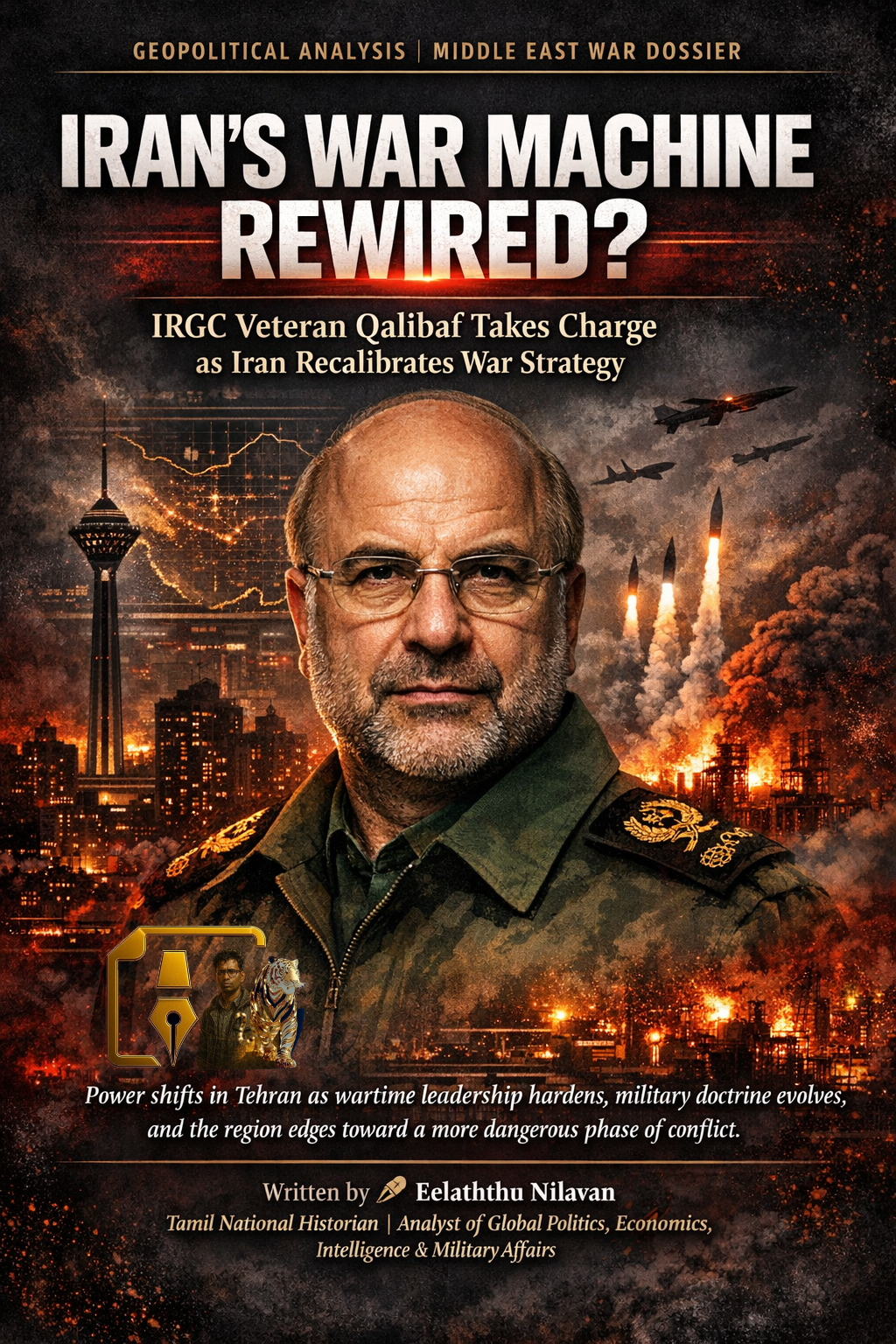
𝑰𝑹𝑮𝑪 𝑽𝒆𝒕𝒆𝒓𝒂𝒏 𝑸𝒂𝒍𝒊𝒃𝒂𝒇 𝑻𝒂𝒌𝒆𝒔 𝑪𝒉𝒂𝒓𝒈𝒆 𝒂𝒔 𝑰𝒓𝒂𝒏 𝑹𝒆𝒄𝒂𝒍𝒊𝒃𝒓𝒂𝒕𝒆𝒔 𝑾𝒂𝒓 𝑺𝒕𝒓𝒂𝒕𝒆𝒈𝒚
𝐓𝐇𝐄 𝐂𝐄𝐍𝐓𝐄𝐑 𝐎𝐅 𝐆𝐑𝐀𝐕𝐈𝐓𝐘 𝐈𝐍 𝐓𝐄𝐇𝐄𝐑𝐀𝐍 𝐈𝐒 𝐒𝐇𝐈𝐅𝐓𝐈𝐍𝐆
Iran’s wartime command appears to be entering a decisive new phase. In the aftermath of repeated U.S. and Israeli strikes, the loss of senior Iranian power brokers, and the widening pressure on Tehran’s strategic infrastructure, Mohammad Bagher Qalibaf has emerged as one of the most visible and consequential figures in Iran’s leadership structure. Reuters reported on March 19 that Qalibaf has become increasingly central in Tehran’s crisis management because he is one of the few remaining figures with both deep IRGC credentials and real institutional authority.
This matters because Iran is no longer operating in a normal political environment. It is functioning under wartime compression: leadership attrition, military pressure, regional escalation, and a race to preserve internal coherence while projecting strength outward. In such a climate, the person who can bridge the military, parliament, security apparatus, and clerical establishment becomes more than a senior politician. He becomes a wartime node of power. That is the space Qalibaf increasingly seems to occupy.
𝐖𝐇𝐘 𝐐𝐀𝐋𝐈𝐁𝐀𝐅 𝐈𝐒 𝐍𝐎𝐖 𝐒𝐎 𝐈𝐌𝐏𝐎𝐑𝐓𝐀𝐍𝐓
Qalibaf is not simply a parliament speaker with rhetorical weight. He is a veteran of the Islamic Revolutionary Guard Corps, a former IRGC Air Force commander, a former national police chief, and a longtime insider who understands both operational command culture and state bureaucracy. That combination is rare inside Iran’s power structure. Reuters noted that analysts see him as one of the few men capable of linking military decision-making with institutional political control at a time when Tehran’s leadership chain has been badly strained.
The reported killing of Ali Larijani, described in multiple reports as one of Iran’s most important national security figures, has sharpened this transition. Larijani’s removal narrowed Tehran’s pool of experienced strategic managers and intensified the search for someone who could stabilize wartime governance. That vacuum has only increased attention on Qalibaf.
His own public language also signals a shift. Qalibaf has framed the conflict not as a conventional contest, but as an “unequal war” requiring adaptation, endurance, and innovation. He has also warned of a coming “storm,” language that suggests Iran’s next phase may not be defensive symbolism alone, but a more deliberate escalation strategy designed to impose costs across a much wider battlespace. Reuters and regional reporting both show him taking a harder and more public line in recent days.
𝐀 𝐖𝐀𝐑𝐓𝐈𝐌𝐄 𝐑𝐄𝐂𝐀𝐋𝐈𝐁𝐑𝐀𝐓𝐈𝐎𝐍, 𝐍𝐎𝐓 𝐉𝐔𝐒𝐓 𝐀 𝐏𝐄𝐑𝐒𝐎𝐍𝐀𝐋𝐈𝐓𝐘 𝐒𝐇𝐈𝐅𝐓
What is happening is bigger than one man’s rise. It appears to be a recalibration of wartime command inside the Islamic Republic.
Iran’s leadership has been battered by targeted killings and infrastructure strikes. In that setting, the state’s survival depends on replacing lost decision-makers, tightening the link between battlefield messaging and domestic control, and keeping the IRGC’s military logic synchronized with the regime’s political institutions. Analysts cited by Reuters say Qalibaf is unusually suited to that task because he can operate across security, political, and administrative systems at once.
The relative lack of public visibility from Mojtaba Khamenei has further concentrated attention on whoever is actually shaping wartime choices in the open. Some commentary has speculated heavily on the internal balance of power, but the clearest sourced picture is this: Qalibaf is presently one of the most visible and operationally relevant leaders in Iran’s public war posture. That does not necessarily make him a supreme decision-maker in every respect, but it does make him one of the central engines of the current strategy.
𝐅𝐑𝐎𝐌 𝐃𝐄𝐓𝐄𝐑𝐑𝐄𝐍𝐂𝐄 𝐓𝐎 𝐀𝐓𝐓𝐑𝐈𝐓𝐈𝐎𝐍: 𝐈𝐑𝐀𝐍’𝐒 𝐖𝐀𝐑 𝐃𝐎𝐂𝐓𝐑𝐈𝐍𝐄 𝐈𝐒 𝐄𝐕𝐎𝐋𝐕𝐈𝐍𝐆
The strategic logic now emerging from Tehran is increasingly clear: if Iran cannot dominate conventionally, it will seek to stretch, exhaust, and psychologically overload its adversaries.
Iran’s latest public messaging reflects that shift. Khatam al-Anbiya Central Headquarters warned that if Iranian infrastructure is struck, Tehran will hit “more important” infrastructure in return. That wording is intentionally broad. It does not bind Iran to one target set; it creates uncertainty across all target sets. Energy facilities, ports, command centers, logistics hubs, research facilities, and forward bases all become part of the deterrent shadow. This is classic coercive signaling: force the enemy to defend everything, everywhere, all at once. Reports today from Iranian and regional outlets also describe the 70th wave of “Operation True Promise 4” as targeting more than 55 locations tied to the U.S. and Israel, including five U.S.-linked sites in the region.
That does not mean every claim from wartime actors should be accepted at face value. Battlefield reporting in active conflicts is often partial, politicized, or impossible to independently verify in real time. But the pattern itself is visible: Iran is emphasizing phased retaliation, distributed pressure, strategic ambiguity, and symbolic timing. Even when interception limits physical damage, the political aim is to widen the cost of defense for opponents and keep the entire region under continuous threat pressure.
𝐍𝐔𝐂𝐋𝐄𝐀𝐑 𝐒𝐈𝐓𝐄𝐒, 𝐑𝐀𝐃𝐈𝐎𝐋𝐎𝐆𝐈𝐂𝐀𝐋 𝐅𝐄𝐀𝐑𝐒, 𝐀𝐍𝐃 𝐓𝐇𝐄 𝐏𝐎𝐋𝐈𝐓𝐈𝐂𝐒 𝐎𝐅 𝐅𝐄𝐀𝐑
One of the most explosive parts of the current information war concerns alleged strikes near highly sensitive nuclear-linked facilities, including Dimona, Soreq, Bushehr, and Natanz. Here, caution is essential.
There is credible reporting that projectiles have struck near or around sensitive sites in this conflict, and there are authoritative statements from the IAEA that previous attacks on Iranian facilities such as Natanz did not produce radiological consequences outside the site. The IAEA’s earlier updates remain important context because they show that even major strikes on nuclear infrastructure do not automatically translate into external radioactive release.
By contrast, some of the more dramatic claims circulating online, including that the WHO activated its highest alert level for a nuclear incident across multiple regional states, were not confirmed in the authoritative sources I checked. I found secondary and social-media-linked reporting discussing WHO concern, but not a solid primary confirmation for the exact claim as stated. So that point should be treated as unverified rather than presented as an established fact.
This distinction matters. In a war involving nuclear sites, rumor itself becomes a weapon. Fear of contamination can alter markets, diplomacy, emergency planning, and public psychology even without an actual radiological event.
𝐄𝐍𝐄𝐑𝐆𝐘, 𝐂𝐇𝐎𝐊𝐄𝐏𝐎𝐈𝐍𝐓𝐒, 𝐀𝐍𝐃 𝐖𝐇𝐘 𝐓𝐇𝐄 𝐖𝐎𝐑𝐋𝐃 𝐂𝐀𝐍𝐍𝐎𝐓 𝐋𝐎𝐎𝐊 𝐀𝐖𝐀𝐘
This war is not confined to missiles and headlines. It is also an energy war.
As strikes and threats expand to refineries, export terminals, and maritime routes, the conflict’s importance lies in its ability to disrupt systems far beyond the battlefield. The repeated emphasis on the Strait of Hormuz reflects the core reality that global energy security is vulnerable not only to physical closure but to persistent instability, insurance shocks, rerouting, military escort requirements, and speculative market panic. Reuters, The Guardian, and regional reporting all point to the war’s growing capacity to reshape energy calculations and impose economic costs across Asia, Europe, and the Gulf.
Iran understands that it cannot match the United States symmetrically. Its leverage comes from threatening what the global system depends on: chokepoints, infrastructure, and political risk. In that sense, Qalibaf’s rise is inseparable from the broader doctrinal shift. Tehran appears to be moving from old deterrence formulas toward a harder wartime model in which survival, retaliation, and systemic disruption are fused together.
𝐑𝐔𝐒𝐒𝐈𝐀, 𝐓𝐇𝐄 𝐑𝐄𝐆𝐈𝐎𝐍, 𝐀𝐍𝐃 𝐓𝐇𝐄 𝐖𝐈𝐃𝐄𝐍𝐈𝐍𝐆 𝐀𝐑𝐄𝐍𝐀
Another reason this moment is so dangerous is that the war is no longer only about Iran and Israel, or even Iran and the United States. It is becoming an arena in which outside powers calibrate their own interests.
Russian positioning has become more openly supportive of Tehran in political language, while regional states are increasingly forced into a posture of layered defense, interception, and crisis management. The more this war expands into Gulf infrastructure, U.S. bases, and maritime routes, the harder it becomes for neighboring states to remain mere observers. At the same time, every outside actor wants to avoid a direct step into full regional conflagration. That contradiction is producing a tense strategic middle ground: intervention without full entry, support without full ownership, warning without restraint.
𝐖𝐇𝐀𝐓 𝐐𝐀𝐋𝐈𝐁𝐀𝐅’𝐒 𝐑𝐈𝐒𝐄 𝐑𝐄𝐀𝐋𝐋𝐘 𝐌𝐄𝐀𝐍𝐒
Qalibaf’s growing prominence signals more than elite reshuffling. It suggests that Iran is centralizing wartime authority in figures who combine ideological loyalty, military legitimacy, and bureaucratic control.
That is usually not the sign of de-escalation. It is the sign of a state preparing for endurance under sustained pressure.
If this trajectory holds, Iran’s strategy under Qalibaf’s stronger shadow is likely to feature four elements:
First, broader retaliatory signaling against strategic infrastructure;
Second, intensified regional pressure on U.S. positions and partner states;
Third, continued use of missile and drone waves as both military and psychological instruments; and
Fourth, a tighter fusion between domestic political authority and frontline war messaging. Those are not abstract shifts. They amount to a rewiring of how Iran may choose to fight, absorb losses, and project power in the next phase of the war.
𝐂𝐎𝐍𝐂𝐋𝐔𝐒𝐈𝐎𝐍: 𝐀 𝐒𝐓𝐎𝐑𝐌 𝐍𝐎𝐓 𝐘𝐄𝐓 𝐅𝐔𝐋𝐋𝐘 𝐔𝐍𝐋𝐄𝐀𝐒𝐇𝐄𝐃
Iran’s wartime leadership is being tested under extraordinary pressure, and Mohammad Bagher Qalibaf has emerged as one of the clearest faces of that transition. His rise reflects a system trying to reorganize itself after leadership losses, absorb strategic shocks, and prepare for a more punishing phase of confrontation. The war is no longer only about battlefield exchanges. It is about political survival, nuclear risk perception, infrastructure vulnerability, and control over the regional narrative.
Qalibaf’s message of an “unequal war” and a coming “storm” should therefore be read not as dramatic rhetoric alone, but as a warning that Tehran may believe the next stage demands sharper escalation, wider target logic, and a longer war mindset. Whether that recalibration stabilizes Iran’s command or drives the region into an even more dangerous spiral will shape the Middle East far beyond the current battle lines.

Written by Eelaththu Nilavan
Tamil National Historian | Analyst of Global Politics, Economics, Intelligence & Military Affairs
21/03/2026
The views expressed in this article are the author’s own and do not necessarily reflect Amizhthu’s editorial stance.
