

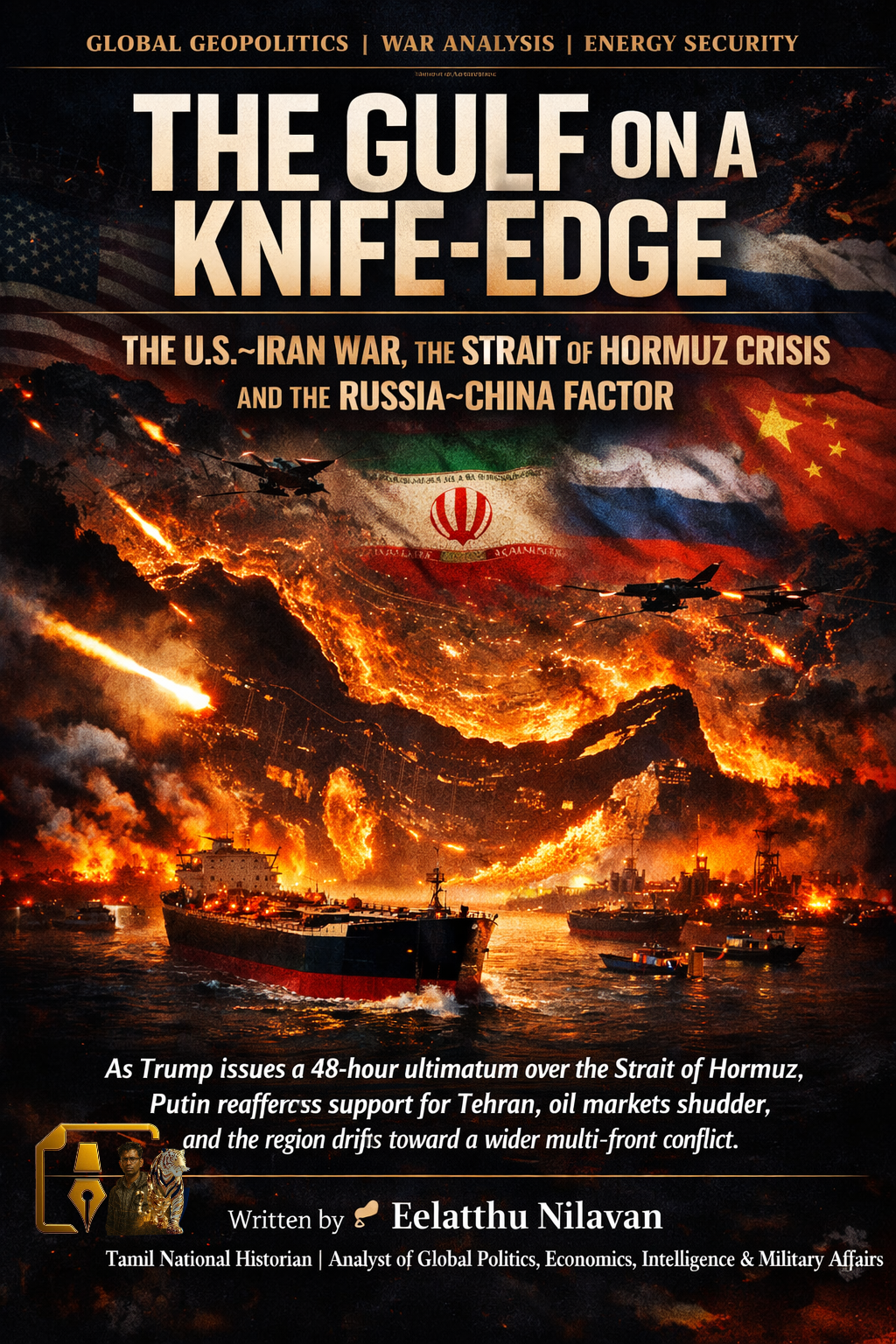
𝑺𝒖𝒃𝒕𝒊𝒕𝒍𝒆: 𝑨𝒔 𝑻𝒓𝒖𝒎𝒑 𝒊𝒔𝒔𝒖𝒆𝒔 𝒂 48-𝒉𝒐𝒖𝒓 𝒖𝒍𝒕𝒊𝒎𝒂𝒕𝒖𝒎 𝒐𝒗𝒆𝒓 𝒕𝒉𝒆 𝑺𝒕𝒓𝒂𝒊𝒕 𝒐𝒇 𝑯𝒐𝒓𝒎𝒖𝒛, 𝑷𝒖𝒕𝒊𝒏 𝒓𝒆𝒂𝒔𝒔𝒖𝒓𝒆𝒔 𝑻𝒆𝒉𝒓𝒂𝒏, 𝒐𝒊𝒍 𝒎𝒂𝒓𝒌𝒆𝒕𝒔 𝒕𝒓𝒆𝒎𝒃𝒍𝒆, 𝒂𝒏𝒅 𝒕𝒉𝒆 𝒓𝒆𝒈𝒊𝒐𝒏 𝒅𝒓𝒊𝒇𝒕𝒔 𝒕𝒐𝒘𝒂𝒓𝒅 𝒂 𝒘𝒊𝒅𝒆𝒓 𝒎𝒖𝒍𝒕𝒊-𝒇𝒓𝒐𝒏𝒕 𝒄𝒐𝒏𝒇𝒍𝒊𝒄𝒕.
𝑨 𝑾𝒂𝒓 𝑻𝒉𝒂𝒕 𝑰𝒔 𝑵𝒐 𝑳𝒐𝒏𝒈𝒆𝒓 𝑱𝒖𝒔𝒕 𝑨𝒃𝒐𝒖𝒕 𝑰𝒓𝒂𝒏
The current U.S.–Iran confrontation has entered a more dangerous and unpredictable phase. What began as a direct military escalation between Washington, Israel, and Tehran is now spilling outward into a broader geopolitical contest involving Russia, China, Gulf monarchies, European hesitation, maritime chokepoints, and the global energy system. On March 21–22, 2026, the crisis intensified dramatically after U.S. President Donald Trump issued a 48-hour ultimatum demanding that the Strait of Hormuz be fully reopened, threatening to “obliterate” Iranian power plants if Tehran failed to comply. At the same time, Russian President Vladimir Putin used a Nowruz message to describe Iran as a “loyal friend and reliable partner,” publicly underlining Moscow’s political support for Tehran.
The symbolism matters. Hormuz is not just another waterway. Roughly one-fifth of global oil and liquefied natural gas flows through the strait, and any disruption there immediately sends shockwaves through freight, insurance, commodity markets, and state security calculations. Reuters reported that the war has already escalated beyond Trump’s original framing, while Iran has said the strait is open only to shipping not linked to what it considers “enemy” states, effectively creating a selective maritime pressure regime rather than a full universal closure.
𝑷𝒖𝒕𝒊𝒏’𝒔 𝑴𝒆𝒔𝒔𝒂𝒈𝒆: 𝑺𝒚𝒎𝒃𝒐𝒍𝒊𝒄 𝑺𝒐𝒍𝒊𝒅𝒂𝒓𝒊𝒕𝒚, 𝑺𝒕𝒓𝒂𝒕𝒆𝒈𝒊𝒄 𝑪𝒂𝒍𝒄𝒖𝒍𝒖𝒔
Putin’s Nowruz message was more than ceremonial diplomacy. By calling Russia a “loyal friend and reliable partner,” the Kremlin signaled that Moscow does not intend to abandon Iran under Western military pressure. Reuters noted that Moscow has framed the U.S. and Israeli attacks as destabilizing the Middle East and worsening a global energy crisis. At the same time, the same reporting also shows the limits of the partnership: Russia and Iran remain close, but they do not have a mutual defense pact, and Moscow still opposes any Iranian move toward nuclear weapons.
That nuance is crucial. Russia is backing Iran politically, likely intelligence-wise to some degree, and certainly rhetorically. But Moscow is also trying to avoid being dragged into a direct state-on-state military commitment with the United States. In other words, Russia wants Iran to be resilient enough to resist Western pressure, but not so emboldened that the war becomes uncontrollable or triggers a nuclear crisis. This is not an alliance of romance. It is an alliance of pressure management, anti-Western balancing, and wartime opportunity.
𝑻𝒆𝒉𝒓𝒂𝒏, 𝑴𝒐𝒔𝒄𝒐𝒘, 𝒂𝒏𝒅 𝑩𝒆𝒊𝒋𝒊𝒏𝒈: 𝑨𝒏 𝑬𝒎𝒆𝒓𝒈𝒊𝒏𝒈 𝑺𝒕𝒓𝒂𝒕𝒆𝒈𝒊𝒄 𝑻𝒓𝒊𝒂𝒏𝒈𝒍𝒆
The broad trend is unmistakable even if the formal structure remains loose: Tehran, Moscow, and Beijing are moving into tighter strategic coordination under the pressure of sanctions, military coercion, and Western containment. Iran’s message that cooperation with Russia and China is expanding fits a pattern already visible over the past several years, from drone transfers and military-industrial exchanges to diplomatic shielding and sanctions workarounds. Reuters’ reporting on Russia’s latest stance reinforces that this alignment is growing under battlefield pressure rather than weakening.
Still, it would be an overstatement to call this a fully unified “axis” in the classic Cold War sense. China’s position remains more commercially cautious and globally calibrated than Russia’s, while Moscow’s support for Tehran is shaped by its own war with Ukraine and its confrontation with NATO. The better description is this: a flexible anti-pressure bloc is consolidating, one that shares interests in weakening Western leverage, fragmenting sanctions enforcement, and creating multiple simultaneous crises that stretch U.S. power.
𝑻𝒉𝒆 𝑺𝒕𝒓𝒂𝒊𝒕 𝒐𝒇 𝑯𝒐𝒓𝒎𝒖𝒛: 𝑻𝒉𝒆 𝑾𝒐𝒓’𝒔 𝑴𝒐𝒔𝒕 𝑫𝒂𝒏𝒈𝒆𝒓𝒐𝒖𝒔 𝑭𝒓𝒐𝒏𝒕
Trump’s 48-hour deadline marks one of the clearest signs yet that Washington sees Hormuz not just as an economic issue, but as a credibility test. The administration appears to believe that allowing Iran to impose even a partial closure would hand Tehran a strategic victory with global consequences. But the threat to destroy Iranian power plants also carries enormous escalation risks. Attacking core civilian energy infrastructure would likely invite immediate Iranian retaliation across the Gulf, including against desalination, oil export, electricity, shipping, and U.S.-linked facilities in partner states. Reuters and other current reporting indicate that Tehran has already warned of broader retaliation if its energy sector is struck.
That means the Strait of Hormuz is now functioning as both a maritime corridor and a hostage space in great-power coercion. The waterway has become the hinge between battlefield operations and global economic panic. Once that happens, every tanker route, insurance premium, and naval deployment becomes part of the war itself.
𝑵𝑨𝑻𝑶 𝑫𝒊𝒗𝒊𝒔𝒊𝒐𝒏𝒔, 𝑬𝒖𝒓𝒐𝒑𝒆𝒂𝒏 𝑯𝒆𝒔𝒊𝒕𝒂𝒕𝒊𝒐𝒏, 𝒂𝒏𝒅 𝑻𝒉𝒆 𝑮𝒖𝒍𝒇’𝒔 𝑯𝒂𝒓𝒅𝒆𝒏𝒊𝒏𝒈 𝑳𝒊𝒏𝒆
The Western camp is not united on how far to go. Reuters reported Trump attacking NATO partners as “cowards” for refusing to help secure Hormuz militarily. Meanwhile, public reporting indicates allies broadly support freedom of navigation but disagree on direct warfighting involvement. That split matters because it reveals a strategic gap between America’s urge to impose immediate coercive outcomes and Europe’s fear of sliding into a broader regional war without a credible exit plan.
At the regional level, however, Gulf Arab calculations appear to be hardening. Reports that Saudi Arabia and the UAE are backing sustained U.S. pressure on Iran suggest that major Arab powers increasingly view this war not as a temporary flare-up but as a chance to degrade Tehran’s long-term military reach. Even where public messaging is calibrated, the strategic direction appears sharper: the Gulf is moving from deterrence-by-distance toward deterrence-by-participation. That is a major shift, because it increases the chance that Iran broadens its target set to include regional enablers, not just the United States and Israel.
𝑫𝒊𝒎𝒐𝒏𝒂, 𝑵𝒂𝒕𝒂𝒏𝒛, 𝒂𝒏𝒅 𝑻𝒉𝒆 𝑵𝒖𝒄𝒍𝒆𝒂𝒓 𝑹𝒆𝒅 𝑳𝒊𝒏𝒆
One of the most alarming features of the current phase is the apparent normalization of strikes near nuclear-sensitive sites. The latest Iranian missile attacks on southern Israel injured more than 100 people in Arad and Dimona, according to current reporting, with one strike landing near the Shimon Peres Negev Nuclear Research Center area. At the same time, strikes on Iranian nuclear-linked facilities such as Natanz have raised parallel fears on the other side. The International Atomic Energy Agency’s chief, Rafael Grossi, has urged maximum restraint, warning against attacks involving nuclear infrastructure.
This is the real nightmare threshold. Once both sides begin signaling around nuclear geography, even without directly breaching reactor cores or causing radiological release, the psychological and strategic effects are massive. It raises the risk of miscalculation, panic escalation, and international intervention. Nuclear facilities do not have to be destroyed to become effective instruments of coercion; merely bringing them into the battlespace is enough to transform the conflict.
𝑻𝒉𝒆 𝑴𝒊𝒔𝒔𝒊𝒍𝒆 𝑾𝒂𝒓 𝒂𝒏𝒅 𝑨𝒊𝒓 𝑫𝒆𝒇𝒆𝒏𝒄𝒆 𝑨𝒕𝒕𝒓𝒊𝒕𝒊𝒐𝒏
The battlefield logic increasingly favors the side that can impose repeated, lower-cost pressure against expensive defensive systems. Even before some of the more dramatic claims circulating online are independently verified, the trend is obvious: Iran is trying to stretch and saturate U.S., Israeli, and partner-state air defense systems through waves of missiles, drones, and geographically dispersed threats. The United States and its allies, by contrast, are relying on high-end interception and regional force projection to hold the line. Reuters’ recent reporting suggests this war is already moving beyond neat political control.
That does not automatically mean Iran is “winning” militarily. It does mean that time and cost are becoming decisive variables. Every prolonged exchange increases the financial, logistical, and political burden on Washington and its partners, especially if commercial shipping remains disrupted and regional bases stay under threat.
𝑾𝒉𝒂𝒕 𝑻𝒉𝒆 𝑼𝑺𝑺 𝑩𝒐𝒙𝒆𝒓 𝑫𝒆𝒑𝒍𝒐𝒚𝒎𝒆𝒏𝒕 𝑹𝒆𝒂𝒍𝒍𝒚 𝑺𝒊𝒈𝒏𝒂𝒍𝒔
The reported deployment of the USS Boxer Amphibious Ready Group with Marines, F-35Bs, Ospreys, and supporting ships points to a familiar American pattern: building layered contingency capacity while preserving options. Such a deployment is not proof of an imminent ground invasion, but it does widen Washington’s menu of responses, from evacuation and escort missions to rapid raids, base reinforcement, and limited amphibious operations. In political terms, it is a signal of readiness. In operational terms, it is insurance against surprise.
But force deployment is not the same thing as strategic clarity. More ships and aircraft can deter, but they can also create more targets and more pressure to act. In crises like this, military presence can stabilize a theater right until the moment it accidentally destabilizes it.
𝑮𝒍𝒐𝒃𝒂𝒍 𝑬𝒏𝒆𝒓𝒈𝒚, 𝑴𝒂𝒓𝒌𝒆𝒕𝒔, 𝒂𝒏𝒅 𝒕𝒉𝒆 𝑪𝒐𝒔𝒕 𝒐𝒇 𝑷𝒓𝒐𝒍𝒐𝒏𝒈𝒆𝒅 𝑾𝒂𝒓
The energy dimension is no side story. It is central. Current reporting shows oil prices rising above $105 a barrel as Hormuz disruptions deepen and shipping slows. That has immediate consequences not only for fuel-importing states in Asia and Europe but also for inflation, food transport, insurance costs, and political stability in fragile economies. The war is now operating as a global tax on vulnerability.
This is why the Kremlin’s messaging matters beyond diplomacy. Russia benefits strategically from higher energy stress in Western-aligned economies, even if it also fears uncontrolled regional chaos. Iran, meanwhile, knows that it does not need to win conventionally to impose pain. It only needs to keep the cost curve rising.
𝑾𝒉𝒂𝒕 𝑯𝒂𝒑𝒑𝒆𝒏𝒔 𝑵𝒆𝒙𝒕?
Several paths now appear possible.
One path is coercive de-escalation: Iran allows broader shipping access, Washington pauses threats against civilian infrastructure, and external powers push for a face-saving maritime formula. Reuters reporting on Iran’s statement that the strait is open to non-enemy-linked shipping suggests Tehran may be leaving space for a negotiated reframing rather than an absolute blockade.
Another path is regional widening: U.S. strikes on Iranian energy assets trigger retaliation against Gulf infrastructure, regional bases, and partner states, pulling Saudi Arabia, the UAE, and perhaps others deeper into overt alignment.
The darkest path is threshold collapse: repeated attacks near nuclear-linked sites, expanding missile ranges, and mounting naval confrontation combine into a war nobody fully controls, but nobody can politically afford to stop.
𝑪𝒐𝒏𝒄𝒍𝒖𝒔𝒊𝒐𝒏: 𝑻𝒉𝒆 𝑴𝒊𝒅𝒅𝒍𝒆 𝑬𝒂𝒔𝒕 𝑰𝒔 𝑩𝒆𝒄𝒐𝒎𝒊𝒏𝒈 𝒕𝒉𝒆 𝑪𝒆𝒏𝒕𝒓𝒂𝒍 𝑨𝒓𝒆𝒏𝒂 𝒐𝒇 𝑮𝒍𝒐𝒃𝒂𝒍 𝑷𝒐𝒘𝒆𝒓 𝑪𝒐𝒎𝒑𝒆𝒕𝒊𝒕𝒊𝒐𝒏
This is no longer just a U.S.–Iran war story. It is a test of whether maritime chokepoints can be weaponized without triggering world-scale economic panic, whether Russia can back Iran without being trapped by it, whether China can benefit from anti-Western alignment without fully owning the consequences, and whether the United States can impose escalation dominance in a conflict where geography, energy, and asymmetric cost ratios all favor prolonged instability.
Putin’s support for Iran, Trump’s ultimatum over Hormuz, the widening fear around nuclear-adjacent targets, and the visible fractures among Western allies all point in the same direction: the conflict is becoming structurally bigger than the original battlefield. As of March 22, 2026, the Gulf is not simply a regional crisis zone. It is the live junction where war, energy, alliance politics, and great-power rivalry are colliding in real time.

Written by Eelaththu Nilavan
Tamil National Historian | Analyst of Global Politics, Economics, Intelligence & Military Affairs
22/03/2026
