


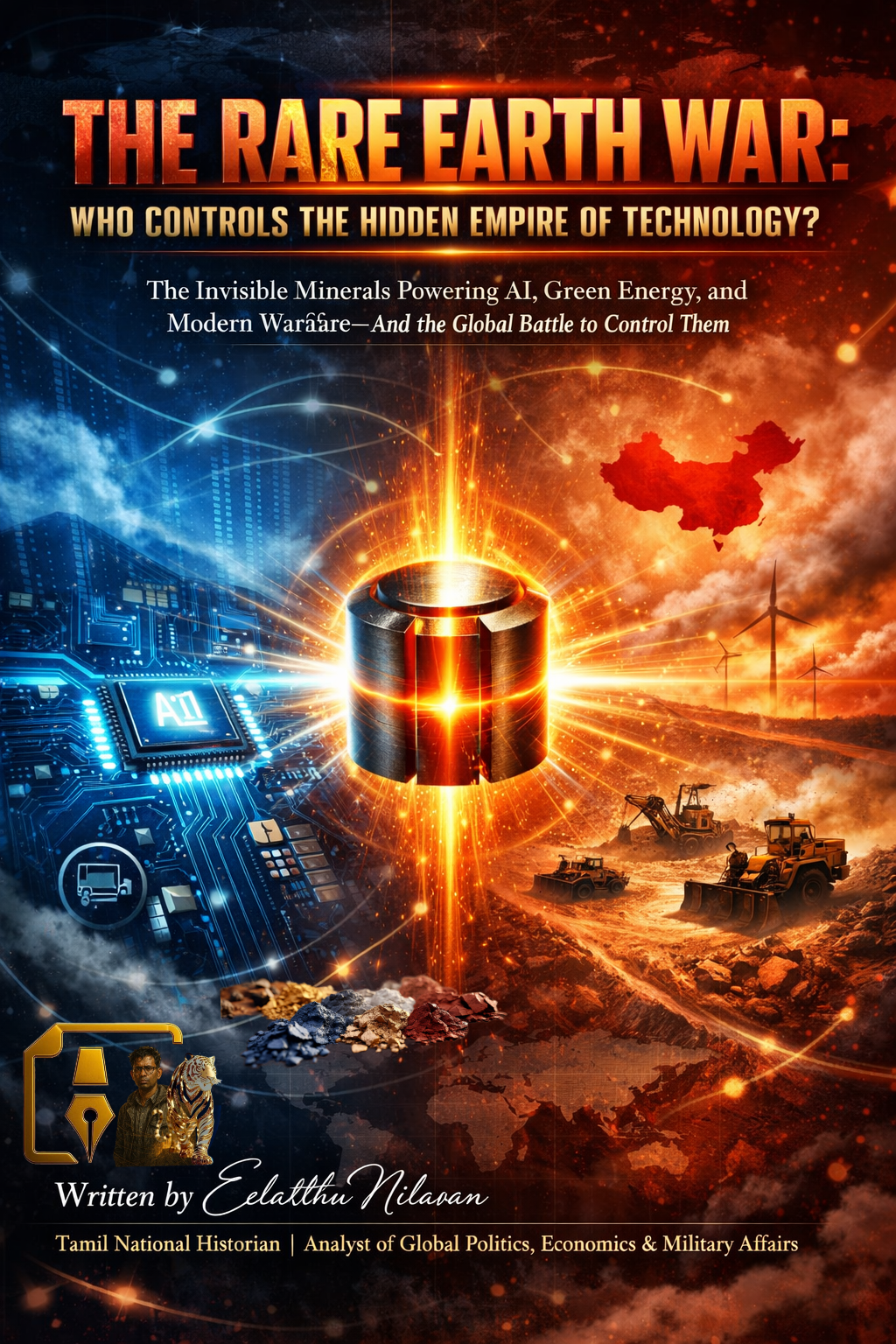
𝐓𝐇𝐄 𝐇𝐈𝐃𝐃𝐄𝐍 𝐀𝐑𝐂𝐇𝐈𝐓𝐄𝐂𝐓𝐔𝐑𝐄 𝐎𝐅 𝐌𝐎𝐃𝐄𝐑𝐍 𝐂𝐈𝐕𝐈𝐋𝐈𝐙𝐀𝐓𝐈𝐎𝐍
Rare Earth Elements (REEs) are not merely industrial inputs—they are the molecular backbone of 21st-century power. From the microchips in smartphones to the propulsion systems of advanced fighter jets, these 17 elements act as silent enablers of modern civilization.
Neodymium, praseodymium, dysprosium, and terbium—names rarely heard outside scientific circles—are now as strategically vital as oil was in the 20th century. Without them:
• Electric vehicles cannot achieve efficient torque and compact motor design
• Wind turbines lose efficiency and scalability
• Advanced radar, sonar, and missile guidance systems degrade in precision
In essence, REEs are not just materials—they are force multipliers of technological dominance.
𝐂𝐇𝐈𝐍𝐀’𝐒 𝐒𝐓𝐑𝐀𝐓𝐄𝐆𝐈𝐂 𝐌𝐀𝐒𝐓𝐄𝐑𝐘: 𝐅𝐑𝐎𝐌 𝐑𝐄𝐒𝐎𝐔𝐑𝐂𝐄 𝐓𝐎 𝐑𝐔𝐋𝐄𝐑
China’s dominance in rare earths is not accidental—it is the result of decades of state-driven industrial policy, geopolitical foresight, and environmental sacrifice.
Deng Xiaoping’s 1992 declaration—“The Middle East has oil; China has rare earths”—was not rhetoric; it was doctrine.
China’s advantage lies in three critical layers:
1. Vertical Integration Supremacy
China controls the entire value chain:
• Mining → Separation → Refining → Magnet production → Component manufacturing
While other nations mine REEs, they often remain dependent on China for high-purity processing, creating a structural dependency that is difficult to break.
2. Industrial Scale & Cost Dominance
China leveraged:
• Lower labor costs
• State subsidies
• Weak environmental enforcement
This allowed it to undercut global competitors, forcing mines in the U.S. and elsewhere to shut down in the early 2000s.
3. Environmental Externalization
Rare earth processing produces:
• Toxic sludge
• Radioactive waste (thorium/uranium traces)
China absorbed these costs domestically, effectively turning environmental degradation into geopolitical leverage.
𝐌𝐈𝐍𝐄𝐑𝐀𝐋𝐒 𝐀𝐒 𝐖𝐄𝐀𝐏𝐎𝐍𝐒: 𝐓𝐇𝐄 𝐍𝐄𝐖 𝐆𝐄𝐎𝐄𝐂𝐎𝐍𝐎𝐌𝐈𝐂 𝐖𝐀𝐑𝐅𝐀𝐑𝐄
Rare earths have quietly become instruments of strategic coercion.
The 2010 Shock (China–Japan Dispute)
When China restricted REE exports to Japan, global supply chains were shaken overnight. Prices surged, exposing how fragile and centralized the system had become.
The U.S.–China Strategic Rivalry
During the trade war era, Beijing signaled that it could:
• Restrict REE exports
• Target U.S. defense and tech industries
This introduced a new concept: “supply chain deterrence”—where control over materials becomes as powerful as military strength.
Modern Implication:
Unlike oil embargoes, rare earth restrictions are more precise—they can target specific industries, such as semiconductors, EVs, or defense systems.
𝐓𝐇𝐄 𝐆𝐋𝐎𝐁𝐀𝐋 𝐂𝐎𝐔𝐍𝐓𝐄𝐑𝐎𝐅𝐅𝐄𝐍𝐒𝐈𝐕𝐄: 𝐁𝐑𝐄𝐀𝐊𝐈𝐍𝐆 𝐓𝐇𝐄 𝐂𝐇𝐎𝐊𝐄𝐇𝐎𝐋𝐃
Recognizing the strategic risk, Western nations and allies have begun a long-term industrial counteroffensive.
United States: Strategic Reawakening
• Revival of the Mountain Pass mine
• Investments in domestic processing facilities
• Defense-linked funding for rare earth supply chains
However, the U.S. still lacks full-spectrum refining capacity, leaving a critical vulnerability.
Australia: Resource Powerhouse
• Home to one of the largest REE reserves
• Lynas Corporation as a key non-Chinese processor
• Expanding partnerships with the U.S. and Japan
Europe & Japan: Diversification Strategy
• Recycling initiatives (urban mining)
• Investment in African and Southeast Asian deposits
• Research into REE substitutes
𝐓𝐇𝐄 𝐏𝐑𝐎𝐂𝐄𝐒𝐒𝐈𝐍𝐆 𝐁𝐎𝐓𝐓𝐋𝐄𝐍𝐄𝐂𝐊: 𝐓𝐇𝐄 𝐑𝐄𝐀𝐋 𝐁𝐀𝐓𝐓𝐋𝐄𝐅𝐈𝐄𝐋𝐃
The critical vulnerability is not geological—it is technological.
Mining rare earths is relatively straightforward compared to:
• Chemical separation
• Solvent extraction
• High-purity refining
These processes require:
• Specialized infrastructure
• Years of technical expertise
• Strict environmental management systems
China’s decades-long head start means that even if new mines open globally, they cannot function independently without processing capabilities.
This creates a paradox:
The world may have the resources—but China still controls the ability to make them usable.
𝐓𝐇𝐄 𝐄𝐍𝐕𝐈𝐑𝐎𝐍𝐌𝐄𝐍𝐓𝐀𝐋 𝐏𝐀𝐑𝐀𝐃𝐎𝐗: 𝐆𝐑𝐄𝐄𝐍 𝐄𝐍𝐄𝐑𝐆𝐘, 𝐃𝐈𝐑𝐓𝐘 𝐎𝐑𝐈𝐆𝐈𝐍𝐒
The transition to clean energy is deeply dependent on environmentally destructive processes.
Key Contradiction:
• Wind turbines and EVs require REEs
• REE extraction produces severe ecological damage
This includes:
• Water contamination
• Soil degradation
• Radioactive waste exposure
Western nations now face a difficult choice:
• Accept environmental costs domestically
• Or remain dependent on China
This dilemma defines the moral and strategic tension of the energy transition.
𝐓𝐇𝐄 𝐍𝐄𝐗𝐓 𝐅𝐑𝐎𝐍𝐓𝐈𝐄𝐑𝐒: 𝐈𝐍𝐍𝐎𝐕𝐀𝐓𝐈𝐎𝐍, 𝐑𝐄𝐂𝐘𝐂𝐋𝐈𝐍𝐆 & 𝐆𝐄𝐎𝐏𝐎𝐋𝐈𝐓𝐈𝐂𝐀𝐋 𝐀𝐋𝐋𝐈𝐀𝐍𝐂𝐄𝐒
To reduce dependence, nations are exploring alternative strategies:
1. Recycling (“Urban Mining”)
Recovering REEs from:
• Old electronics
• Batteries
• Wind turbine components
2. Material Substitution
Developing technologies that:
• Reduce or eliminate REE dependency
• Use alternative magnetic materials
3. Strategic Alliances
Emerging “mineral alliances” between:
• U.S., Australia, Japan, and EU
• Investments in Africa (e.g., Tanzania) and Southeast Asia
These efforts signal the emergence of a new global order centered on resource security.
𝐅𝐈𝐍𝐀𝐋 𝐀𝐍𝐀𝐋𝐘𝐒𝐈𝐒: 𝐓𝐇𝐄 𝐍𝐄𝐖 𝐄𝐍𝐄𝐑𝐆𝐘 𝐂𝐇𝐄𝐒𝐒𝐁𝐎𝐀𝐑𝐃
The rare earth struggle is not a temporary market imbalance—it is a systemic geopolitical transformation.
Key realities define the future:
• Control over processing = control over technology
• Supply chains are now weapons of influence
• Energy transition depends on fragile mineral networks
China’s dominance will not disappear quickly. Even with aggressive investment, the rest of the world faces a 10–20 year horizon to build a fully independent supply chain.
Until then, global power will remain delicately balanced on a hidden axis—
not of oil wells or gas pipelines,
but of refineries, magnets, and microscopic elements that shape the future of civilization.

Written by 𝐄𝐞𝐥𝐚𝐭𝐡𝐭𝐡𝐮 𝐍𝐢𝐥𝐚𝐯𝐚𝐧
Tamil National Historian | Analyst of Global Politics, Economics, Intelligence & Military Affairs
08/04/2026
The views expressed in this article are the author’s own and do not necessarily reflect Amizhthu’s editorial stance.
