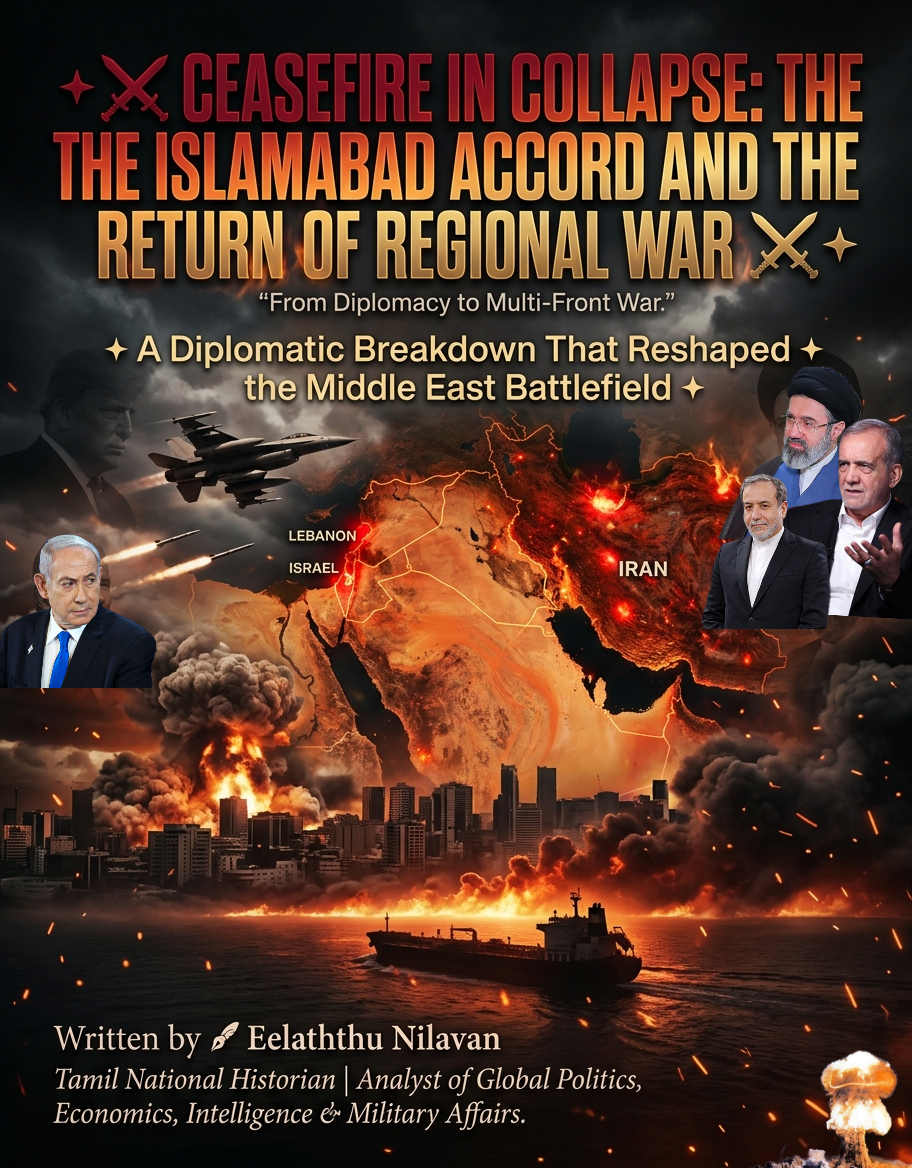

A Diplomatic Breakdown That Reshaped the Middle East Battlefield
THE ISLAMABAD INITIATIVE: A FRAGILE HOPE FOR PEACE
In a moment that briefly suggested a pathway out of escalating regional conflict, Pakistan positioned itself as a critical diplomatic broker. Prime Minister Shehbaz Sharif announced what was presented as a comprehensive ceasefire framework involving the United States, Iran, and aligned actors.
At the heart of this initiative was an implicit multi-front de-escalation, reportedly including:
• Immediate cessation of hostilities between U.S. and Iranian forces
• A halt to proxy engagements across regional theaters
• Crucially, an extension of calm into Lebanon, one of the most volatile fronts
However, this framework was never uniformly acknowledged—revealing a fundamental ambiguity at the core of the agreement.
THE STRATEGIC “U-TURN”: CONTESTING THE TERMS
Almost immediately after the announcement, contradictions surfaced.
• Washington’s Position: President Donald Trump publicly denied that Lebanon was ever part of the agreement, reframing the deal as a narrow bilateral de-escalation with Iran.
• Tel Aviv’s Position: Prime Minister Benjamin Netanyahu went further, outright rejecting any linkage to Lebanon, stating unequivocally:
“There is no ceasefire in Lebanon.”
This divergence exposes a critical diplomatic fault line:
• Pakistan and possibly Iran viewed the agreement as multi-theater
• The U.S. and Israel treated it as compartmentalized and limited
This was not merely a misunderstanding—it reflects deliberate strategic ambiguity, often used in high-stakes diplomacy but here resulting in immediate destabilization.
LEBANON IGNITES: FROM CEASEFIRE TO CONFLAGRATION
The consequences of this interpretive divide were swift and devastating.
Israeli Escalation
Israel launched a large-scale air campaign across:
• Beirut
• Southern Lebanon
• Bekaa Valley
Reported Impact (within 48 hours):
• Over 300 killed
• More than 1,100 wounded
• Critical infrastructure targeted, including Rafik Hariri Governmental Hospital
This marked a transition from contained conflict to urban devastation, signaling that Lebanon was now an active warfront—regardless of diplomatic claims.
THE RESISTANCE AXIS RESPONDS
In retaliation:
• Lebanese armed groups launched rocket barrages into Northern Israel
• Targeted cities included Haifa, Nahariya, and Kiryat Shmona
• Air raid sirens extended as far as Tel Aviv
This escalation underscores a key reality:
Lebanon cannot be isolated from broader regional dynamics
Any attempt to exclude it from ceasefire frameworks inevitably collapses under military realities.
IRAN’S POSITION: TRUST COLLAPSE AND STRATEGIC WARNING
Iran’s response has been both diplomatic and military in tone:
• Foreign Minister Abbas Araghchi accused the U.S. of acting in bad faith
• President Masoud Pezeshkian declared:
“Hands remain on the trigger.”
• IRGC leadership warned of “severe and regretful punishment”
Key Strategic Shift:
Iran now views the ceasefire as:
• Either comprehensive across all fronts
• Or invalid altogether
As a result:
• Tehran has stalled negotiations in Islamabad
• Trust in U.S. commitments has significantly eroded
THE STRAIT OF HORMUZ: ECONOMIC WARFARE DIMENSION
Parallel to military escalation, Iran has introduced geo-economic pressure:
• Declared restrictions on the Strait of Hormuz
• Warned that unauthorized vessels may be targeted and destroyed
Global Implications:
• Threatens global oil supply chains
• Raises energy prices and economic uncertainty
• Transforms a regional conflict into a global strategic crisis
REGIONAL AND GLOBAL REACTIONS
Turkey’s Strategic Critique
Foreign Minister Hakan Fidan accused Israel of:
• Sabotaging diplomacy
• Pursuing expansionist objectives
Turkey also proposed:
• A new regional security architecture
• Normalization between Iran and Gulf states
Syria’s Position
Syria condemned:
• Continued Israeli operations
• Violations of territorial sovereignty
It called for enforcement of:
• Existing international agreements
• Withdrawal from contested territories
Global Powers Respond
• China, Russia, and France condemned strikes on Lebanon
• Called for restraint and respect for sovereignty
• Highlighted risks of a wider regional war
United Nations Crisis
A coalition of 70+ countries and the EU:
• Condemned attacks on UNIFIL peacekeepers
• Warned such actions may constitute war crimes
Humanitarian Situation:
• Over 1 million displaced
• Massive infrastructure destruction
• Increasing risk of state collapse in Lebanon
PUBLIC SENTIMENT: DISTRUST AND WAR FATIGUE
In Iran
• Citizens view the ceasefire as a temporary pause
• Widespread skepticism toward U.S. intentions
• Strong support for continued military readiness
In Israel
• Nearly half the population believes the war was not a victory
• Rising dissatisfaction with leadership outcomes
This reflects a broader trend: Diplomatic narratives are losing credibility among populations directly affected by war
CRITICAL ANALYSIS: WHY THE CEASEFIRE FAILED
1. Structural Ambiguity
The agreement lacked:
• Clearly defined geographic scope
• Binding enforcement mechanisms
2. Divergent Strategic Goals
• U.S.: De-escalate direct confrontation with Iran
• Israel: Maintain operational freedom against Hezbollah
• Iran: Protect regional allies and deterrence credibility
3. Proxy War Reality
The Middle East conflict is inherently:
• Multi-layered
• Network-based
A ceasefire excluding key nodes like Lebanon is structurally unsustainable.
Credibility Deficit
The perceived reversal by the U.S. has:
• Undermined diplomatic trust
• Strengthened hardline positions in Iran
CONCLUSION: FROM DIPLOMACY TO MULTI-FRONT WAR
The Islamabad initiative illustrates a harsh geopolitical truth:
A ceasefire that is not universally defined, mutually trusted, and regionally inclusive is not a ceasefire—it is a pause before escalation.
What began as a diplomatic breakthrough has rapidly devolved into:
• Intensified warfare in Lebanon
• Strategic brinkmanship in the Strait of Hormuz
• Deepening global divisions
The region now stands at a critical juncture—
not between war and peace,
but between contained conflict and systemic regional collapse.

Written by Eelaththu Nilavan
Tamil National Historian | Analyst of Global Politics, Economics, Intelligence & Military Affairs
10/04/2026
The views expressed in this article are the author’s own and do not necessarily reflect Amizhthu’s editorial stance.