

Introduction
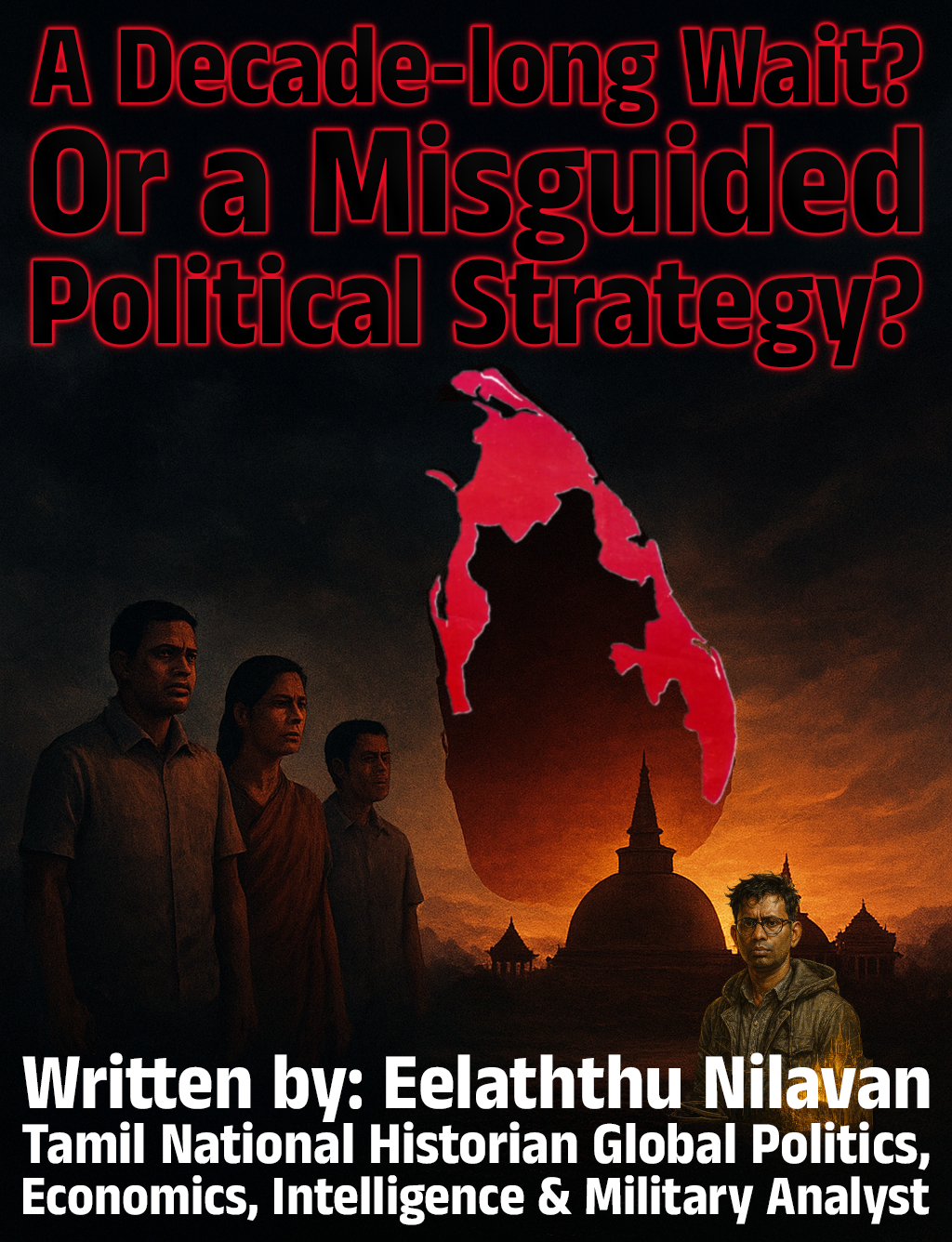
For more than seven decades, the search for a political solution to the Tamil national question in Sri Lanka has continued without reaching any meaningful destination. International interventions, India’s regional calculations, and internal political transitions have all failed to address the long-standing aspirations of the Tamil people. Instead, each decade dissolves into another cycle of waiting, cultivating an atmosphere of uncertainty and disillusionment.
This article examines the current political landscape facing the Tamil nation and highlights the need for alternative pathways rooted in long-term, structured political strategy. It also analyzes the historical roots of the ethnic conflict, the Sinhala political establishment’s refusal to accept Tamil national rights, and the systemic political diversion that has prevented any sustainable solution.

The Root Causes: Denial, Concealment, and Political Diversion
The Sinhala Ruling Class and Its Foundational Refusal
Successive Sinhala-dominated governments in Sri Lanka have consistently refused to acknowledge that beyond the Sinhala-Buddhist identity, the Tamil, Muslim, and Hill Country Tamil communities possess legitimate national claims. This denial forms the first—and most significant—obstacle to reaching any durable solution.
Concealment of Root Causes
Instead of addressing structural crises such as:
• deep economic instability,
• overwhelming national debt,
• poverty,
• and institutional decay,
the ruling class repeatedly foregrounds superficial issues such as development, poverty alleviation, and drug eradication. These are deployed as political tools to divert public attention, preventing the Sinhala masses from understanding the underlying national problem and thereby safeguarding the ruling elite.
International Paralysis
Despite significant efforts by Tamil activists at platforms such as the UN and Geneva, the international community has not taken decisive steps. Mechanisms of international justice stretch across decades — while the nation that awaits justice risks fragmentation and decline.
The Sinhala-Buddhist Nationalist Fortress
Understanding the psychology of Sinhala political resistance toward Tamil aspirations is crucial. Their rejection is not rooted in a genuine concern for the nation but in the fear that accommodating Tamil aspirations will undermine their political survival.
The Dominance of the Vote Bank
No Sinhala politician is willing to risk losing the Sinhala vote bank. Any movement towards power-sharing is perceived as a threat to their future political existence.
The Political Authority of Buddhist Monastic Institutions
Buddhist monastic establishments serve as the spiritual and political center of Sinhala-Buddhist nationalism. Without their endorsement, no political solution can receive social or legal legitimacy.
Events such as:
• the postponement of Provincial Council elections,
• the removal of devolution provisions from constitutional reforms,
• and the derailment of new constitution-making efforts
are all manifestations of pressure exerted by these institutions.
The Need for an Alternative Path: Reimagining Civil Society’s Role
There is now a harsh realization that electoral politics alone cannot resolve the Tamil national question. A new political space beyond traditional party politics has become indispensable.
Reframing the Discourse
Describing it merely as “the Tamil people’s issue” only reinforces a sense of alienation among the Sinhala majority. Instead, it must be reframed as:
Sri Lanka’s national crisis — the failure of a multi-ethnic state to embrace coexistence.
Constructive Dialogue
Tamil representatives must develop the capacity to communicate their political claims to Sinhala civil society, intellectuals, and religious leaders through constructive and positive dialogue. The approach of constant confrontation must give way to the pursuit of common ground.
Intellectual Leadership
A broad, non-partisan platform of:
• intellectuals,
• thinkers,
• human rights advocates,
• legal experts,
• and social activists
is required. Although political parties may support them in the background, the platform must be free from personal ambitions.
A New Strategy for Engagement: Dialogue with Buddhist Leadership
Avoiding Direct Confrontation
Direct communication with Buddhist monastic authorities often creates a “glass barrier” due to religious and ceremonial formalities, preventing honest and in-depth discussions.
Engaging Through Trusted, Non-Political Intermediaries
Tamil leadership can request Buddhist institutions to appoint neutral representatives — intellectuals and legal scholars who are respected by the Sinhala majority — for meaningful and structured dialogue.
Through these discussions,
• Points of Convergence (possible agreements) and
• Points of Divergence (areas of conflict)
can be identified objectively.
This enables civil society to gradually plant new ideas within the Sinhala public consciousness, beyond the limitations of electoral politics.
Conclusion: From the Edge of Annihilation to the Dawn of Liberation
Tamils can no longer remain trapped within the historical cycle of waiting—
a cycle that has only pushed us toward gradual destruction.
The time has come to end the outdated political habits that have held us back for decades:
• Waiting without action
• Passive hope and helpless expectation
• Extending time without strategy
• The illusion that foreign powers will solve our problems
“A nation that waits endlessly for others to deliver its freedom eventually gets consumed by time.”
This historical truth can no longer be ignored.
Why did other communities progress, while we fell behind?
Although living within the same country, both Sinhalese and Muslims advanced through disciplined, collective, and strategic action:
• Institutionally: Schools, colleges, business networks, cultural foundations
• Economically: Strong business communities, property ownership, investment systems, entrepreneurship
• Politically: Unity of purpose and a consistent national vision
Meanwhile, the Tamil community continues to face severe internal obstacles:
• Political stagnation: Absence of new ideas and modern strategies
• Social fragmentation: Lack of unity and responsibility
• Generational disconnect: Weak dialogue between youth and elders
• Dependency on external actors: Expecting outsiders to resolve core problems
As a result, we have been unable to build the political, economic, and social structures we desperately need.
The key to liberation lies in our own hands
Liberation cannot be built through blind trust in the actions of foreign powers.
The true strength of Tamil political survival rests in knowledge, unity, planning, and action.
Paths to the New Era
1. Building an Intellectual Leadership
Scholars, researchers, thinkers, social activists, and visionary political leaders must work together to form a collective intellectual leadership that guides the nation forward.
2. Strengthening the Social Foundation
Transformation does not flow only from the top.
It must rise from the people — from youth, civil society, and grassroots movements.
3. A New Culture of Dialogue Based on Respect
Framing Sinhalese people as enemies will not move us forward.
Our true challenge lies in institutional racism and structural oppression, not ordinary people.
A new dialogue rooted in truth, understanding, and mutual respect is essential.
4. Breaking the Cycle of Vote-Bank Ethnic Politics
Election-time emotional manipulation must be rejected firmly.
The only power capable of defeating this pattern is public awareness.
Liberation: A History to Be Created, Not a Gift to Be Received
If Tamils build upon these foundations, a new social and political era can emerge — one that is:
• Dignified
• Knowledge-driven
• Economically strong
• Politically united
This is the rebirth of Tamil nationalism.
Liberation is not a miracle delivered from afar.
It is a history shaped by strategic planning, unwavering determination, and collective effort.
The time has come for Tamils to write their own destiny.

╭────────────────────╮
Written by Eelaththu Nilavan
╰────────────────────╯
20/11/2025
