
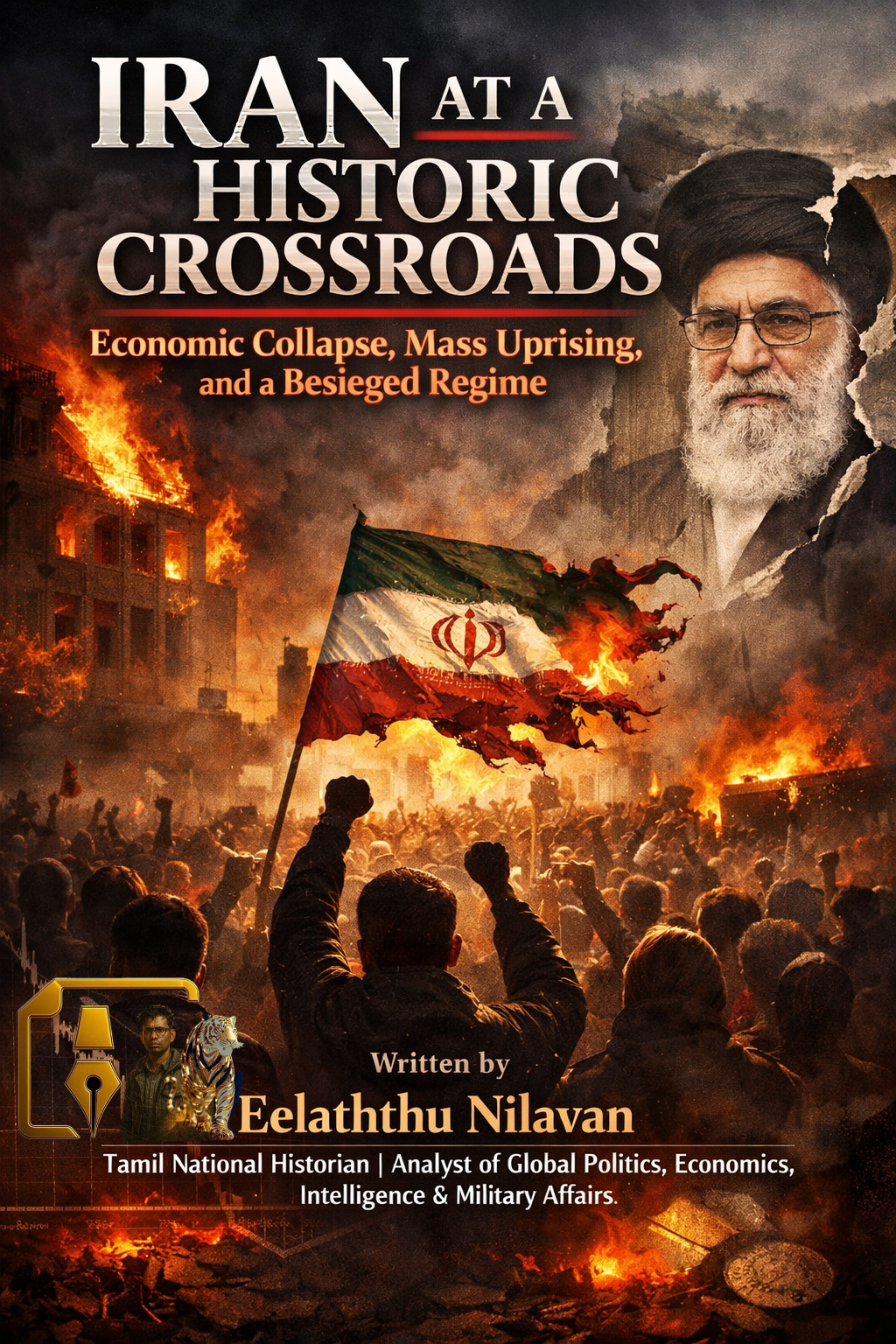
𝘈 𝘯𝘢𝘵𝘪𝘰𝘯𝘸𝘪𝘥𝘦 𝘦𝘤𝘰𝘯𝘰𝘮𝘪𝘤 𝘳𝘦𝘷𝘰𝘭𝘵 𝘦𝘴𝘤𝘢𝘭𝘢𝘵𝘦𝘴 𝘪𝘯𝘵𝘰 𝘢 𝘥𝘪𝘳𝘦𝘤𝘵 𝘤𝘩𝘢𝘭𝘭𝘦𝘯𝘨𝘦 𝘵𝘰 𝘵𝘩𝘦 𝘐𝘴𝘭𝘢𝘮𝘪𝘤 𝘙𝘦𝘱𝘶𝘣𝘭𝘪𝘤, 𝘢𝘴 𝘵𝘦𝘩𝘳𝘢𝘯 𝘣𝘭𝘢𝘮𝘦𝘴 𝘧𝘰𝘳𝘦𝘪𝘨𝘯 𝘱𝘭𝘰𝘵𝘴 𝘢𝘯𝘥 𝘵𝘩𝘳𝘦𝘢𝘵𝘦𝘯𝘴 𝘧𝘰𝘳𝘤𝘦

✦ 𝐀 𝐂𝐨𝐮𝐧𝐭𝐫𝐲 𝐢𝐧 𝐔𝐩𝐫𝐨𝐚𝐫: 𝟏𝟑+ 𝐃𝐚𝐲𝐬 𝐨𝐟 𝐍𝐚𝐭𝐢𝐨𝐧𝐰𝐢𝐝𝐞 𝐏𝐫𝐨𝐭𝐞𝐬𝐭𝐬
Iran is witnessing one of the most severe waves of civil unrest in years, with demonstrations continuing for over 13 consecutive nights across more than 100 cities and 27 provinces. What began as economic protests triggered by currency collapse, inflation, and soaring food prices has rapidly transformed into open calls for regime change.
Bazaar closures, strikes, street battles, and torching of government-linked buildings signal a systemic rupture between the state and society. Chants of “Death to the Dictator” and the burning of Supreme Leader Ayatollah Ali Khamenei’s banners underscore the unprecedented scale of public anger.
✦ 𝐄𝐜𝐨𝐧𝐨𝐦𝐢𝐜 𝐌𝐞𝐥𝐭𝐝𝐨𝐰𝐧: 𝐓𝐡𝐞 𝐒𝐩𝐚𝐫𝐤 𝐓𝐡𝐚𝐭 𝐈𝐠𝐧𝐢𝐭𝐞𝐝 𝐭𝐡𝐞 𝐅𝐢𝐫𝐞
Iran’s economic crisis forms the core driver of the unrest:
• The national currency has plunged sharply, eroding purchasing power.
• Essential goods have seen price surges within days, not months.
• Traders report food inflation reaching catastrophic levels — eggs alone rising over 50% in one week.
• Sanctions, mismanagement, and capital flight have hollowed out the economy.
The protests notably originated in Tehran’s Grand Bazaar, a historic barometer of political legitimacy in Iran — signaling elite merchant-class revolt, not merely street-level dissent.
✦ 𝐋𝐚𝐫𝐢𝐣𝐚𝐧𝐢’𝐬 𝐀𝐜𝐜𝐮𝐬𝐚𝐭𝐢𝐨𝐧: “𝐈𝐧𝐭𝐞𝐫𝐧𝐚𝐥 𝐒𝐮𝐛𝐯𝐞𝐫𝐬𝐢𝐨𝐧” 𝐨𝐯𝐞𝐫 𝐀𝐢𝐫𝐬𝐭𝐫𝐢𝐤𝐞𝐬
In a nationally televised interview, Ali Larijani, Secretary of Iran’s Supreme National Security Council, acknowledged that economic grievances are legitimate, but sharply distinguished them from what he called “organized sabotage”.
Key Claims by Larijani
• Israel has allegedly abandoned direct military confrontation.
• A new strategy focuses on internal destabilization using “structures built in Iran.”
• Acts such as arson, Molotov attacks, and shootings are attributed to foreign-backed quasi-terrorist groups.
• The objective, he claims, is to fracture Iran from within by destroying national and religious identity.
✦ 𝐒𝐲𝐦𝐛𝐨𝐥𝐬 𝐔𝐧𝐝𝐞𝐫 𝐀𝐭𝐭𝐚𝐜𝐤: 𝐈𝐝𝐞𝐧𝐭𝐢𝐭𝐲 𝐚𝐬 𝐚 𝐁𝐚𝐭𝐭𝐥𝐞𝐟𝐢𝐞𝐥𝐝
Larijani and other officials point to the targeting of symbolic pillars of the Islamic Republic, including:
• The national flag
• Statues of General Qasem Soleimani
• Mosques and copies of the Quran
The state frames these actions as psychological warfare, aimed at dismantling Iran’s religious legitimacy and revolutionary narrative, rather than spontaneous protest behavior.
✦ 𝐑𝐞𝐳𝐚 𝐏𝐚𝐡𝐥𝐚𝐯𝐢’𝐬 𝐂𝐚𝐥𝐥: 𝐅𝐫𝐨𝐦 𝐏𝐫𝐨𝐭𝐞𝐬𝐭 𝐭𝐨 𝐏𝐚𝐫𝐚𝐥𝐲𝐬𝐢𝐬
Exiled opposition figure Reza Pahlavi has issued a direct call to escalate unrest into nationwide economic warfare:
Strategic Directives
• Immediate strikes across transport, oil, gas, and energy sectors
• Coordinated marches to seize and hold city centers
• Crowd convergence using multiple routes
• Demonstrations scheduled for January 10–11 at 6 PM
• Appeals to security forces to undermine repression from within
Pahlavi has also expressed readiness to return to Iran, portraying the moment as the “decisive phase” of a national revolution.
✦ 𝐓𝐡𝐞 𝐂𝐫𝐚𝐜𝐤𝐝𝐨𝐰𝐧: 𝐙𝐞𝐫𝐨 𝐋𝐞𝐧𝐢𝐞𝐧𝐜𝐲, 𝐁𝐥𝐚𝐜𝐤𝐨𝐮𝐭, 𝐚𝐧𝐝 𝐁𝐥𝐨𝐨𝐝𝐬𝐡𝐞𝐝
Iran’s leadership has responded with escalating force:
• Internet and phone networks shut down nationwide
• Over 2,000 arrests reported
• At least 35–36 deaths confirmed by rights groups
• Reports of live ammunition use
• Allegations of security forces storming hospitals to arrest wounded protesters
Chief Justice Gholam-Hossein Mohseni-Eje’i warned that no mercy would be shown to those accused of aiding the U.S. or Israel.
✦ 𝐊𝐡𝐚𝐦𝐞𝐧𝐞𝐢’𝐬 𝐋𝐢𝐧𝐞 𝐢𝐧 𝐭𝐡𝐞 𝐒𝐚𝐧𝐝
Supreme Leader Ayatollah Ali Khamenei, in a critical live address, is expected to:
• Attribute unrest to foreign enemies
• Reject concessions
• Issue stern warnings to demonstrators
• Reaffirm Iran’s resistance doctrine
The regime’s posture suggests containment through force, not reform.
✦ 𝐔.𝐒. 𝐚𝐧𝐝 𝐖𝐞𝐬𝐭𝐞𝐫𝐧 𝐑𝐞𝐬𝐩𝐨𝐧𝐬𝐞: 𝐓𝐡𝐫𝐞𝐚𝐭𝐬 𝐨𝐟 𝐈𝐧𝐭𝐞𝐫𝐯𝐞𝐧𝐭𝐢𝐨𝐧
U.S. President Donald Trump has issued his strongest warning yet:
• Declaring the U.S. is “locked and loaded”
• Threatening to strike Iran hard if lethal
force is used against civilians
• Ruling out ground troops but not airpower
European leaders, including Keir Starmer, have condemned the killings, increasing Iran’s diplomatic isolation.
✦ 𝐀 𝐑𝐞𝐠𝐢𝐦𝐞 𝐖𝐢𝐭𝐡𝐨𝐮𝐭 𝐚 𝐒𝐚𝐟𝐞 𝐄𝐱𝐢𝐭
Analysts note a critical paradox:
• The regime is weakened but ruthless
• The opposition is energized but fragmented
• No single unifying leader has yet emerged inside Iran
Yet the merchant-led origins, economic depth, and nationwide scale mark this uprising as structurally different from 2009 or 2022.
✦ 𝐂𝐨𝐧𝐜𝐥𝐮𝐬𝐢𝐨𝐧: 𝐀 𝐇𝐢𝐬𝐭𝐨𝐫𝐢𝐜 𝐂𝐫𝐨𝐬𝐬𝐫𝐨𝐚𝐝𝐬
Iran now stands at a historic inflection point.
What unfolds next — brutal suppression, elite fracture, military intervention, or regime transformation — will not only determine Iran’s future but reshape Middle Eastern geopolitics.
The streets are burning.
The economy is collapsing.
And the regime’s monopoly on fear is being tested as never before.


Written by Eelaththu Nilavan
Tamil National Historian.
Analyst of Global Politics, Economics, Intelligence & Military Affairs
