


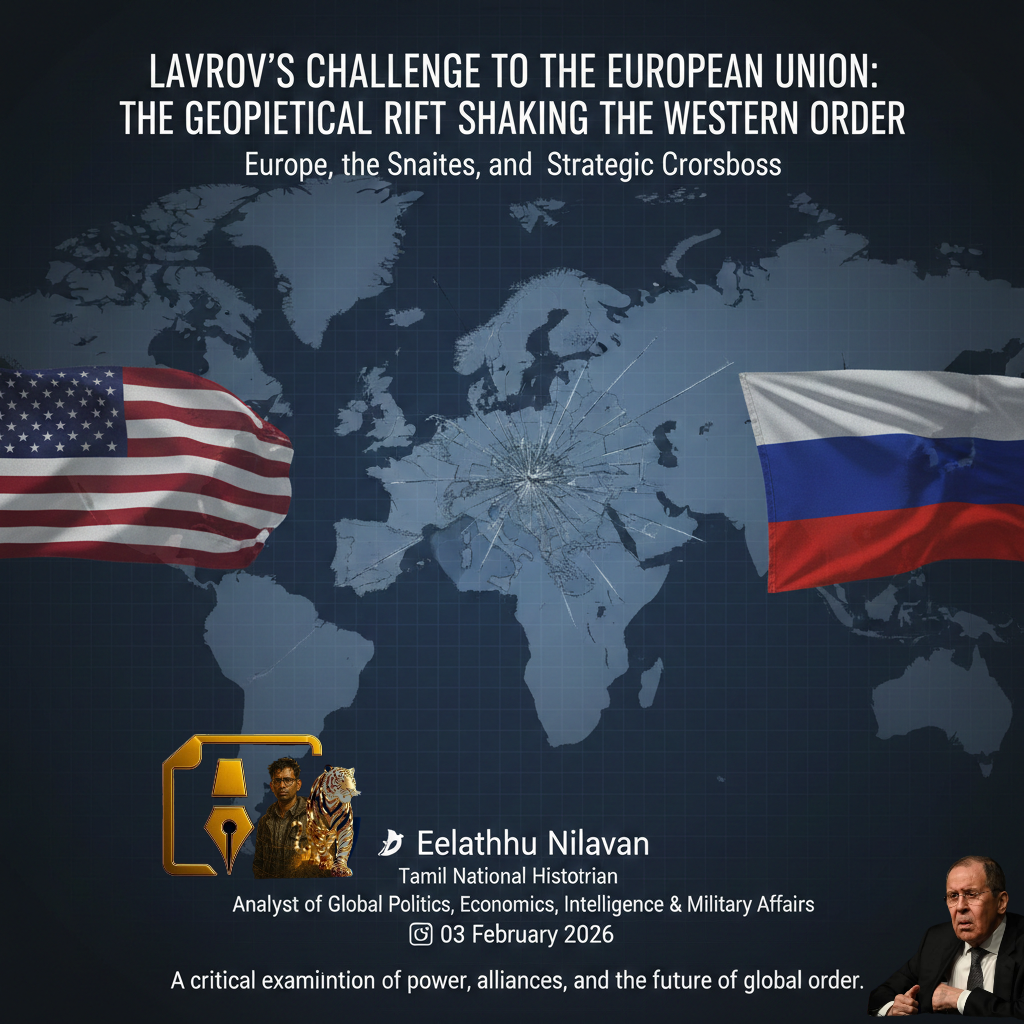
Europe, America, and Russia at a Strategic Crossroads

Russian Foreign Minister Sergey Lavrov’s latest remarks mark more than routine diplomatic sparring—they expose a widening fracture inside the Western alliance itself. Accusing European leaders of attempting to sabotage a potential U.S.–Russia diplomatic reset under President Donald Trump, Lavrov reframed the Ukraine conflict not as a simple East–West confrontation, but as a struggle over who controls global decision-making.
According to Moscow’s narrative, Europe is no longer a stabilising partner but an anxious actor clinging to fading influence, unsettled by Washington’s evolving priorities.
✦. 𝐄𝐔𝐑𝐎𝐏𝐄 𝐀𝐒 𝐓𝐇𝐄 “𝐒𝐏𝐎𝐈𝐋𝐄𝐑”: 𝐋𝐀𝐕𝐑𝐎𝐕’𝐒 𝐂𝐎𝐑𝐄 𝐀𝐂𝐂𝐔𝐒𝐀𝐓𝐈𝐎𝐍
Fear of Strategic Irrelevance
Lavrov outright rejected claims that Russia is undermining transatlantic unity. Instead, he accused Brussels and key European capitals of deliberately trying to “drive a wedge” between Moscow and Washington.
From the Kremlin’s perspective:
• Europe fears losing its automatic influence over U.S. foreign policy
• A Trump-led America prioritising national interests over alliance orthodoxy threatens Europe’s political leverage
• Direct U.S.–Russia dialogue sidelines the EU as a secondary power broker
This explains the visible discomfort across Europe—from diplomatic irritation to open scepticism, including muted but telling reactions from leaders such as Italy’s Giorgia Meloni.
✦. 𝐓𝐇𝐄 𝐓𝐑𝐔𝐌𝐏 𝐅𝐀𝐂𝐓𝐎𝐑: 𝐖𝐀𝐒𝐇𝐈𝐍𝐆𝐓𝐎𝐍’𝐒 𝐏𝐈𝐕𝐎𝐓 𝐀𝐍𝐃 𝐄𝐔𝐑𝐎𝐏𝐄’𝐒 𝐀𝐍𝐗𝐈𝐄𝐓𝐘
A Break from Automatic Alignment
Lavrov’s comments repeatedly underline one idea: Europe no longer dictates U.S. strategic direction.
He highlighted a February 2025 meeting with U.S. Secretary of State Marco Rubio, portraying the Trump administration as:
• Respecting the national interests of other major powers
• Willing to compartmentalise disagreements rather than escalate them
• Open to pragmatic cooperation where interests align
For Europe—long accustomed to Washington acting as its security guarantor and diplomatic amplifier—this shift is deeply unsettling.
✦. 𝐔𝐊𝐑𝐀𝐈𝐍𝐄 𝐀𝐒 𝐓𝐇𝐄 𝐁𝐀𝐓𝐓𝐋𝐄𝐅𝐈𝐄𝐋𝐃 𝐎𝐅 𝐀𝐋𝐋𝐈𝐀𝐍𝐂𝐄 𝐓𝐄𝐍𝐒𝐈𝐎𝐍𝐒
Military Claims and Strategic Messaging
As diplomacy frays, the battlefield narrative intensifies.
Russia’s Defence Ministry claims:
• Operational advances across Kharkiv, Donetsk, Zaporizhzhia, and Dnepropetrovsk
• The “liberation” of settlements such as Zelenoye, Sukhetskoye, Zelanino, and Predojun
• Heavy Ukrainian casualties and the destruction of Western-supplied armour, artillery, and air-defence assets
While these figures cannot be independently verified, they serve a clear purpose: to project momentum and inevitability, reinforcing Moscow’s belief that time favours Russia, not Kyiv or Brussels.
✦. 𝐓𝐇𝐄 𝐊𝐇-𝟑𝟐 𝐌𝐄𝐒𝐒𝐀𝐆𝐄: 𝐒𝐓𝐑𝐀𝐓𝐄𝐆𝐈𝐂 𝐃𝐄𝐓𝐄𝐑𝐑𝐄𝐍𝐂𝐄, 𝐍𝐎𝐓 𝐑𝐀𝐍𝐃𝐎𝐌 𝐄𝐒𝐂𝐀𝐋𝐀𝐓𝐈𝐎𝐍
Challenging Western Air Defences
Russia’s selective use of the Kh-32 air-launched cruise missile is a calculated signal rather than brute escalation.
Key implications:
• Speeds of Mach 4–5 and steep terminal dive stress Ukraine’s air-defence network
• Only systems like Patriot and SAMP/T have a realistic interception chance
• Each launch forces Kyiv and NATO to make hard choices about defence prioritisation
In essence, Moscow is demonstrating that sanctions have not stripped it of high-end strike capabilities.
✦. 𝐌𝐄𝐃𝐕𝐄𝐃𝐄𝐕’𝐒 𝐕𝐄𝐑𝐁𝐀𝐋 𝐎𝐅𝐅𝐄𝐍𝐒𝐈𝐕𝐄: 𝐄𝐂𝐎𝐍𝐎𝐌𝐈𝐂 𝐀𝐍𝐃 𝐒𝐄𝐂𝐔𝐑𝐈𝐓𝐘 𝐅𝐀𝐋𝐋𝐎𝐔𝐓
Europe Paying the Price
Former President Dmitry Medvedev sharpened the attack, accusing EU leaders of ideological fanaticism and strategic incompetence.
His core arguments:
• Sanctions hurt Europe more than Russia
• Loss of cheap Russian gas crippled industries, especially in Germany
• NATO expansion foreclosed alternative post–Cold War security arrangements
• Ukraine became the battlefield for Europe’s outsourced security ambitions
Medvedev’s rhetoric is harsh, but it resonates with growing economic and political unease inside the EU.
✦.𝐍𝐀𝐓𝐎’𝐒 𝐄𝐀𝐒𝐓𝐄𝐑𝐍 𝐅𝐋𝐀𝐍𝐊: 𝐃𝐄𝐓𝐄𝐑𝐑𝐄𝐍𝐂𝐄 𝐎𝐑 𝐏𝐑𝐎𝐕𝐎𝐂𝐀𝐓𝐈𝐎𝐍?
Germany’s Lithuania Brigade
Europe’s response has been militarisation, not mediation.
Germany’s permanent deployment of its 45th Armoured Brigade near Belarus:
• Signals NATO’s readiness for long-term confrontation
• Commits Berlin to becoming a logistical hub for large-scale war
• Is justified by intelligence warnings that Russia could field 1.5 million troops by 2028–29
To Moscow, this confirms Lavrov’s claim that Europe is preparing for direct involvement, not de-escalation.
✦. 𝐑𝐔𝐒𝐒𝐈𝐀–𝐂𝐇𝐈𝐍𝐀 𝐀𝐗𝐈𝐒: 𝐀 𝐂𝐎𝐔𝐍𝐓𝐄𝐑𝐖𝐄𝐈𝐆𝐇𝐓 𝐓𝐎 𝐖𝐄𝐒𝐓𝐄𝐑𝐍 𝐏𝐑𝐄𝐒𝐒𝐔𝐑𝐄
Strategic Synchronisation
The meeting between Sergei Shoigu and Wang Yi reinforces a deeper reality:
• Moscow and Beijing see the global order as unstable and Western-dominated
• Both stress coordination on “core national interests”
• Concerns span from Japan’s militarisation to the Taiwan Strait
This partnership limits the West’s ability to isolate Russia and reshapes global power balances.
✦. 𝐂𝐎𝐍𝐂𝐋𝐔𝐒𝐈𝐎𝐍: 𝐀 𝐖𝐄𝐒𝐓 𝐃𝐈𝐕𝐈𝐃𝐄𝐃, 𝐀 𝐖𝐎𝐑𝐋𝐃 𝐈𝐍 𝐓𝐑𝐀𝐍𝐒𝐈𝐓𝐈𝐎𝐍
Lavrov’s warnings are blunt but strategic:
a heated confrontation between Moscow and Washington would be a crime, and Europe, in Russia’s view, is playing with fire.
What is unfolding is not just the Ukraine war—but a reordering of alliances, where:
• The U.S. reassesses its global role
• Europe struggles with declining influence
• Russia leverages military resilience and diplomatic openings
• China positions itself as a systemic counterweight
The era of automatic Western unity is fading. What replaces it will define global security for decades.


Written by Eelaththu Nilavan
Tamil National Historian | Analyst of Global Politics, Economics, Intelligence & Military Affairs
03/02/2026
