


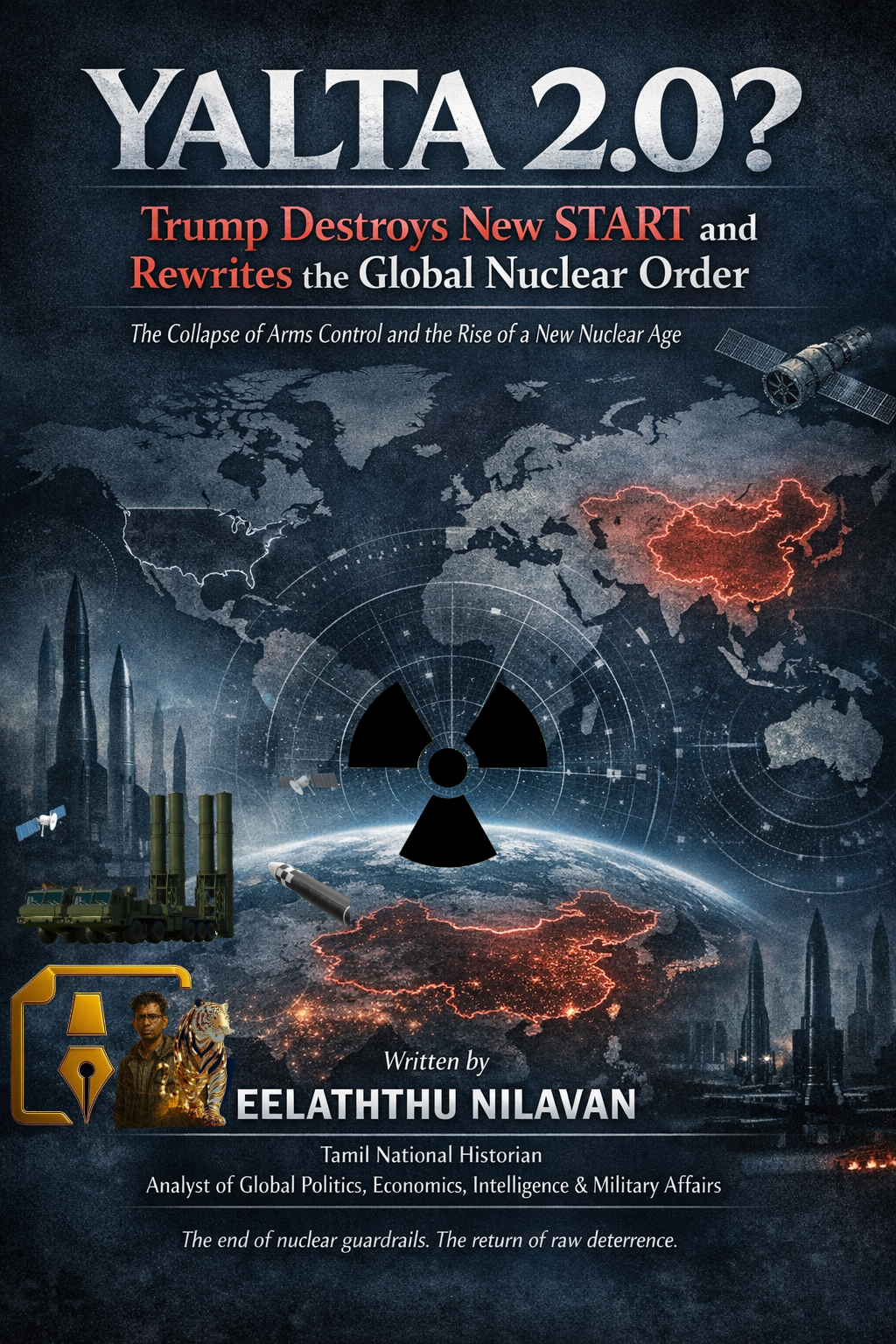
𝘛𝘩𝘦 𝘌𝘯𝘥 𝘰𝘧 𝘈𝘳𝘮𝘴 𝘊𝘰𝘯𝘵𝘳𝘰𝘭 𝘢𝘯𝘥 𝘵𝘩𝘦 𝘉𝘪𝘳𝘵𝘩 𝘰𝘧 𝘢 𝘕𝘦𝘸 𝘕𝘶𝘤𝘭𝘦𝘢𝘳 𝘈𝘨𝘦
✦ 𝗧𝗛𝗘 𝗙𝗜𝗡𝗔𝗟 𝗖𝗢𝗟𝗟𝗔𝗣𝗦𝗘 𝗢𝗙 𝗡𝗘𝗪 𝗦𝗧𝗔𝗥𝗧

On February 5, the New START (Strategic Arms Reduction Treaty) officially expired, bringing an end to the last surviving nuclear arms control agreement between the United States and Russia. For over a decade, the treaty functioned as the final guardrail restraining the world’s two largest nuclear arsenals, together accounting for nearly 90% of global nuclear weapons.
With its expiration:
• All legal caps on deployed strategic warheads are gone
• On-site inspections and data exchanges have ceased
• Transparency mechanisms have vanished overnight
This moment marks not merely the death of a treaty, but the collapse of the post-Cold War nuclear architecture itself.
✦ 𝗧𝗥𝗨𝗠𝗣’𝗦 𝗖𝗔𝗟𝗖𝗨𝗟𝗔𝗧𝗘𝗗 𝗥𝗨𝗣𝗧𝗨𝗥𝗘
President Donald Trump rejected extending New START, arguing that it represents an outdated bilateral model ill-suited to modern strategic realities. Instead, Washington is pushing for a new framework written on U.S. terms, reflecting:
• Emerging technologies (hypersonic weapons, space warfare)
• Multipolar nuclear dynamics
• The rise of China as a strategic peer
Trump’s decision signals a clear doctrine:
➽ Arms control will no longer be about mutual restraint, but about strategic dominance.
This approach echoes Yalta-style power politics, where global order is reshaped not through consensus—but through leverage.
✦ 𝗠𝗢𝗦𝗖𝗢𝗪’𝗦 𝗥𝗘𝗦𝗣𝗢𝗡𝗦𝗘: 𝗙𝗥𝗢𝗠 𝗥𝗘𝗚𝗥𝗘𝗧 𝗧𝗢 𝗥𝗘𝗔𝗥𝗠𝗔𝗠𝗘𝗡𝗧
The Kremlin publicly expressed regret, noting it had proposed a one-year extension to preserve stability. Washington’s refusal ended that possibility.
Russia has now declared:
• It is no longer bound by New START limits
• Nuclear force planning will proceed without legal constraints
• Strategic deterrence will be recalibrated for worst-case scenarios
This marks a decisive shift from managed rivalry to unrestricted strategic competition.
✦ 𝗧𝗛𝗘 “𝗖𝗛𝗜𝗡𝗔 𝗙𝗔𝗖𝗧𝗢𝗥” 𝗔𝗡𝗗 𝗧𝗛𝗘 𝗘𝗡𝗗 𝗢𝗙 𝗕𝗜𝗣𝗢𝗟𝗔𝗥 𝗔𝗥𝗠𝗦 𝗖𝗢𝗡𝗧𝗥𝗢𝗟
Washington insists that China must be included in any future arms control regime due to its rapidly expanding nuclear arsenal.
However:
• China has rejected formal trilateral negotiations
• Beijing argues its arsenal is still far smaller than U.S. and Russian stockpiles
• Inclusion would legitimize American nuclear superiority
The result is a strategic deadlock—where no power wants to limit itself first, and mistrust replaces diplomacy.
✦ 𝗧𝗛𝗘 𝗗𝗔𝗡𝗚𝗘𝗥𝗢𝗨𝗦 𝗔𝗙𝗧𝗘𝗥𝗠𝗔𝗧𝗛: 𝗔 𝗪𝗢𝗥𝗟𝗗 𝗪𝗜𝗧𝗛𝗢𝗨𝗧 𝗡𝗨𝗖𝗟𝗘𝗔𝗥 𝗚𝗨𝗔𝗥𝗗𝗥𝗔𝗜𝗟𝗦
With New START gone, the world enters its most unstable nuclear phase since the 1960s.
Key Risks Include:
• ❖ No inspections → no verification
• ❖ No data sharing → strategic blind spots
• ❖ No ceilings → quantitative arms races
• ❖ Faster decision-making under uncertainty
In such an environment, miscalculation becomes as dangerous as intent.
✦ 𝗥𝗨𝗦𝗦𝗜𝗔’𝗦 𝗦-𝟱𝟬𝟬 𝗣𝗥𝗢𝗠𝗘𝗧𝗛𝗘𝗨𝗦: 𝗧𝗛𝗘 “𝗚𝗢𝗟𝗗𝗘𝗡 𝗗𝗢𝗠𝗘” 𝗗𝗢𝗖𝗧𝗥𝗜𝗡𝗘
Against this backdrop, Russia has unveiled its most ambitious defensive system yet—the S-500 Prometheus.
Operational Reality (Early 2026):
• First regiment fully operational since December 2025
• Designed by Almaz-Antey
• Initially deployed around Moscow, with plans for nationwide coverage
The S-500 represents a paradigm shift—from deterrence by retaliation to deterrence by denial.
✦ 𝗧𝗘𝗖𝗛𝗡𝗜𝗖𝗔𝗟 𝗦𝗨𝗣𝗘𝗥𝗜𝗢𝗥𝗜𝗧𝗬 𝗢𝗙 𝗧𝗛𝗘 𝗦-𝟱𝟬𝟬
The system integrates air, missile, and space defense into a single battle network:
• Detection Range: Up to 600 km
• Engagement Range: 500–600 km
• Altitude: Up to 200 km (near space)
• Interceptor Speed:Mach 10–12
• Hypersonic Tracking: 10 targets simultaneously
• Targets:
✓ Ballistic missiles
✓ Cruise missiles
✓ Stealth aircraft (F-22, F-35)
✓ Drones
✓ Low-orbit satellites
This effectively blurs the boundary between air defense and space warfare.
✦ 𝗔𝗡𝗧𝗜-𝗦𝗔𝗧𝗘𝗟𝗟𝗜𝗧𝗘 𝗪𝗔𝗥𝗙𝗔𝗥𝗘 𝗔𝗡𝗗 𝗧𝗛𝗘 𝗠𝗜𝗟𝗜𝗧𝗔𝗥𝗜𝗭𝗔𝗧𝗜𝗢𝗡 𝗢𝗙 𝗦𝗣𝗔𝗖𝗘
Russian officials have openly acknowledged the S-500’s anti-satellite capabilities, signaling a willingness to:
• Blind adversary ISR networks
• Disrupt command-and-control systems
• Paralyze NATO’s space-dependent warfare doctrine
In a post-New START world, space becomes the next nuclear frontier.
✦ 𝗠𝗢𝗦𝗖𝗢𝗪–𝗕𝗘𝗜𝗝𝗜𝗡𝗚: 𝗔 𝗡𝗘𝗪 𝗦𝗧𝗥𝗔𝗧𝗘𝗚𝗜𝗖 𝗔𝗫𝗜𝗦
As U.S.–Russia relations deteriorate, Russia and China are tightening strategic coordination, including:
• Missile defense interoperability
• Nuclear signaling alignment
• Shared opposition to U.S.-led arms regimes
This emerging axis represents the end of Western monopoly over global nuclear rule-making.
✦ 𝗬𝗔𝗟𝗧𝗔 𝟮.𝟬: 𝗔 𝗪𝗢𝗥𝗟𝗗 𝗥𝗘𝗗𝗥𝗔𝗪𝗡 𝗕𝗬 𝗙𝗢𝗥𝗖𝗘
Just as Yalta (1945) reshaped the post-World War II order, today’s collapse of New START signals a repartitioning of power—not through treaties, but through:
• Technological superiority
• Strategic coercion
• Nuclear posturing
The age of arms control is giving way to an age of raw deterrence.
✦ 𝗖𝗢𝗡𝗖𝗟𝗨𝗦𝗜𝗢𝗡: 𝗔 𝗠𝗢𝗥𝗘 𝗗𝗔𝗡𝗚𝗘𝗥𝗢𝗨𝗦 𝗪𝗢𝗥𝗟𝗗
The expiration of New START is not an isolated diplomatic failure—it is a civilizational turning point.
Without rules, inspections, or trust:
• Nuclear weapons regain political centrality
• Defensive systems like the S-500 redefine deterrence
• Miscalculation becomes existential
The world has entered a post-arms-control era, where peace is no longer negotiated—but enforced.
Written by


Eelaththu Nilavan
Tamil National Historian | Analyst of Global Politics, Economics, Intelligence & Military Affairs
08/02/2026
