


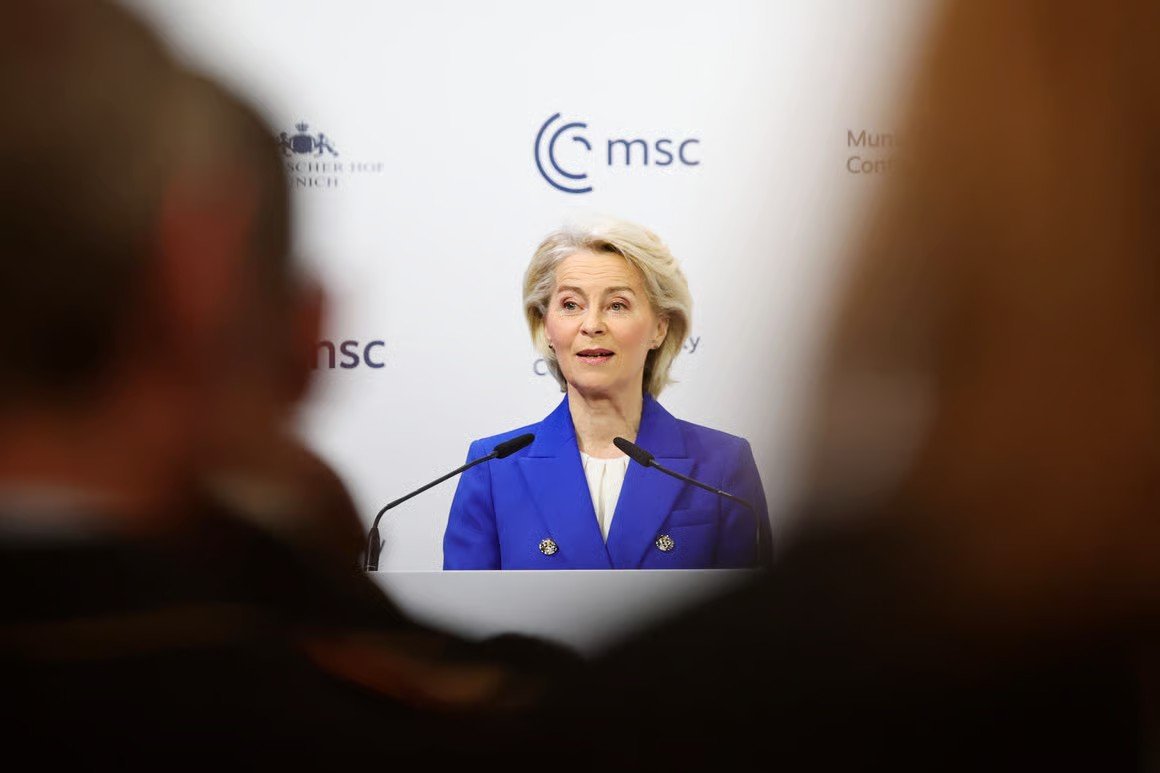

European Commission President Ursula von der Leyen issued a forceful call for Europe to “bring to life” its long‑standing but underused mutual defence clause, arguing that the European Union must be prepared to act collectively in the face of rising global threats. Speaking at the Munich Security Conference, she stressed that Europe’s security obligations are not optional but embedded in the EU’s founding treaty.
A Renewed Push for Collective Security
Von der Leyen underscored that Article 42.7 of the EU Treaty — the bloc’s mutual defence clause — represents a binding commitment for member states to support one another in the event of aggression. She framed the clause as a core expression of European unity, describing it as a promise of solidarity: “one for all and all for one.”
Her remarks come at a time when Europe faces mounting geopolitical uncertainty, including questions about the long‑term reliability of transatlantic security guarantees. The Munich Security Conference, a key annual forum for global defence and foreign policy leaders, has been dominated this year by discussions on the war in Ukraine, shifting U.S. foreign policy priorities, and the future of NATO.
“The Time Has Come” to Activate the Clause
Expanding on her message, von der Leyen stated that the EU must be ready to act decisively and more rapidly, even if that requires relying on qualified majority voting rather than unanimity in certain security decisions. She emphasized that no treaty change is needed to strengthen Europe’s defence posture — only the political will to use existing tools.
She pointed to successful multinational defence initiatives as proof that flexible, cooperative structures can work. Among them, she highlighted:
- The Joint Expeditionary Force, led by the United Kingdom, brings together 10 European countries to bolster deterrence in the Baltic region.
- The Coalition of the Willing, spearheaded by UK Prime Minister Keir Starmer and French President Emmanuel Macron, is developing enhanced security guarantees for Ukraine with participation from more than 30 countries, including non‑European partners.
These examples, she argued, demonstrate that Europe can build credible defence capabilities by leveraging existing alliances and creative cooperation models.
Strategic Context and Political Undercurrents
Von der Leyen’s call also reflects broader political dynamics within the EU. As Europe navigates internal divisions and external pressures, its leadership has faced both support and scrutiny. The Munich Security Conference follows a period of intense diplomatic activity, including meetings of EU defence ministers and heads of government, as the bloc seeks to coordinate its response to global instability.
Her message aligns with growing sentiment among European policymakers that the continent must assume greater responsibility for its own security, particularly as U.S. commitments evolve.
A Defining Moment for Europe
Von der Leyen’s appeal marks one of the clearest and most urgent endorsements yet for operationalizing the EU’s mutual defence clause. By urging member states to transform treaty obligations into concrete action, she positioned the moment as a test of Europe’s unity, credibility, and readiness to defend its values and territory.
As the Munich Security Conference continues, her remarks are expected to shape high‑level discussions on Europe’s strategic future — and may signal a turning point in the continent’s approach to collective defence.
