

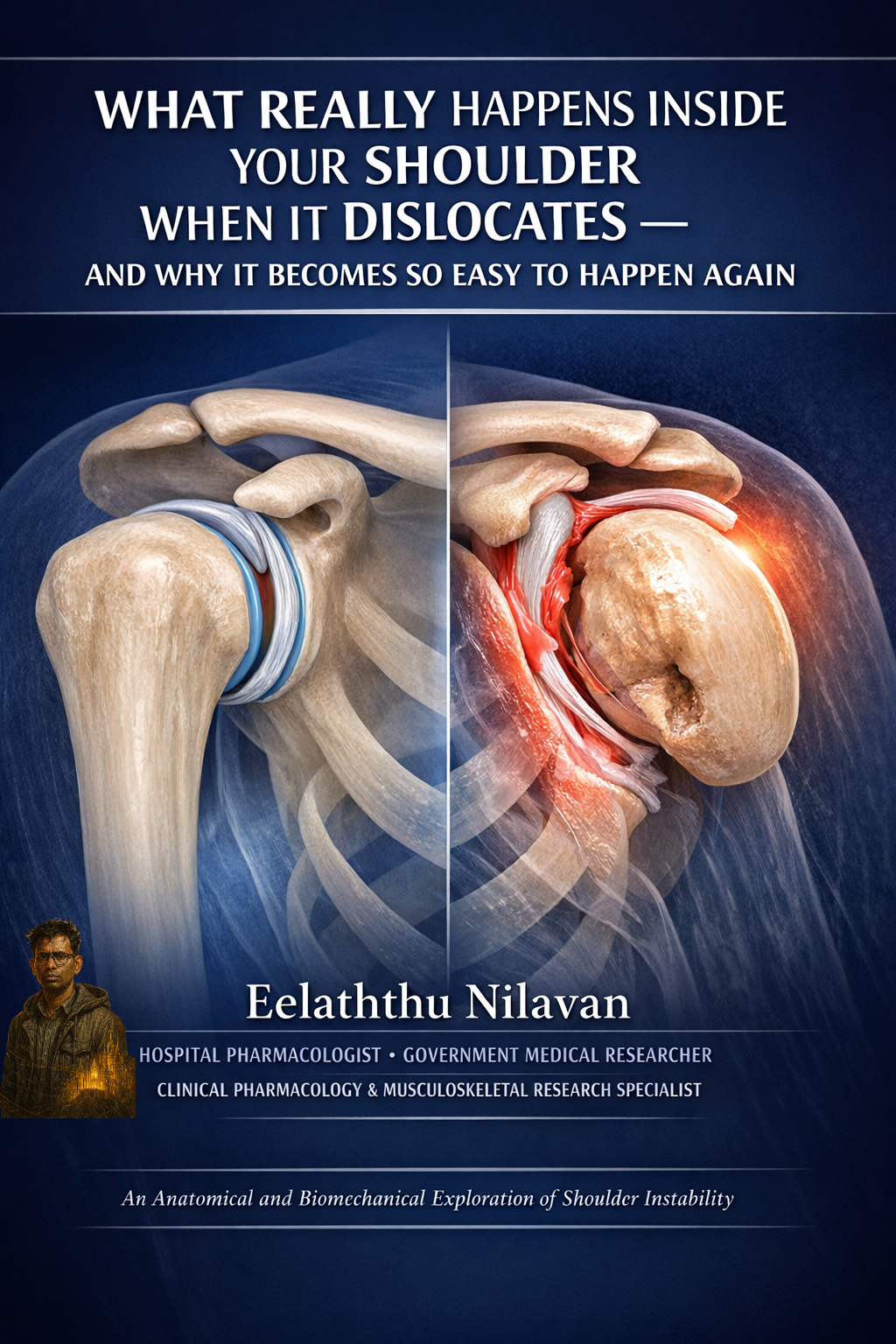
The shoulder is the most mobile joint in the human body — and that extreme mobility comes at a cost. When a shoulder dislocates, it is not just a simple “bone popping out.” A complex cascade of structural damage occurs inside the joint.
Let’s break down what truly happens — anatomically and physiologically.
✦. The Anatomy: Why the Shoulder Is Vulnerable
The shoulder joint is called the glenohumeral joint.

It is formed by:
• The humeral head (the ball)
• The glenoid fossa of the scapula (the socket)
Unlike the hip joint (which has a deep socket), the shoulder socket is shallow — more like a golf ball sitting on a tee.
Stability is provided not mainly by bone, but by:
• The labrum (a cartilage rim around the socket)
• The joint capsule
• Ligaments
• Rotator cuff muscles
This design gives you incredible range of motion — but less inherent stability.
✦. What Actually Happens During a Dislocation?
Most shoulder dislocations are anterior dislocations (the humeral head moves forward).
When the arm is:
• Abducted (lifted outward)
• Externally rotated
• Forced backward
The humeral head is pushed out of the socket.
Inside the joint, the following damage often occurs:
1. Labral Tear (Bankart Lesion)
The rim of cartilage (labrum) tears away from the glenoid.
This is called a Bankart lesion.
What this means:
• The socket loses its “grip”
• Stability decreases immediately
2. Capsule Stretching or Rupture
The joint capsule is overstretched or torn.
Think of it like overstretching an elastic band — it may not return to its original tightness.
3. Bone Damage (Hill-Sachs Lesion)
When the humeral head slams against the front rim of the glenoid, it may get dented.
This compression fracture is called a Hill-Sachs lesion.
Now the ball is no longer perfectly round — which further destabilizes the joint.
4. Muscle and Nerve Injury
• Rotator cuff strain or tear
• Axillary nerve injury (causing numbness over the shoulder)
So a “simple” dislocation can involve cartilage, bone, ligaments, and nerves.
✦. Why Does It Become So Easy to Dislocate Again?
This is the key question.
After the first dislocation, three major biomechanical changes occur:
A. The Labrum Does Not Fully Heal
The labrum has poor blood supply.
If it detaches (Bankart lesion), it often:
• Heals improperly
• Remains loose
• Or does not heal at all
This leaves the socket permanently unstable.
B. The Capsule Stays Loose
The joint capsule becomes stretched.
In young patients (especially under 25):
• Recurrence rates can exceed 70–80%
The capsule loses its tight tension — allowing the humeral head to slip out more easily.
C. Bone Defects Create a Mechanical Trap
A Hill-Sachs lesion acts like a notch.
When the arm rotates in certain positions:
• The dent engages with the socket rim
• The joint “locks” and pops out again
This creates a mechanical predisposition for recurrent instability.
✦. Age Matters
Younger patients:
• Stronger muscles
• Higher activity levels
• More elastic tissue
Ironically, this makes recurrence more likely.
Older patients:
• Less recurrence
• But higher risk of rotator cuff tears
✦. What Happens at the Cellular Level?
After dislocation:
• Inflammatory cytokines are released
• Collagen fibers remodel
• Scar tissue forms
However:
• The collagen alignment is disorganized
• Tensile strength is reduced
• Elastic properties change
So even if pain improves, structural integrity may not fully return.
✦. Why Some People Become “Chronic Dislocators”
Repeated dislocations lead to:
• Progressive bone loss of the glenoid
• Enlargement of Hill-Sachs defect
• Muscle inhibition due to fear and pain
• Proprioceptive dysfunction (the brain loses accurate joint position sense)
The joint becomes neurologically and mechanically unstable.
At that point, physiotherapy alone may not be enough.
✦. Can It Be Prevented After First Dislocation?
Management depends on:
• Age
• Activity level
• Degree of structural damage
• Presence of bone loss
Treatment options include:
✧. Conservative:
• Immobilization
• Structured physiotherapy
• Rotator cuff strengthening
• Proprioceptive training
✧. Surgical (for high-risk patients):
• Labral repair
• Capsule tightening
• Bone graft procedures (e.g., Latarjet procedure)
Early surgical stabilization in young athletes significantly reduces recurrence rates.
✧. Final Summary
When a shoulder dislocates, it is not just a temporary displacement.
It often causes:
• Labral detachment
• Capsule stretching
• Bone defects
• Neuromuscular disruption
Because the shoulder depends more on soft tissue stability than bony architecture, any structural injury dramatically increases the risk of recurrence.
The first dislocation changes the biomechanics of the joint — sometimes permanently.
That is why the shoulder, once dislocated, often “remembers” the injury.

Author: Eelaththu Nilavan
Hospital Pharmacologist | Government Medical Researcher
04/03/2026

