

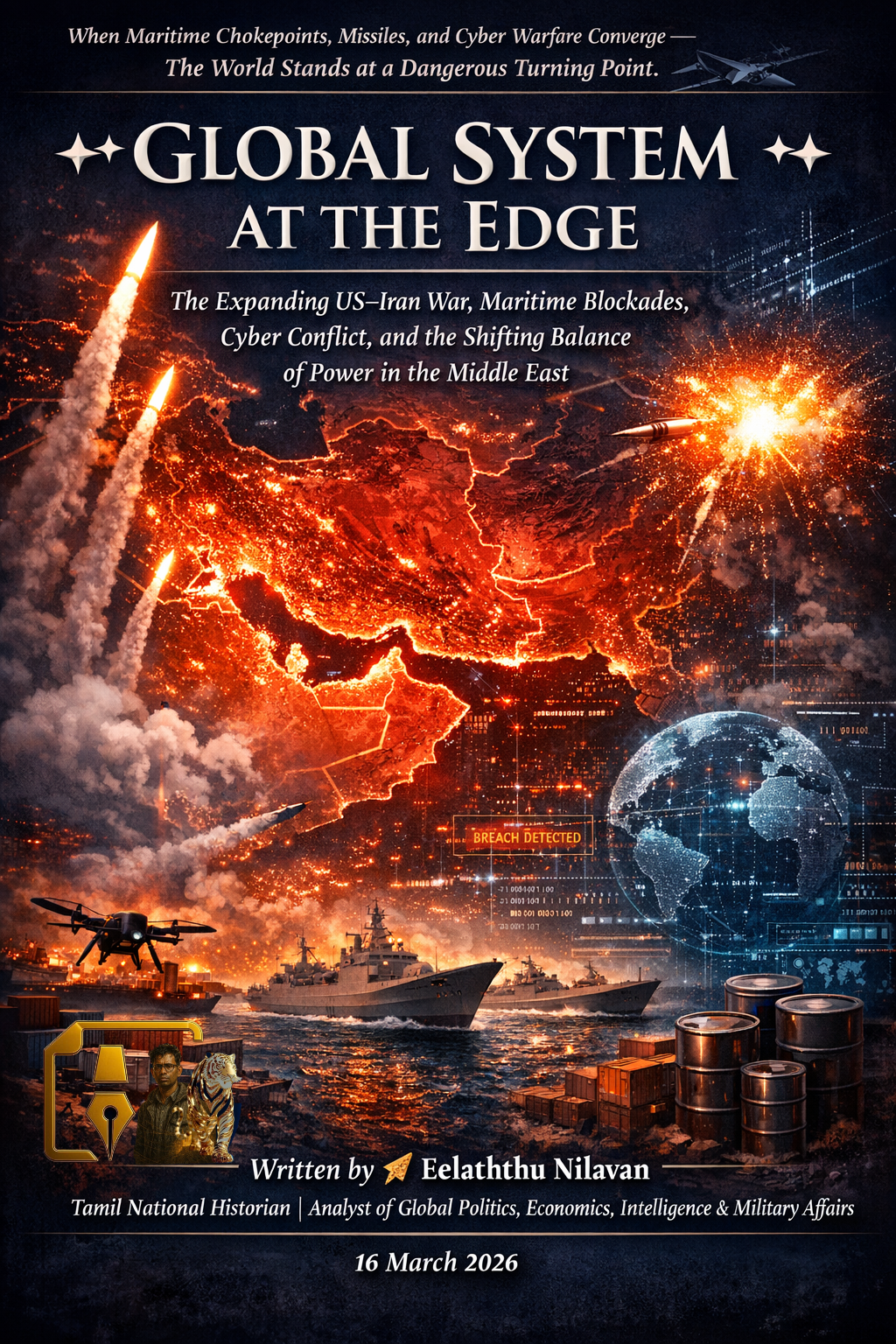
The Expanding US–Iran War, Maritime Blockades, Cyber Conflict, and the Shifting Balance of Power in the Middle East
✦. A MULTI-LAYERED WAR EMERGES IN THE MIDDLE EAST ✦
The rapidly escalating confrontation between the United States, Israel, and Iran has evolved into one of the most complex geopolitical crises of the 21st century. What began as targeted strikes against Iranian infrastructure in late February 2026 has now transformed into a multi-domain conflict involving missile warfare, maritime blockades, cyber operations, intelligence battles, and proxy conflicts across several regions.
Following the joint US–Israeli strike on Iranian strategic facilities on February 28, Tehran launched a sweeping retaliatory campaign under what the Islamic Revolutionary Guard Corps (IRGC) calls “Operation True Promise 4.”
This operation has already entered more than fifty waves of missile and drone strikes, targeting:
• Israeli urban centers
• American bases in the Middle East
• Logistics hubs across Iraq and Kuwait
• Strategic military infrastructure across the region
At the same time, the conflict has expanded far beyond the traditional battlefield.
It now threatens to disrupt global trade routes, oil supply chains, and digital infrastructure worldwide.
✦. IRAN CLAIMS TO FOIL AN EIGHT-STAGE DESTABILIZATION PLOT ✦
Inside Iran, authorities have announced the dismantling of what they describe as a foreign-engineered destabilization strategy allegedly orchestrated by the United States and Israel.
Iranian intelligence services claim the plan consists of eight sequential stages designed to destabilize and ultimately fracture the Iranian state.
According to Iranian officials, the operation is currently in Stage Four.
Mass Arrests Across Several Provinces
Security forces conducted large-scale operations in several strategic regions:
• Mazandaran
• Razavi Khorasan
• Khuzestan
• Kerman
More than 50 individuals were detained, accused of espionage, sabotage planning, and cooperation with foreign intelligence networks.
Among the accusations:
• transmitting coordinates of sensitive locations to Israeli intelligence
• filming restricted facilities
• organizing riots and urban chaos
• establishing clandestine mercenary cells
Authorities also seized:
• firearms
• hand grenades
• bladed weapons
• ammunition stockpiles
Iran’s Ministry of Intelligence declared that “national security is a red line,” promising uncompromising action against foreign interference.
One detained suspect reportedly confessed that their network was instructed to wait for large-scale unrest before initiating violent destabilization operations.
✦. MISSILE WARFARE PUSHES ISRAEL’S DEFENSE SYSTEMS TO THEIR LIMITS ✦
While Israel’s multi-layered missile defense architecture—including Iron Dome, David’s Sling, and Arrow systems—has historically proven highly effective, the scale of Iranian attacks is now pushing the system to its operational limits.
Israeli officials have reportedly warned Washington that interceptor reserves are “critically low.”
The strain stems from:
• the sheer volume of Iranian missile launches
• the increasing complexity of warheads
• the introduction of cluster munitions
Iran’s New Tactical Weapon: Cluster Ballistic Missiles
Iran has begun deploying cluster warheads mounted on ballistic missiles, including variants of the Khorramshahr system.
Instead of delivering a single explosive payload, these missiles release dozens of smaller bomblets during descent.
This creates multiple challenges:
• missile defense radars must track dozens of objects
• interceptors must engage multiple targets simultaneously
• debris fields increase the chance of breakthroughs
Even with high interception rates, some missiles are penetrating defenses, causing casualties and damage near Tel Aviv and other urban areas.
✦. THE RED SEA CRISIS: A SECOND GLOBAL CHOKEPOINT UNDER THREAT ✦
The war has now expanded into a critical maritime dimension.
Yemen’s Houthi movement (Ansar Allah) has warned that it may impose a naval blockade on the Bab el-Mandeb Strait.
This narrow waterway connects:
• the Red Sea
• the Gulf of Aden
• the Suez Canal trade route
It represents one of the most important shipping corridors on Earth.
Global Trade at Risk
Nearly 12–15% of global trade passes through the Suez route.
If the Bab el-Mandeb Strait is blocked while the Strait of Hormuz remains unstable, the world could face a dual chokepoint crisis.
Consequences could include:
• massive shipping disruptions
• severe oil price spikes
• supply chain collapse across Europe and Asia
Houthi officials have warned that they may target:
• merchant vessels linked to the US or Israel
• military ships protecting them
• ships destined for Israeli ports
If enacted, this would represent one of the most disruptive maritime blockades in modern history.
✦. CYBER WARFARE OPENS A NEW FRONT ✦
Parallel to physical combat, the conflict has expanded into cyber warfare.
Security analysts report that Iranian-linked actors have already conducted major cyberattacks targeting American corporate networks.
These attacks typically pursue three objectives:
1. Infrastructure Disruption
Cyber operations may shut down critical systems in sectors such as:
• energy
• transportation
• logistics
• healthcare
2. Strategic Data Theft
Hackers aim to extract sensitive material including:
• internal communications
• contracts
• defense-related information
This data can later be used for information warfare or blackmail.
3. Long-Term Network Access
Sophisticated intrusions often leave hidden backdoor access points, allowing attackers to remain inside networks for months or years.
Experts warn that modern wars increasingly combine kinetic strikes with digital sabotage, making cyber conflict a permanent feature of geopolitical rivalry.
✦. REGIONAL POWERS EDGE CLOSER TO THE CONFLICT ✦
The widening conflict has begun drawing regional powers closer to the crisis.
Turkey recently issued a sharp warning to Israel after missiles from Iranian strikes approached Turkish airspace.
Ankara has expressed concern that Israel’s operations in Lebanon could escalate further, warning against what it described as a potential humanitarian catastrophe.
At the same time, Turkey has insisted it does not wish to be dragged into the war, while emphasizing its powerful military deterrent capabilities.
Meanwhile, Lebanon has suffered heavy casualties following Israeli air strikes targeting Hezbollah infrastructure.
✦. THE WESTERN MILITARY RESPONSE AND THE HORMUZ CRISIS ✦
The Strait of Hormuz, through which nearly 20% of the world’s oil supply flows, remains the central strategic battleground.
In response to threats against commercial shipping, Western nations are beginning to reinforce naval presence in the Gulf.
The United Kingdom has already deployed the HMS Dragon, a sophisticated air-defense destroyer designed to intercept missiles and aircraft.
British defense planners are also considering deploying autonomous mine-hunting drones to protect shipping from Iranian sea mines.
Washington has urged NATO partners and major economies to join a multinational maritime coalition aimed at keeping the strait open.
✦. INTERNAL POLITICAL TENSIONS IN THE UNITED STATES ✦
While the war intensifies abroad, it is also creating deep political divisions within the United States.
Prominent conservative figures have begun questioning the strategic direction of the conflict.
Senior technology investor and presidential adviser David Sacks has warned that the war risks spiraling into a catastrophic regional escalation.
Meanwhile political commentator Tucker Carlson has suggested that many supporters of Donald Trump feel betrayed by Washington’s continued support for Israel in the conflict.
Carlson has even claimed that intelligence agencies may be investigating him over past contacts in Iran, highlighting how the war is now influencing domestic politics in Washington.
✦. DRONE WARFARE EXPOSES NEW MILITARY VULNERABILITIES ✦
In a dramatic demonstration of asymmetric warfare, an Iranian-backed FPV drone reportedly breached U.S. defenses at Camp Victoria in Baghdad.
The drone bypassed advanced counter-rocket and air defense systems before striking a fortified bunker.
The incident underscores a growing military reality:
Low-cost drones costing a few thousand dollars can threaten defense systems worth billions.
This technological shift is transforming modern warfare and giving non-state actors unprecedented capabilities.
✦. THE GLOBAL SYSTEM APPROACHES A DANGEROUS TURNING POINT ✦
Taken together, these developments suggest that the current conflict is no longer a regional confrontation.
It has become a system-level geopolitical crisis involving:
• missile warfare
• maritime chokepoints
• cyber attacks
• proxy forces
• global energy markets
• internal political divisions in major powers
If the Strait of Hormuz and Bab el-Mandeb were both closed simultaneously, the world could face:
• the largest oil shock since the 1973 crisis
• global inflation spikes
• severe economic disruption
• major military escalation
The coming weeks may determine whether the Middle East descends into a full regional war — or whether global powers succeed in containing the crisis before it spreads further.

Written by Eelaththu Nilavan
Tamil National Historian | Analyst of Global Politics, Economics, Intelligence & Military Affairs
16 March 2026
