


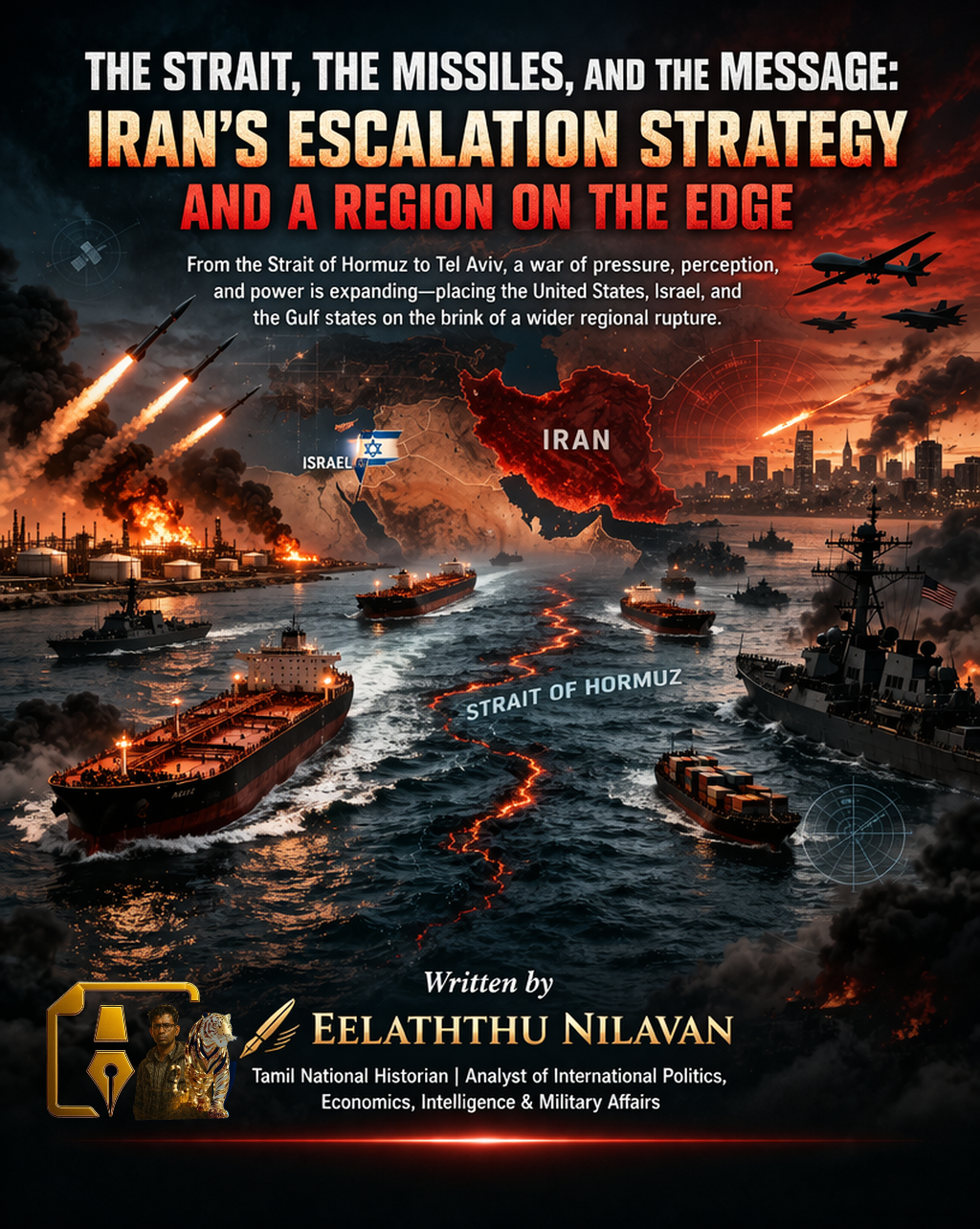
A war of pressure, perception, and power is unfolding from the Strait of Hormuz to Tel Aviv, with the United States, Israel, and the Gulf now facing the risk of a broader regional rupture.
⧉▬▬▬▬▬▬▬▬▬▬▬▬▬▬⧉
𝑩𝒚

𝑬𝒆𝒍𝒂𝒕𝒉𝒕𝒉𝒖 𝑵𝒊𝒍𝒂𝒗𝒂𝒏
Tamil National Historian | Analyst of Global Politics, Economics, Intelligence & Military Affairs
⊰❉⊱══════════════════⊰❉⊱
The Strait of Hormuz Becomes the Center of Global Anxiety
Iran’s latest posture over the Strait of Hormuz has pushed the Middle East into one of its most dangerous moments in recent years. Iranian Revolutionary Guard-linked messaging has presented Tehran as holding effective control over the waterway, while also signaling that it does not need to rely solely on old doctrines such as naval mining to impose pressure. That matters because Hormuz is not just a regional shipping lane; it is one of the world’s most critical energy chokepoints, carrying roughly a fifth of global oil and liquefied natural gas flows. Reuters and AP both report that the conflict has already sharply disrupted traffic through the strait and rattled oil markets, with Washington tying its threats directly to whether the route is reopened.
What Iran is attempting is bigger than a military blockade in the narrow sense. It is projecting an image of selective sovereignty: the message is that passage may remain possible for some, but only under terms shaped by Tehran. Reuters reported on March 22 that Iran said Hormuz was open to all except ships linked to hostile states, while also warning it could completely close the strait if U.S. attacks on Iranian energy targets go ahead.
This is why the Strait has become both a battlefield and a bargaining chip. Iran is showing that it can threaten the arteries of global commerce without necessarily announcing a total and permanent closure every hour of the day. The ambiguity itself is strategic.
Trump’s Pause Did Not Lower the Temperature
U.S. President Donald Trump publicly claimed that American representatives had reached “major points of agreement” with Iran and said planned attacks on Iranian energy infrastructure and power plants would be delayed for five days. But that pause did not produce calm. Instead, it exposed a deep credibility gap. Iran rejected Trump’s claims of talks, describing them as false and manipulative, while fighting continued across multiple fronts. Reuters and AP both say Tehran denied that any formal talks had taken place, even as Trump suggested progress toward a deal and linked restraint to Hormuz reopening.
That contradiction is central to the current crisis. Washington is trying to combine coercion and diplomacy: threaten devastating strikes, then present a diplomatic opening. Tehran, by contrast, is trying to portray U.S. statements as psychological warfare aimed at influencing markets and buying operational time. Reuters reported that global oil prices initially fell on Trump’s comments, only to rise again as missile attacks resumed and confidence evaporated.
So the pause was not de-escalation in any meaningful sense. It was a tactical interruption inside a larger confrontation.
Iran’s Missile Barrages Signal a Wider Strategic Message
Iran’s missile attacks on Israel, including strikes affecting the Tel Aviv area, show that Tehran wants to demonstrate not only retaliation, but reach, persistence, and psychological effect. Reuters reported on March 24 that Iran launched fresh waves of missiles into Israel after dismissing Trump’s talk of negotiations as “fake news,” while AP said a direct missile strike hit central Tel Aviv as the wider conflict continued.
The significance of these strikes lies in timing as much as impact. They came during a moment when public messaging from Washington implied that diplomacy might be gaining traction. By launching again, Iran signaled that it would not allow U.S. narrative management to define the tempo of war. In other words, Tehran is trying to prove that it retains escalation control even while under pressure.
This also reinforces a second message aimed at Israel and the Gulf: the conflict is no longer confined to isolated retaliatory exchanges. Sensitive locations, urban centers, military infrastructure, and energy-linked geography are all part of the same strategic theater. Earlier reporting from AP and Reuters also tied recent Iranian strikes to areas near Dimona and to broader threats against Gulf infrastructure if U.S. attacks intensify.
The Gulf States Are No Longer Watching from a Safe Distance
One of the most important features of this phase is that Gulf Arab states are no longer merely observers. AP reports that Iran has targeted Gulf Arab states during this escalation, and Reuters has noted Iranian warnings that energy infrastructure in countries hosting U.S. bases could become legitimate targets if American strikes expand.
That changes the strategic map dramatically. Saudi Arabia, the United Arab Emirates, Kuwait, and others sit at the intersection of U.S. force posture, regional logistics, desalination vulnerability, and global energy export routes. A conflict that directly touches them risks becoming a full-spectrum regional crisis involving not only missiles and drones, but also electricity supply, shipping insurance, port operations, and investor confidence.
The old assumption that Gulf capitals could absorb shocks while keeping the economic machine running is now under severe strain. Even limited attacks or credible threats can create outsized consequences because markets react not only to destruction, but to uncertainty.
Energy Warfare Is Now at the Heart of the Conflict
At this stage, energy is not a side effect of war. Energy is one of the main arenas of war.
The Strait of Hormuz sits at the center of that reality, but the contest extends well beyond the waterway. Trump has threatened Iranian power plants and energy facilities. Iran has threatened U.S.-linked infrastructure and warned that regional energy systems could also be hit. Reuters reported that oil markets have swung sharply as each new statement or strike changes trader expectations about supply risk, inflation, and global economic fallout.
This means the struggle is no longer just about battlefield advantage. It is about who can impose the higher economic cost on the other side and on the world. Tehran appears to believe that its leverage grows when energy insecurity rises, because every disruption multiplies pressure on Washington and its allies. The United States, meanwhile, appears to believe that threats to Iran’s power and export systems can force Tehran back into a narrower strategic box.
The danger is obvious: once both sides define infrastructure as fair game, escalation becomes easier to trigger and much harder to contain.
A War of Narratives Is Running Alongside the War of Missiles
This crisis is being fought in words almost as intensely as in weapons. Trump says progress is being made. Iran says no talks exist. The U.S. frames delay as diplomacy. Tehran frames it as American hesitation under pressure. Israel presents ongoing operations as necessary to break Iran’s missile and nuclear capacity. Iran presents its own strikes as calibrated resistance and proof that deterrence is still alive.
That narrative struggle matters because modern conflict is not only about battlefield outcomes. It is about shaping the political interpretation of events before markets, allies, and domestic audiences settle on a story. Reuters and AP both show that even when diplomacy is publicly invoked, the military reality on the ground has kept worsening.
In this sense, every claim about a ceasefire window, every denial, every missile wave, and every threat to Hormuz is part of the same contest for strategic perception.
Why This Moment Is Especially Dangerous
The present situation is more dangerous than a normal exchange of threats for three reasons.
First, the conflict has fused maritime pressure, energy coercion, and long-range missile warfare into a single crisis. Second, it now touches multiple countries directly or indirectly, which increases the chance of miscalculation. Third, public claims of diplomacy are not being matched by trust, verification, or visible de-escalatory mechanisms. Reuters and AP reporting indicates that fighting has continued even as talk of possible indirect diplomacy circulates.
That is the nightmare combination: high military tempo, high economic stakes, and low political trust.
Conclusion: Iran Is Signaling Control, but the Region Is Sliding Toward Disorder
Iran’s actions suggest a deliberate strategy: demonstrate command over escalation, show the ability to pressure global energy flows, strike Israel visibly, intimidate Gulf states, and reject any narrative that Washington still dictates the pace of events. The United States, meanwhile, is trying to preserve deterrence without immediately triggering a still larger energy and regional disaster. Israel continues pressing military operations, convinced that pressure must be sustained. The Gulf states are trapped between geography, alliance structures, and existential economic risk.
The result is a Middle East standing at the edge of a wider rupture. The Strait of Hormuz is no longer just a shipping lane in this crisis. It is the symbolic and strategic heart of a confrontation that now stretches from sea lanes to cities, from oil terminals to parliaments, and from diplomacy to disinformation.
Unless a credible channel of de-escalation emerges very quickly, this conflict may no longer be remembered as a contained regional showdown. It may be seen as the moment when energy warfare, missile escalation, and geopolitical confrontation merged into a single, unstable front.

Written by Eelaththu Nilavan
Tamil National Historian.
Analyst of Global Politics, Economics, Intelligence & Military Affairs
24/03/2026
