


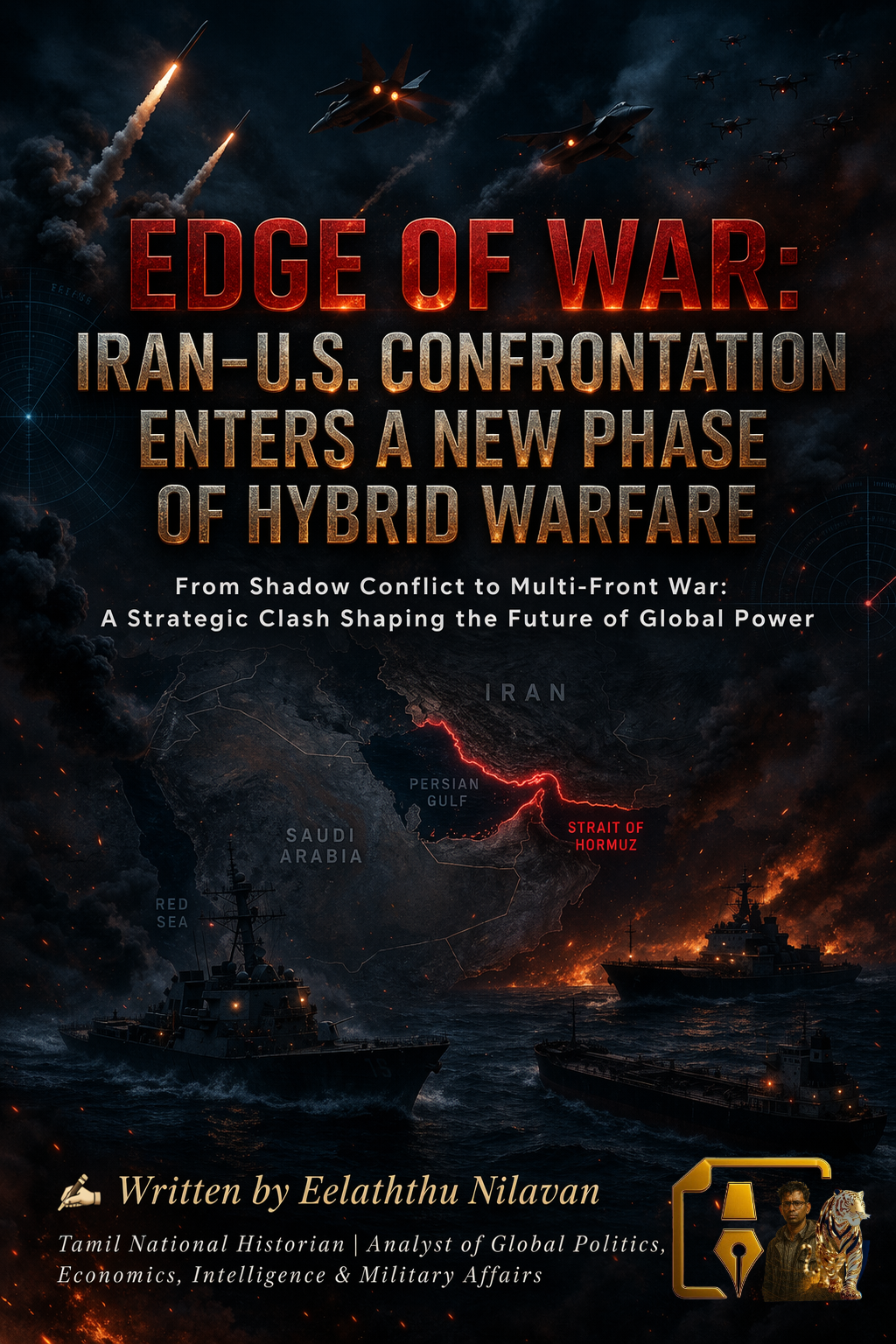
A REGION ON THE BRINK: FROM SHADOW CONFLICT TO DIRECT MILITARY COLLISION
The confrontation between Iran and the United States has rapidly evolved from a prolonged shadow war into a direct, multi-domain military standoff with global implications. What was once defined by proxy engagements, cyber operations, and covert strikes is now transitioning toward overt conflict involving strategic bombardments, large-scale deployments, and explicit threats of ground warfare.
At the center of this escalation stands Iran’s Islamic Revolutionary Guard Corps (IRGC), which has shifted from deterrence messaging to active battlefield preparation. Simultaneously, the United States has responded with accelerated force projection, signaling readiness for rapid dominance operations while maintaining ambiguity over a full-scale ground invasion.
This convergence of military postures represents one of the most dangerous inflection points in Middle Eastern geopolitics in decades.
IRAN’S STRATEGIC DOCTRINE: TERRAIN, ATTRITION, AND HYBRID WARFARE
Iran’s military strategy is deeply rooted in asymmetric warfare principles, designed specifically to counter technologically superior adversaries.
Geographic Advantage as a Weapon
Iran’s terrain forms the backbone of its defensive architecture. The Zagros mountain range, expansive deserts, and dense urban environments provide natural defensive barriers. These landscapes are being actively integrated into military planning as “kill zones,” where advancing forces can be slowed, isolated, and systematically targeted.
Decentralised Combat Structure
Rather than relying on centralized command, IRGC ground units operate in flexible, semi-autonomous formations. This decentralization allows Iran to fragment the battlefield into multiple micro-fronts, complicating enemy coordination and stretching operational capacity.
Hybrid Warfare Integration
Iran’s doctrine combines:
• Anti-tank guided missile ambushes
• Drone swarm saturation attacks
• Guerrilla-style hit-and-run tactics
• Electronic warfare and battlefield disruption
This approach is designed not to win quickly, but to prolong the conflict, increase costs, and erode the political will of the opponent.
THE U.S. MILITARY RESPONSE: SPEED, FORCE, AND STRATEGIC AMBIGUITY
The United States continues to rely on its doctrine of rapid dominance—overwhelming force applied with speed and precision.
Force Deployment and Readiness
Thousands of troops from the 82nd Airborne Division, alongside Marine Expeditionary Units and naval strike groups, have been deployed across the region. Strategic bombers, including B-52 aircraft, are conducting long-range strike missions targeting Iran’s defense infrastructure.
Operation Epic Fury
According to U.S. defense sources, the campaign has:
• Targeted over 11,000 sites
• Neutralized more than 150 naval assets
• Degraded missile and drone production capabilities
The operation reflects a shift toward “wartime speed,” emphasizing unpredictability and maintaining multiple ground invasion contingencies.
Strategic Objectives
Washington’s priorities include:
• Crippling Iran’s military-industrial base
• Preventing nuclear weaponization
• Securing maritime routes
• Reasserting regional deterrence
Yet, despite these objectives, U.S. leadership appears divided between escalation and a controlled exit strategy.
MULTI-FRONT ESCALATION: THE EXPANDING BATTLESPACE
The conflict is no longer confined to a single theater. Instead, it is expanding across multiple geographic and operational domains.
Persian Gulf and Strategic Strikes
Iran has launched coordinated missile and drone attacks targeting U.S. bases and allied infrastructure across the Gulf. These strikes aim to increase operational costs and demonstrate regional reach.
Red Sea and Maritime Threats
Iran’s influence over Yemeni Houthi forces introduces a critical maritime dimension. The potential targeting of commercial shipping in the Red Sea threatens global trade routes and energy flows.
Israel Front Activation
Missile strikes against Israeli territory, including sensitive military and nuclear-related sites, signal a widening conflict that risks drawing additional actors into direct confrontation.
CRITICAL CHOKEPOINTS: STRAIT OF HORMUZ AND BAB AL-MANDEB
Two maritime chokepoints have emerged as central to the strategic contest:
Strait of Hormuz
Handling roughly 20% of global oil supply, this corridor remains under significant Iranian influence. Any sustained disruption could trigger severe global economic consequences, including energy shortages and price surges.
Bab al-Mandeb Strait
A key link between the Red Sea and the Gulf of Aden, this passage is increasingly vulnerable to proxy attacks. Its closure would disrupt Europe–Asia trade flows and amplify global supply chain instability.
Together, these chokepoints form the backbone of Iran’s “dual pressure strategy,” leveraging geography to exert global economic influence.
THE AIR DEFENSE CRISIS: GULF STATES UNDER PRESSURE
Gulf nations are facing an unprecedented strain on their air defense systems.
• Approximately 2,400 interceptor missiles have been used within weeks
• Pre-conflict reserves were estimated below 2,800
• Continuous Iranian barrages are accelerating depletion
This rapid drawdown exposes critical vulnerabilities in regional defense architecture. As interceptor stocks decline, the ability to protect infrastructure, oil facilities, and civilian centers becomes increasingly uncertain.
The situation underscores a broader reality: even advanced defense systems struggle under sustained, high-intensity missile and drone warfare.
ESCALATION IN ISFAHAN: STRIKES ON STRATEGIC DEPTH
The city of Isfahan has emerged as a focal point of escalation.
Deep Penetration Strikes
U.S. bunker-buster munitions targeted fortified underground facilities, likely associated with missile storage or nuclear-related infrastructure.
Iranian Countermeasures
Iran claims to have intercepted and destroyed a U.S. MQ-9 Reaper drone using advanced air defense systems, signaling improvements in its integrated defense network.
Nuclear Risk Concerns
The targeting of deeply buried facilities raises global alarm regarding potential contamination or unintended escalation involving nuclear materials.
GLOBAL POWER DYNAMICS: RUSSIA, REGIONAL ALLIES, AND EMERGING ALIGNMENTS
The conflict is reshaping global geopolitical alignments.
Russia’s Position
Moscow has criticized U.S. actions, framing the crisis as a breakdown of international order. While positioning itself as a mediator, Russia’s rhetoric aligns more closely with Tehran’s narrative.
Gulf States’ Calculations
Key regional players such as Saudi Arabia and the UAE reportedly favor continued pressure on Iran, viewing the conflict as a strategic opportunity to weaken its influence.
Diverging Regional Views
At the same time, nations like Qatar and Oman advocate for de-escalation, reflecting internal divisions within the Gulf Cooperation Council.
INTERNAL SECURITY IN IRAN: CONSOLIDATION UNDER PRESSURE
Amid external conflict, Iran is intensifying internal control measures.
• Mass arrests targeting alleged espionage networks
• Executions linked to anti-state activities
• Expanded legal frameworks enabling asset seizures
These actions indicate a broader effort to stabilize the domestic front while confronting external threats.
THE RISK OF A PROLONGED WAR: ATTRITION VS RAPID DOMINANCE
At its core, the conflict represents a clash between two opposing military doctrines:
United States:
• Speed, precision, overwhelming force
• Short-duration, high-intensity campaigns
Iran:
• Attrition, endurance, decentralization
• Long-duration conflict designed to exhaust
While the U.S. may achieve early tactical successes, Iran’s strategy is structured to transform the battlefield into a prolonged war of attrition—where time, cost, and political pressure become decisive factors.
CONCLUSION: A FRAGILE WORLD ORDER AT A CROSSROADS
The current trajectory suggests that the international system is entering a period of extreme volatility. The integration of multiple conflict zones—spanning the Gulf, Red Sea, and Levant—has created a single, interconnected theater where escalation in one area rapidly affects others.
With global energy routes at risk, military doctrines colliding, and major powers increasingly involved, the margin for miscalculation is dangerously thin.
Unless decisive diplomatic efforts intervene, the situation may evolve into a prolonged, multi-regional confrontation with far-reaching consequences for global stability, economic security, and the future structure of international order.

Written by Eelaththu Nilavan
Tamil National Historian | Analyst of Global Politics, Economics, Intelligence & Military Affairs
31/03/2026
The views expressed in this article are the author’s own and do not necessarily reflect Amizhthu’s editorial stance.
