


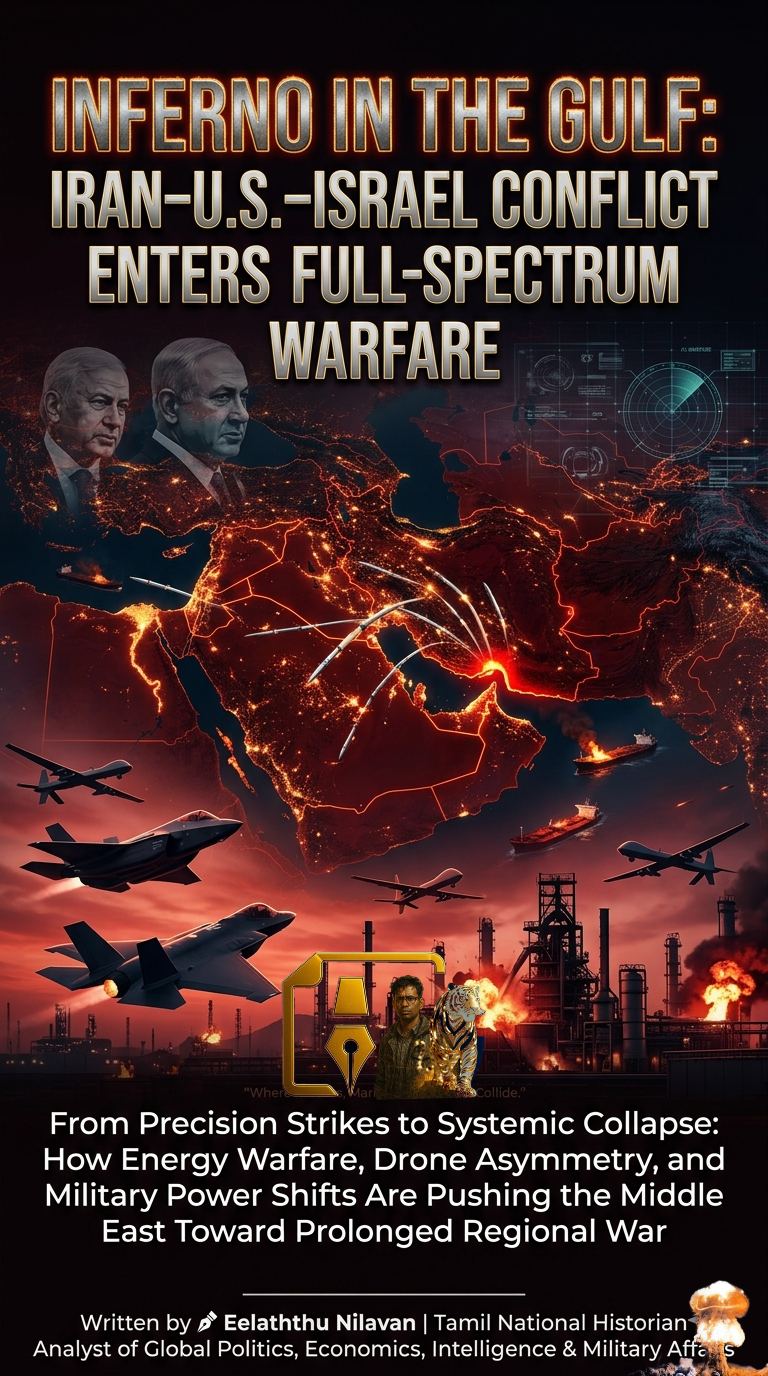
From Precision Strikes to Systemic Collapse: A Region Sliding Toward Prolonged Catastrophe
“TRUE PROMISE 4” — IRAN’S MULTI-DOMAIN OFFENSIVE STRATEGY
The Islamic Revolutionary Guard Corps (IRGC) has escalated the conflict to unprecedented levels with Wave 90 of “Operation True Promise 4.” This phase marks a decisive shift from symbolic retaliation to strategic infrastructure warfare.
Key Targets in the Latest Wave
• Industrial steel facilities in Abu Dhabi
• Aluminum production plants in Bahrain
• Reported strikes on defense-linked infrastructure near Manama
These targets are not incidental. Gulf aluminum exports form a critical component of U.S. defense supply chains, particularly in:
• Aircraft fuselage production
• Missile systems
• Advanced aerospace engineering
By targeting these, Iran is effectively extending the battlefield into the industrial backbone of Western military power.
THE “HORMUZ DOCTRINE”: CONTROL OF A GLOBAL CHOKEPOINT
The emergence of the IRGC-linked unit calling itself the “Hormuz Guys” signals a doctrinal shift centered on dominance of the Strait of Hormuz.
Strategic Importance:
• Handles nearly 20% of global oil and LNG flows
• Connects Gulf energy producers to global markets
• Serves as leverage against Western economies
Their message—“the Strait is bigger than their mouths”—is not rhetoric alone; it reflects a strategy of economic strangulation as deterrence.
PSYCHOLOGICAL WARFARE: SYMBOLS, NARRATIVES & PERCEPTION CONTROL
In a striking evolution of hybrid warfare, Iranian missiles reportedly carried provocative imagery depicting:
• Donald Trump
• Benjamin Netanyahu
• Jeffrey Epstein
This tactic blends propaganda with military action, aiming to:
• Undermine adversary legitimacy
• Influence global narratives
• Reinforce ideological defiance
Modern warfare is no longer fought solely on battlefields—it is fought in perception, symbolism, and psychological dominance.
CONTESTED BATTLESPACE: JORDAN, SAUDI ARABIA & THE EXPANDING FRONT
Jordan: Strategic Air Corridor Under Pressure
Iranian media released footage of a strike on a U.S. base in Jordan, but Jordanian forces reported:
• Successful interception of missiles and drones
• Multiple debris incidents, not confirmed direct hits
Jordan’s airspace remains critical for Israeli and U.S. operations—making it a high-value geopolitical node.
Saudi Arabia: Loss of High-Value Military Assets
At Prince Sultan Air Base, reports indicate:
• Destruction of an E-3 Sentry AWACS
• Damage to additional airborne systems
• Injuries to U.S. personnel
Strategic Implications:
• AWACS aircraft function as airborne command centers
• Their loss severely degrades:
• Radar coverage
• Threat detection
• Coordinated response capability
Asymmetric Warfare in Action
Iran’s use of low-cost Shahed-136 drones to target high-value assets underscores a key reality:
Cost-efficiency is redefining military superiority
• $20,000 drones vs. $1B aircraft
• Attrition through affordability
“OPERATION EPIC FURY” — CLAIMS VS BATTLEFIELD REALITY
The U.S., under Donald Trump, has framed its campaign as “Operation Epic Fury.”
Official Claims:
• Iranian navy and air force “destroyed”
• Nuclear capabilities “neutralized”
Ground Reality:
• Iran continues launching mass missile and drone waves
• Strategic reserves appear largely intact
Strategic Contradictions:
• Objectives constantly shifting
• No clear end-state defined
• Escalation without closure
This reflects a doctrinal inconsistency that risks prolonging the conflict indefinitely.
IRAN’S MILITARY WARNING: HIDDEN CAPABILITIES & TOTAL RETALIATION
Iranian commanders have issued severe warnings:
• Ground invasion of Kharg Island would result in total annihilation of invading forces
• U.S. intelligence is described as “incomplete”
Undisclosed Capabilities:
• Precision-guided missile reserves
• Long-range drone fleets
• Advanced electronic warfare systems
Iran’s strategy hinges on:
Strategic ambiguity + deterrence through uncertainty
INTERNAL SHIFT: THE RISE OF A MILITARY STATE
A critical transformation is underway inside Iran:
• The IRGC is consolidating control over the state
• Civilian leadership under President Masoud Pezeshkian is increasingly sidelined
• Governance is shifting toward a military-command structure
Implications:
• Faster escalation decisions
• Reduced diplomatic engagement
• Greater unpredictability
This marks a transition toward a war-state model.
ISRAELI STRIKES & THE COLLAPSE OF DIPLOMACY
An Israeli strike reportedly injured senior Iranian diplomat Kamal Kharazi and killed his wife.
Strategic Consequences:
• Disruption of backchannel negotiations
• Loss of experienced diplomatic intermediaries
• Acceleration toward military-only solutions
Diplomacy is rapidly being replaced by force-driven outcomes.
ECONOMIC WARFARE: GLOBAL SHOCKWAVES
Industrial Collapse
• Major Gulf facilities, including petrochemical hubs, have halted operations
• Supply chains for plastics, chemicals, and industrial materials disrupted
Macroeconomic Fallout
• Estimated $200 billion GDP loss across the region
• Millions pushed into poverty
• Rising unemployment and inflation
Energy Market Turbulence
• Oil prices surge above $102/barrel
• Volatility driven by conflicting signals from Donald Trump
Statements oscillate between:
• Ceasefire intentions
• Total destruction threats
This unpredictability destabilizes global energy markets.
REGIONAL FRACTURES: ALLIES DIVIDED
Hawkish Bloc
• UAE → pushing for ground invasion
• Saudi Arabia → demands total neutralization of Iran
Diplomatic Bloc
• Qatar & Oman → advocating negotiations
This divide weakens strategic cohesion and complicates coalition planning.
SUPREME LEADERSHIP UNCERTAINTY
The status of Iran’s Supreme Leader
Mojtaba Khamenei remains unclear:
• Official claims: safe and operational
• External reports: possibly injured
His absence from public view adds layers of:
• Strategic ambiguity
• Internal instability
• Leadership uncertainty
A REGION AT THE BRINK: WHAT COMES NEXT?
The conflict now spans multiple domains:
• Military (air, land, sea)
• Economic (energy, industry)
• Psychological (information warfare)
• Political (internal power struggles)
Emerging Risks:
• Full-scale regional war
• Direct U.S.–Iran ground confrontation
• Long-term closure of the Strait of Hormuz
• Collapse of Gulf economic systems
FINAL ANALYSIS: A WAR WITHOUT LIMITS OR ENDPOINT
This is no longer a contained conflict—it is a systemic confrontation reshaping global order.
• Weapons are evolving → drones, precision strikes
• Targets are expanding → economies, infrastructure
• Strategies are blurring → war + narrative + economics
The defining feature of this phase is simple:
Uncertainty has become the most powerful weapon of all.

Written by Eelaththu Nilavan
Tamil National Historian | Analyst of Global Politics, Economics, Intelligence & Military Affairs
0204/2026
The views expressed in this article are the author’s own and do not necessarily reflect Amizhthu’s editorial stance.
