


Introduction
The human heart is the central engine of life — a muscular organ that beats approximately 70 times per minute, pumping about 7,000 liters of blood per day. Through this continuous rhythm, the heart supplies oxygen, nutrients, and hormones to every cell of the body while removing carbon dioxide and metabolic waste. Without its precise coordination, cellular life and tissue function would cease almost instantly.

Anatomy and Structural Function
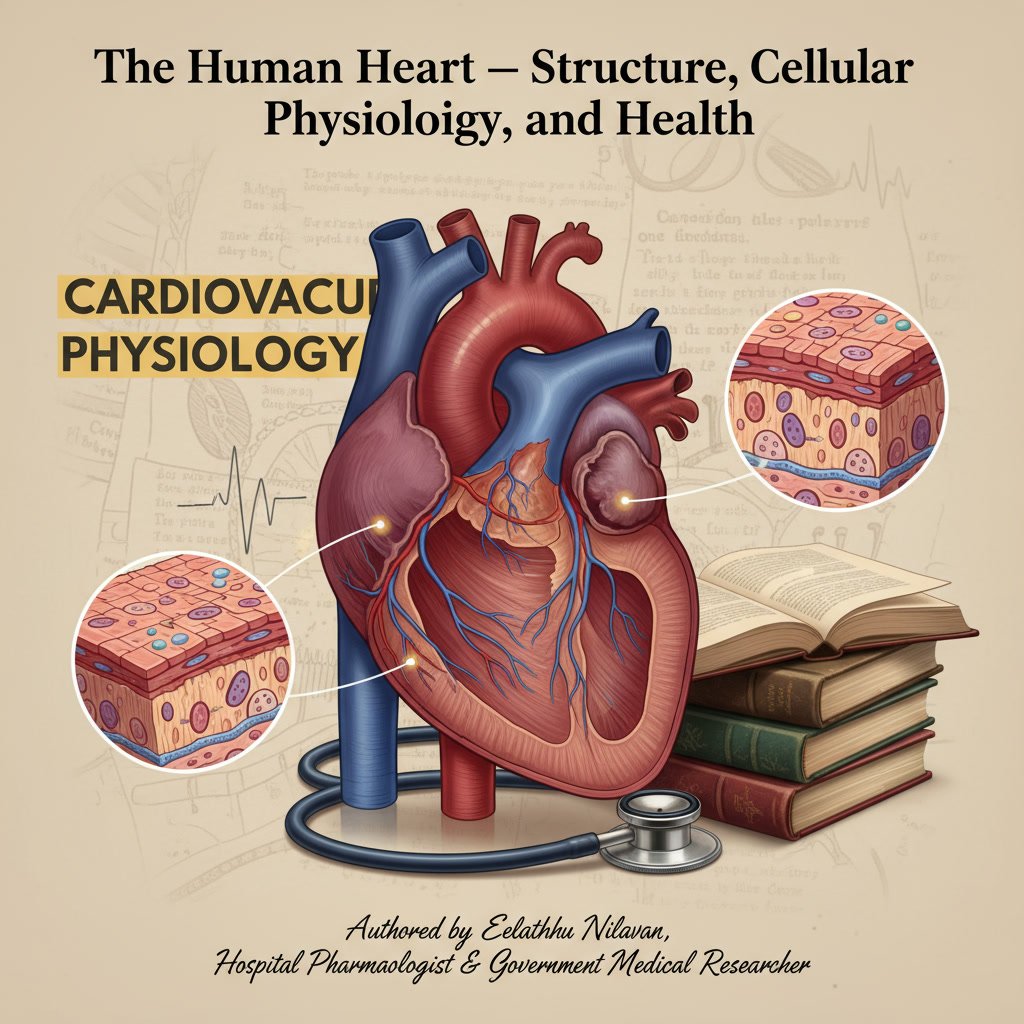
The human heart consists of four chambers — two atria and two ventricles — that work in perfect harmony:
• Right Atrium: Receives deoxygenated blood from the body via the superior and inferior vena cava.
• Right Ventricle: Pumps deoxygenated blood to the lungs through the pulmonary artery.
• Left Atrium: Receives oxygenated blood from the lungs through the pulmonary veins.
• Left Ventricle: The thickest and most powerful chamber, responsible for pumping oxygenated blood to the entire body through the aorta.
The heart wall has three layers:
• Epicardium: The outer protective layer, surrounded by the pericardial sac.
• Myocardium: The muscular middle layer composed of cardiac muscle fibers responsible for contraction.
• Endocardium: The smooth inner lining that reduces friction and houses the heart valves.
Heart Valves and Blood Flow Regulation
There are four main valves that control blood flow and prevent backflow:
• Tricuspid Valve – Between the right atrium and right ventricle.
• Pulmonary Valve – Between the right ventricle and pulmonary artery.
• Mitral (Bicuspid) Valve – Between the left atrium and left ventricle.
• Aortic Valve – Between the left ventricle and aorta.
Each valve opens and closes in perfect timing during the cardiac cycle, maintaining unidirectional blood movement throughout the circulatory system.
Circulatory Pathways
The heart operates within two interconnected circuits:
• Pulmonary Circulation: Carries deoxygenated blood from the right ventricle to the lungs, where gas exchange occurs — carbon dioxide is expelled and oxygen is absorbed. The oxygenated blood then returns to the left atrium.
• Systemic Circulation: Distributes oxygenated blood from the left ventricle to the entire body and returns deoxygenated blood to the right atrium.
This dual circulation system ensures continuous oxygen delivery and efficient removal of metabolic waste.
Electrical Conduction System
The heart’s rhythmic contraction is governed by its intrinsic electrical conduction system, which ensures precise timing between atrial and ventricular contractions:
• Sinoatrial (SA) Node: The natural pacemaker located in the right atrium; initiates electrical impulses at about 70 beats per minute.
• Atrioventricular (AV) Node: Delays the impulse to allow complete filling of the ventricles before contraction.
• Bundle of His and Purkinje Fibers: Conduct the impulses through the ventricles, triggering synchronized contraction.
This electrical coordination enables a steady and efficient heartbeat essential for consistent blood flow.
Cellular Physiology of the Heart (Cardiac Muscle Function)
Cardiac muscle cells, or cardiomyocytes, are unique in their ability to generate and propagate electrical impulses.
• These cells contain a high density of mitochondria, enabling continuous ATP production for contraction.
• Calcium ions (Ca²⁺) play a critical role in contraction and relaxation.
• When electrical impulses arrive, calcium enters the cell, binds to troponin, and triggers the interaction between actin and myosin filaments, resulting in contraction.
• When calcium is pumped back out or stored in the sarcoplasmic reticulum, relaxation (diastole) occurs.
• This excitation–contraction coupling is the foundation of every heartbeat and defines cardiac physiology.
Blood Pressure and Cardiac Output
Blood pressure is the force exerted by circulating blood on the walls of blood vessels. A normal adult blood pressure reading is around 120/80 mmHg, where:
• 120 mmHg (Systolic Pressure): The pressure during ventricular contraction.
• 80 mmHg (Diastolic Pressure): The pressure during relaxation and filling of the heart chambers.
The efficiency of the heart can be quantified by its Cardiac Output (CO):
Cardiac Output = Heart Rate × Stroke Volume
• Heart Rate (HR): Number of heartbeats per minute (≈ 70 bpm).
• Stroke Volume (SV): Volume of blood pumped per beat (≈ 70 mL).
Thus, the average cardiac output is about 4.9 liters per minute in a healthy adult.
Oxygen Transport and Gas Exchange
The primary role of the heart is to facilitate oxygen delivery and carbon dioxide removal:
• In the lungs, hemoglobin in red blood cells binds oxygen, forming oxyhemoglobin.
• The left side of the heart pumps this oxygen-rich blood through the aorta to body tissues.
• Within cells, oxygen is utilized in aerobic respiration to produce ATP, the body’s energy currency.
• Carbon dioxide produced as a byproduct diffuses into the blood and is carried back to the lungs for exhalation.
This continuous cycle of oxygen–carbon dioxide exchange sustains life at the cellular level.
Heart Diseases and Prevention
Common cardiovascular diseases include:
• Coronary Artery Disease (CAD): Narrowing of coronary arteries due to plaque buildup.
• Myocardial Infarction (Heart Attack): Blockage of blood flow to cardiac muscle leading to tissue death.
• Heart Failure: Inability of the heart to pump blood efficiently.
Preventive Measures:
• Maintain a balanced diet low in saturated fats and sodium.
• Engage in regular physical activity (at least 150 minutes per week).
• Avoid smoking and excessive alcohol.
• Manage stress, blood pressure, and cholesterol levels.
• Undergo periodic health screenings to detect risk factors early.
Conclusion:
The human heart is a marvel of biological engineering — a self-regulating organ operating through electrochemical precision and cellular synchronization. Each heartbeat is a testimony to the delicate balance between physiology and life. Understanding its structure and cellular mechanisms is essential not only for medical science but also for preserving heart health through preventive care and lifestyle management. A healthy heart is indeed the foundation of a healthy life.

Written by Eelaththu Nilavan
02/11/2025
