


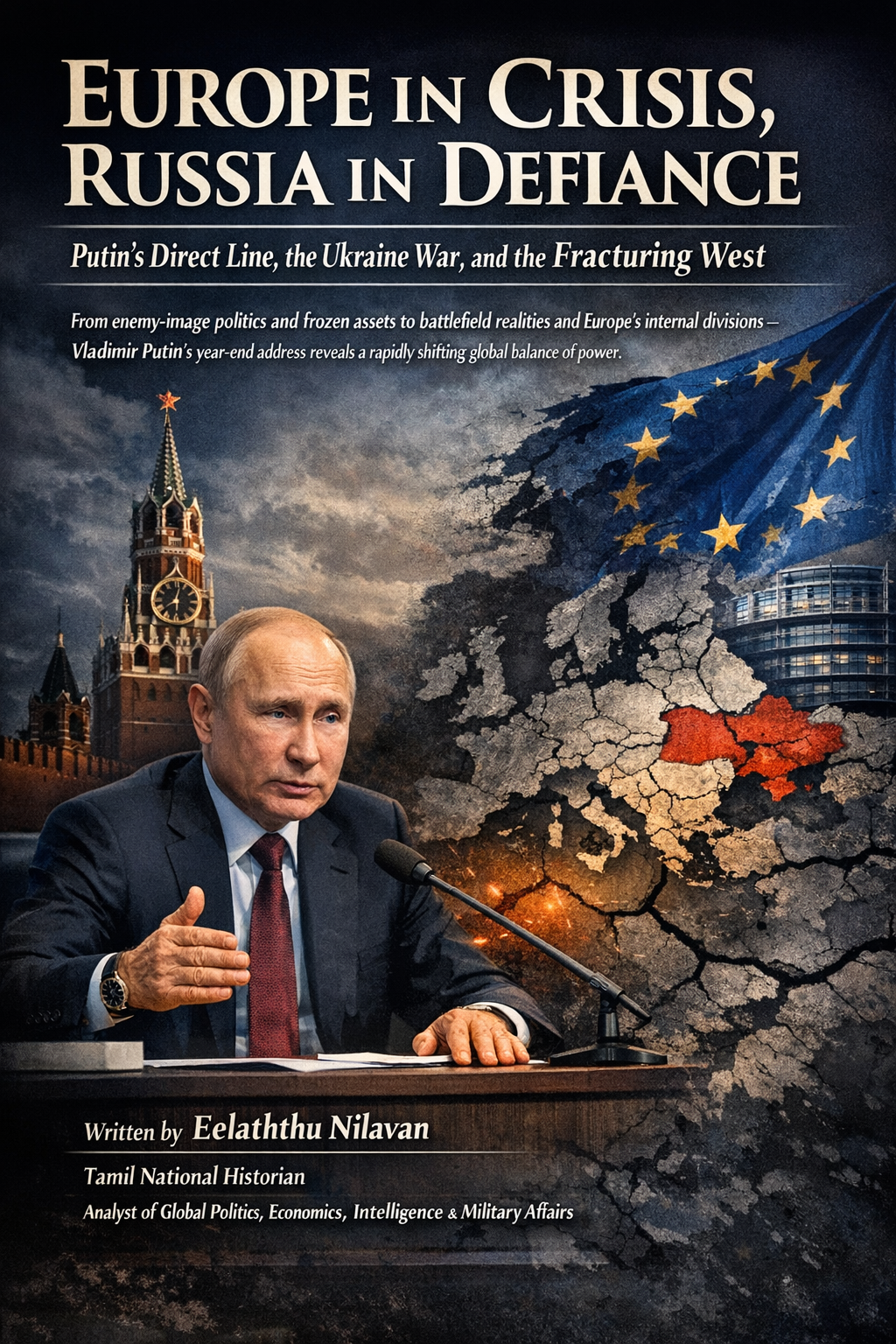
From enemy-image politics and frozen assets to battlefield realities and Europe’s internal divisions, Vladimir Putin’s year-end intervention exposes a rapidly shifting global balance.
𝐀𝐧 “𝐈𝐦𝐚𝐠𝐞 𝐨𝐟 𝐚𝐧 𝐄𝐧𝐞𝐦𝐲”: 𝐏𝐮𝐭𝐢𝐧’𝐬 𝐀𝐭𝐭𝐚𝐜𝐤 𝐨𝐧 𝐄𝐔 𝐄𝐥𝐢𝐭𝐞𝐬

During the annual Results of the Year with Putin and the Putin Direct Line broadcast, Russian President Vladimir Putin launched one of his sharpest critiques yet of European political leadership. According to Putin, European elites have deliberately constructed an exaggerated image of Russia as an existential threat in order to distract their populations from deep-rooted domestic failures.
He accused EU governments of masking years of systemic mismanagement—particularly in energy policy, economic growth, and social welfare—by exploiting fear surrounding the Ukraine war. Putin dismissed claims that Russia plans to attack Europe as “nonsense,” framing such warnings as political theatre designed to justify continued military funding for Kyiv and to maintain public compliance amid economic decline.
𝐏𝐨𝐥𝐢𝐭𝐢𝐜𝐚𝐥 𝐃𝐢𝐬𝐬𝐞𝐧𝐭 𝐚𝐧𝐝 𝐭𝐡𝐞 “𝐅𝐨𝐫𝐞𝐢𝐠𝐧 𝐀𝐠𝐞𝐧𝐭” 𝐃𝐞𝐛𝐚𝐭𝐞
Addressing Western accusations of political repression, Putin defended Russia’s “foreign agent” laws, directly comparing them to legislation in the United States. He claimed that American laws impose criminal liability, whereas Russia’s framework merely requires transparency regarding foreign funding.
Putin insisted that individuals who disengage from political activity or foreign-funded operations face no repression or criminal responsibility. This comparison was clearly aimed at countering the dominant Western narrative portraying Russia as uniquely authoritarian, and at reframing the debate as one of double standards in liberal democracies.
𝐍𝐀𝐓𝐎, 𝐓𝐫𝐮𝐬𝐭, 𝐚𝐧𝐝 𝐭𝐡𝐞 𝐎𝐫𝐢𝐠𝐢𝐧𝐬 𝐨𝐟 𝐂𝐨𝐧𝐟𝐥𝐢𝐜𝐭
On security matters, Putin reiterated long-standing grievances regarding NATO’s eastward expansion, accusing Western leaders of repeatedly deceiving Moscow despite assurances given after the Cold War. He argued that today’s confrontation is not the result of Russian aggression, but of a systematic erosion of trust.
Putin stated that there would be no new special military operations if Russia were treated with respect and if its core security interests were acknowledged. He reaffirmed his position that the Ukraine conflict began with the 2014 overthrow of the Ukrainian government, followed by the abandonment of agreements such as the Minsk and Istanbul accords.
𝐄𝐜𝐨𝐧𝐨𝐦𝐢𝐜 𝐖𝐚𝐫𝐟𝐚𝐫𝐞 𝐚𝐧𝐝 𝐭𝐡𝐞 𝐑𝐢𝐬𝐤 𝐭𝐨 𝐆𝐥𝐨𝐛𝐚𝐥 𝐅𝐢𝐧𝐚𝐧𝐜𝐞
One of the most consequential warnings in Putin’s address concerned European attempts to seize frozen Russian sovereign assets to finance Ukraine. He described the proposal not as theft, but as “robbery carried out openly”, warning of severe long-term consequences had it been implemented.
According to Putin, such actions undermine the foundational trust of the global financial system, particularly the credibility of the Eurozone. He suggested that resource-rich nations, especially oil-producing states, are closely watching Europe’s actions and reassessing the safety of their reserves held in Western institutions.
Putin compared fiscal indicators to strengthen his argument, noting Russia’s public debt stands at 17.7%, while France’s exceeds 120%, and emphasizing Russia’s relatively controlled budget deficit. He warned that if assets can be seized today over Ukraine, similar justifications could be used tomorrow over ideological or cultural disagreements.
𝐁𝐚𝐭𝐭𝐥𝐞𝐟𝐢𝐞𝐥𝐝 𝐑𝐞𝐚𝐥𝐢𝐭𝐢𝐞𝐬 𝐚𝐧𝐝 𝐭𝐡𝐞 𝐙𝐞𝐥𝐞𝐧𝐬𝐤𝐲 𝐂𝐨𝐧𝐭𝐫𝐨𝐯𝐞𝐫𝐬𝐲
Putin also mocked Ukrainian President Volodymyr Zelensky’s recent frontline appearance near Kupyansk, calling him a “talented actor” and dismissing the footage as staged propaganda. He questioned why Zelensky filmed at an obelisk outside the city rather than entering it, if Ukrainian forces indeed controlled the area.
According to Russian claims, the region is saturated with UAVs from both sides, making such movements extremely dangerous. Putin asserted that Ukrainian forces have suffered heavy losses and depleted strategic reserves, leaving Kyiv with diminishing leverage despite continued Western military aid.
𝐄𝐮𝐫𝐨𝐩𝐞’𝐬 𝐃𝐢𝐯𝐢𝐬𝐢𝐨𝐧𝐬 𝐚𝐧𝐝 𝐌𝐚𝐜𝐫𝐨𝐧’𝐬 𝐃𝐢𝐩𝐥𝐨𝐦𝐚𝐭𝐢𝐜 𝐒𝐢𝐠𝐧𝐚𝐥
The broader European context reveals growing fractures within the EU. At a recent Brussels summit, member states failed to approve a €140 billion plan using frozen Russian assets, settling instead for a €90 billion loan for Ukraine covering 2026–2027.
French President Emmanuel Macron subsequently called for Europe to re-engage in dialogue with Vladimir Putin, arguing that a framework for talks is in the interest of both Europeans and Ukrainians. His remarks signaled a potential shift after intense internal disagreements, with countries such as Hungary, Slovakia, and the Czech Republic expressing legal and financial concerns.
Macron’s earlier proposal of deploying “reassurance forces” in Ukraine—positioned as deterrence rather than combat—remains controversial and highlights the absence of a unified European strategy.
𝐓𝐨𝐰𝐚𝐫𝐝 𝐍𝐞𝐠𝐨𝐭𝐢𝐚𝐭𝐢𝐨𝐧𝐬 𝐨𝐫 𝐅𝐮𝐫𝐭𝐡𝐞𝐫 𝐄𝐬𝐜𝐚𝐥𝐚𝐭𝐢𝐨𝐧?
Putin concluded by stating that Russia is prepared to stop fighting immediately if its long-term security is guaranteed. However, he expressed skepticism regarding Kyiv’s readiness for genuine peace talks, citing past betrayals and external influence.
As global power balances shift, with Russia highlighting its position as the fourth-largest economy by GDP (PPP) and Europe struggling with unity, the Ukraine war increasingly appears not only as a regional conflict, but as a decisive test of Western political coherence, economic credibility, and strategic endurance.
What emerges from Putin’s intervention is a clear message: the era of uncontested Western narrative dominance is over, and the costs of prolonging confrontation—financial, political, and systemic—may soon outweigh the benefits.
Written by

Tamil National Historian | Analyst of Global Politics, Economics, Intelligence & Military Affairs
19/12/2025
