


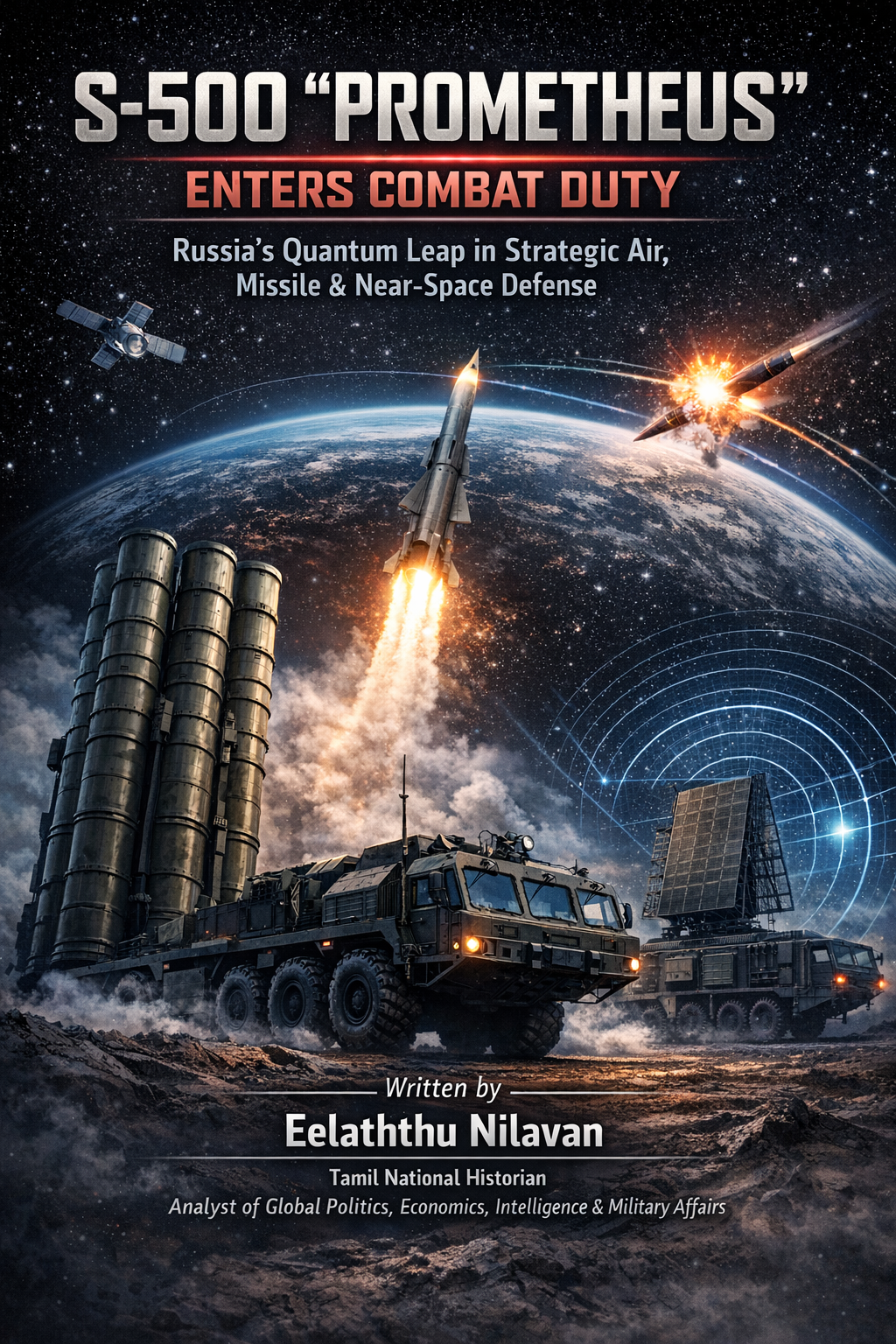
𝐀 𝐐𝐮𝐚𝐧𝐭𝐮𝐦 𝐋𝐞𝐚𝐩 𝐢𝐧 𝐒𝐭𝐫𝐚𝐭𝐞𝐠𝐢𝐜 𝐀𝐢𝐫, 𝐌𝐢𝐬𝐬𝐢𝐥𝐞 & 𝐍𝐞𝐚𝐫-𝐒𝐩𝐚𝐜𝐞 𝐃𝐞𝐟𝐞𝐧𝐬𝐞
Russia has officially placed its first S-500 “Prometheus” air and missile defense regiment on combat duty, marking one of the most consequential developments in global strategic defense in recent decades. Confirmed by Defense Minister Andrey Belousov, the deployment represents not merely an upgrade to existing systems, but the birth of a new defensive doctrine—one that fuses air defense, missile defense, and near-space warfare into a single integrated architecture.

The S-500 is not an incremental successor to the S-400; rather, it is a strategic system designed to reshape the balance of deterrence, especially amid intensifying NATO-Russia confrontation.
𝐅𝐫𝐨𝐦 𝐓𝐞𝐬𝐭 𝐑𝐚𝐧𝐠𝐞 𝐭𝐨 𝐂𝐨𝐦𝐛𝐚𝐭 𝐑𝐞𝐚𝐝𝐢𝐧𝐞𝐬𝐬
𝐀 𝐃𝐞𝐜𝐚𝐝𝐞-𝐋𝐨𝐧𝐠 𝐆𝐞𝐬𝐭𝐚𝐭𝐢𝐨𝐧 𝐂𝐮𝐥𝐦𝐢𝐧𝐚𝐭𝐞𝐬
Initial S-500 components were delivered as early as 2021 to the Kapustin Yar test range, where extensive trials focused on high-velocity ballistic interception and near-space tracking. After years of delays, refinement, and doctrinal restructuring, the Russian Ministry of Defense announced on December 17, 2025, that the first full regiment is now operational.
Crucially, this is not a symbolic deployment. The S-500 regiment forms the core of a dedicated air and missile defense division, underscoring Moscow’s intent to operationalize the system as a strategic shield, not merely a technological demonstration.
𝐓𝐞𝐜𝐡𝐧𝐨𝐥𝐨𝐠𝐢𝐜𝐚𝐥 𝐂𝐨𝐫𝐞 𝐨𝐟 𝐭𝐡𝐞 𝐒-𝟓𝟎𝟎
𝐖𝐡𝐞𝐫𝐞 𝐀𝐢𝐫 𝐃𝐞𝐟𝐞𝐧𝐬𝐞 𝐌𝐞𝐞𝐭𝐬 𝐒𝐩𝐚𝐜𝐞 𝐖𝐚𝐫𝐟𝐚𝐫𝐞
The defining strength of the S-500 lies in its interceptor family—77N6-N and 77N6-N1—which reportedly reach velocities of up to 5,500 meters per second within seconds. These speeds place the system firmly within the realm of hypersonic engagement.
Key Technical Attributes
• Engagement Envelope:
• Estimated range of 500–600 km
• Engagement altitude exceeding 100 km, extending into near-space
• Target Spectrum:
• Medium-range and intercontinental ballistic missile warheads
• Hypersonic glide vehicles
• Strategic aircraft and airborne command posts
• Low-orbit satellites
• Hit-to-Kill Technology:
The S-500 employs kinetic interceptors, destroying targets through direct impact rather than explosive fragmentation—significantly increasing lethality against hardened re-entry vehicles.
This capability places the S-500 in a very limited global category, rivaled only by experimental or highly specialized systems.
𝐍𝐞𝐚𝐫-𝐒𝐩𝐚𝐜𝐞 𝐃𝐞𝐟𝐞𝐧𝐬𝐞: 𝐓𝐡𝐞 𝐍𝐞𝐰 𝐅𝐫𝐨𝐧𝐭𝐢𝐞𝐫
𝐁𝐥𝐮𝐫𝐫𝐢𝐧𝐠 𝐭𝐡𝐞 𝐋𝐢𝐧𝐞 𝐁𝐞𝐭𝐰𝐞𝐞𝐧 𝐀𝐢𝐫 & 𝐎𝐫𝐛𝐢𝐭
One of the most disruptive aspects of the S-500 is its ability to engage targets in near space. This directly challenges NATO’s growing dependence on:
• Early-warning satellites
• Space-based communications
• Orbital reconnaissance assets
While not a dedicated anti-satellite weapon, the S-500 introduces credible space denial potential, complicating adversary planning and increasing the survivability of Russia’s nuclear command-and-control infrastructure.
𝐈𝐧𝐭𝐞𝐠𝐫𝐚𝐭𝐢𝐨𝐧 𝐰𝐢𝐭𝐡 𝐀-𝟏𝟑𝟓: 𝐓𝐡𝐞 𝐌𝐨𝐬𝐜𝐨𝐰 𝐒𝐡𝐢𝐞𝐥𝐝
𝐀 𝐌𝐮𝐥𝐭𝐢-𝐋𝐚𝐲𝐞𝐫𝐞𝐝 𝐅𝐨𝐫𝐭𝐫𝐞𝐬𝐬
The S-500’s immediate strategic role is its integration with the A-135 “Amur” missile defense system, which protects Moscow. Together with:
• S-400 (long-range air defense)
• S-350 and Pantsir systems (short-range protection)
Russia is constructing a layered defensive dome, capable of intercepting threats across:
• Low altitude
• High altitude
• Hypersonic trajectories
• Ballistic re-entry paths
This architecture significantly raises the threshold for any decapitation or first-strike scenario.
𝐒-𝟓𝟎𝟎 𝐯𝐬 𝐖𝐞𝐬𝐭𝐞𝐫𝐧 𝐒𝐲𝐬𝐭𝐞𝐦𝐬
𝐀 𝐃𝐨𝐜𝐭𝐫𝐢𝐧𝐚𝐥 𝐃𝐢𝐯𝐞𝐫𝐠𝐞𝐧𝐜𝐞
Unlike Western systems that specialize in narrow mission sets:
• THAAD: Terminal-phase ballistic missile interception
• Aegis BMD: Naval and space-linked missile defense
The S-500 attempts a doctrinal synthesis—combining long-range air defense, terminal ballistic defense, and near-space interception within a mobile land-based platform.
This makes it less flexible in deployment volume, but far more strategic in defensive depth.
𝐋𝐢𝐦𝐢𝐭𝐚𝐭𝐢𝐨𝐧𝐬 & 𝐑𝐞𝐚𝐥𝐢𝐭𝐢𝐞𝐬
𝐏𝐨𝐰𝐞𝐫𝐟𝐮𝐥, 𝐁𝐮𝐭 𝐍𝐨𝐭 𝐌𝐚𝐬𝐬-𝐃𝐞𝐩𝐥𝐨𝐲𝐚𝐛𝐥𝐞
Despite its capabilities, analysts caution:
• Production rates remain limited
• The system is too costly and complex for widespread deployment
• It relies on layered protection from S-400 and short-range systems
Thus, the S-500 should be viewed not as a universal shield, but as a strategic guardian of Russia’s most critical assets.
𝐆𝐞𝐨𝐩𝐨𝐥𝐢𝐭𝐢𝐜𝐚𝐥 𝐈𝐦𝐩𝐚𝐜𝐭
𝐀 𝐂𝐚𝐥𝐜𝐮𝐥𝐚𝐭𝐞𝐝 𝐒𝐢𝐠𝐧𝐚𝐥 𝐭𝐨 𝐍𝐀𝐓𝐎
The operational deployment of the S-500 sends a clear message:
• Russia is preparing for high-end conflict scenarios
• Hypersonic weapons are no longer uncontested
• Strategic depth, not expeditionary warfare, is Moscow’s priority
In an era where deterrence increasingly hinges on speed, altitude, and space, the S-500 represents a reassertion of Russian strategic autonomy.
𝐂𝐨𝐧𝐜𝐥𝐮𝐬𝐢𝐨𝐧
𝐓𝐡𝐞 𝐒-𝟓𝟎𝟎 𝐚𝐬 𝐚 𝐏𝐢𝐥𝐥𝐚𝐫 𝐨𝐟 𝐍𝐞𝐰-𝐀𝐠𝐞 𝐃𝐞𝐭𝐞𝐫𝐫𝐞𝐧𝐜𝐞
The S-500 “Prometheus” is not merely an air defense system—it is a strategic statement. By bridging air, missile, and near-space defense, Russia has entered a domain where few nations can follow.
While its ultimate effectiveness will depend on scale, integration, and combat testing, its deployment alone reshapes threat calculations, reinforcing Russia’s position as a central actor in the evolving architecture of global military power.
Written byEelaththu Nilavan
Tamil National Historian | Analyst of Global Politics, Economics, Intelligence & Military Affairs
20/12/2025
