


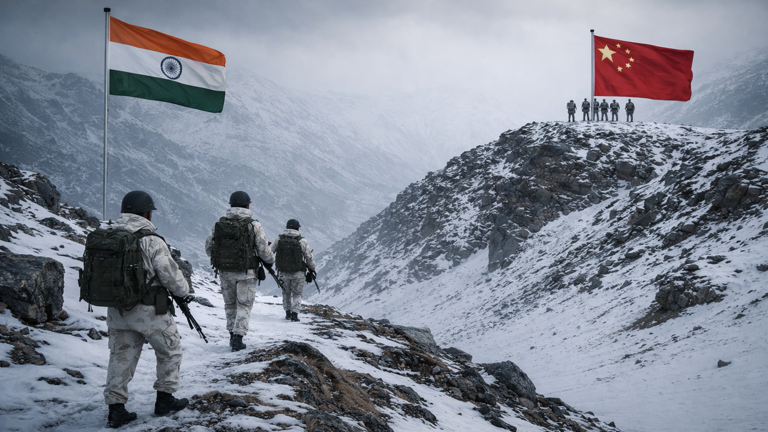

Tensions between China and India have resurfaced along the Himalayan frontier, as new reports and diplomatic exchanges highlight renewed unease over military positioning, infrastructure development, and shifting geopolitical alignments in the Indo‑Pacific region.
According to recent assessments referenced in U.S. government reporting, China is attempting to leverage a period of reduced friction along the Line of Actual Control (LAC) to stabilize relations with India while simultaneously curbing New Delhi’s growing strategic alignment with the United States. The reports suggest that Beijing views disengagement from remaining standoff points as an opportunity to reset ties after years of strained relations following the deadly 2020 border clash.
However, Indian officials and analysts remain cautious. Despite incremental steps toward normalization—such as the resumption of tourist visas and direct flights—New Delhi reportedly harbors skepticism about China’s long‑term intentions, particularly regarding military infrastructure expansion and Beijing’s deepening defense cooperation with Pakistan.
U.S. Report Sparks Diplomatic Back‑and‑Forth
The latest U.S. Department of War assessment has drawn sharp criticism from Beijing. Chinese Foreign Ministry spokesperson Lin Jian dismissed the report as misleading and accused Washington of attempting to sow discord between China and India while justifying its own military posture in the region. China maintains that its relationship with India is “stable” and that border management mechanisms remain functional.
India has not issued a formal response to the U.S. report, but officials familiar with the matter note that New Delhi continues to monitor Chinese activities along the frontier closely, particularly infrastructure developments that could alter the tactical balance.
Infrastructure Race in the Himalayas
A recent analysis highlighted by Indian media underscores the long‑standing asymmetry in border infrastructure between the two nations. China has spent decades building extensive road and rail networks along the frontier, while India has only accelerated its own construction efforts in recent years. The 2020 clash exposed vulnerabilities in India’s logistical preparedness, prompting a surge in road‑building and military modernization initiatives.
Experts warn that while both sides have engaged in phased disengagement, the underlying strategic competition remains unresolved. “The risk lies not in immediate conflict but in the structural mistrust that continues to shape both countries’ calculations,” one analyst noted.
Geopolitical Ripples Beyond the Border
The resurfacing tensions come at a time when broader regional dynamics are shifting. India’s participation in the Quad—alongside the U.S., Japan, and Australia—has been a focal point of Indo‑Pacific strategy. Yet recent diplomatic developments suggest a recalibration, with India and China both exploring avenues to reduce friction even as Washington and Beijing remain locked in strategic rivalry.
Analysts say that China’s outreach to India may be part of a broader effort to prevent New Delhi from deepening its security cooperation with the United States. Meanwhile, India continues to balance its relationships, seeking stability along its northern frontier while maintaining strategic autonomy.
Outlook: Cautious Engagement, Persistent Suspicion
Despite diplomatic overtures, the situation along the LAC remains fragile. Both nations have maintained significant troop deployments, and confidence‑building measures have yet to fully restore trust.
With winter setting in across the high-altitude border zones, immediate escalation appears unlikely. However, the long-term trajectory of China–India relations will depend on whether both sides can translate tactical disengagement into durable political understanding.
For now, the tensions—though muted—have undeniably resurfaced.
