


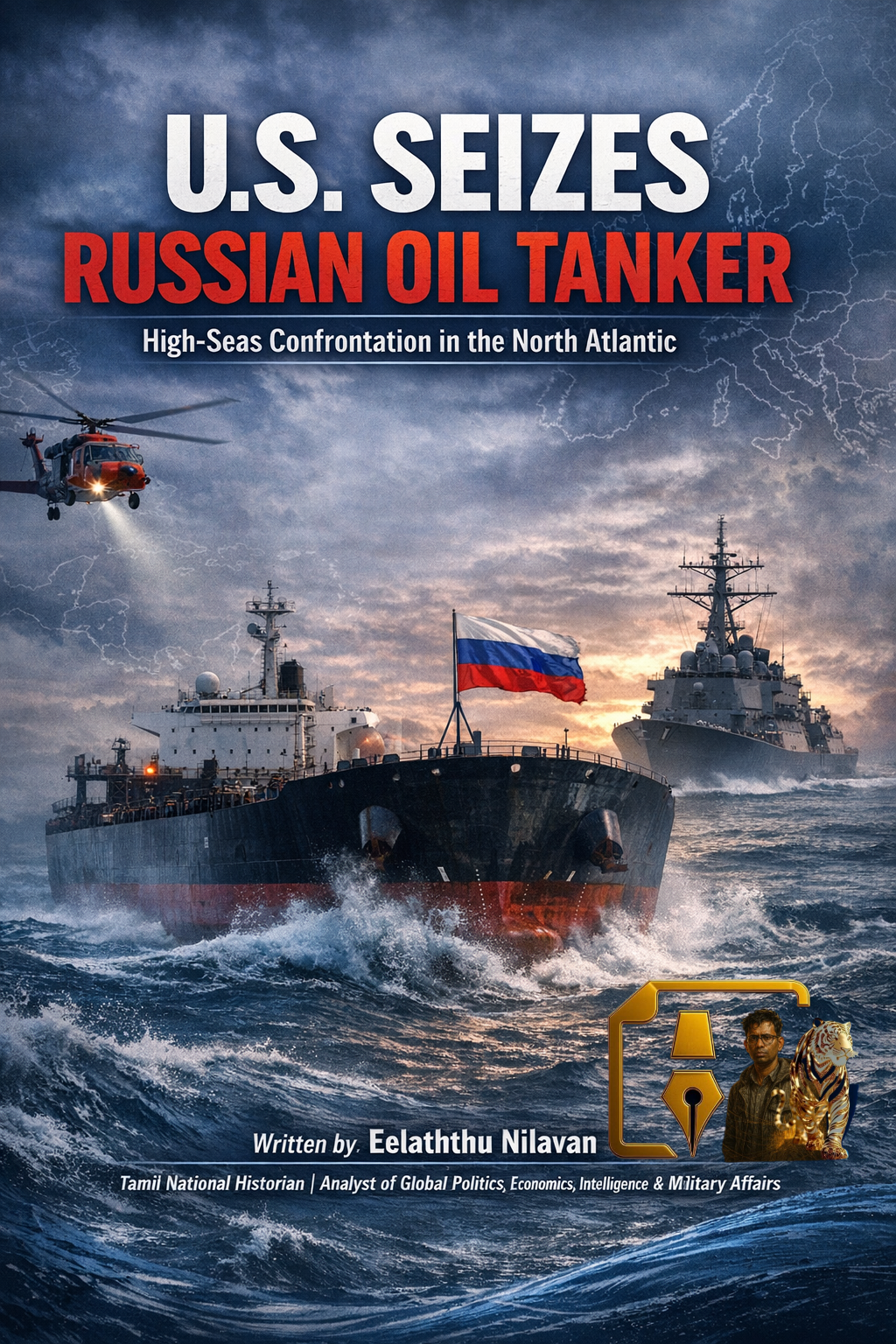
✦ The Incident: Marinera Captured in International Waters
The United States has escalated tensions with Russia by seizing the Russian-flagged oil tanker Marinera (formerly Bella 1) in the North Atlantic. The operation, led by the U.S. Department of Homeland Security with military support, followed a weeks-long pursuit that began off the coast of Venezuela.
The vessel, previously linked to sanctioned oil shipments for the Maduro regime, had attempted to evade U.S. enforcement by repainting a Russian flag and re-registering mid-voyage. This sudden maneuver complicates international maritime law, as Russia claims the vessel was operating legally in international waters, labeling the U.S. action as “piracy dressed up as sanctions enforcement.”


High-Seas Pursuit and Military Escalation
• Initial Confrontation: U.S. forces attempted to board the tanker near the Caribbean, but the crew resisted.
• Atlantic Escalation: As the ship entered the North Atlantic, U.S. warships, helicopters, and NATO air surveillance intensified the pursuit.
• European Involvement: NATO aircraft trailed the vessel while EU states provided airspace access and operational support. The UK Ministry of Defence confirmed its role, noting that no UK personnel boarded the ship.
This marks a rare combination of legal authority, military power, and international coordination to enforce sanctions at sea.
✦ Russian Reaction and Global Implications
Moscow has condemned the seizure, arguing it violates international maritime law. Russian naval assets, including a submarine and warships, were dispatched to protect the vessel.
Analysts warn that this confrontation could escalate beyond a single tanker, potentially impacting energy flows, maritime jurisdiction, and international sanctions enforcement. The incident coincides with ongoing fragile Ukraine peace talks, raising concerns about broader geopolitical consequences.
✦ The Shadow Fleet: Sanctions Evasion at Sea
The Marinera is part of a growing “shadow fleet” used to transport oil for sanctioned states such as Venezuela, Russia, and Iran. U.S. authorities report:
• Over 12% of the global tanker fleet operates outside traditional oversight.
• At least 17 vessels reflagged under Russia in December 2025 alone to evade U.S. seizure.
• Environmental and legal risks are rising due to these unregulated operations.
The U.S. crackdown aims to disrupt illicit oil transport and weaken Russia’s control over its shadow fleet, but the trend of vessels switching flags to Russia is strengthening Moscow’s leverage over these operations.
✦ U.S. Military and Legal Operations
• The Coast Guard, Justice Department, and Department of Homeland Security coordinated the operation.
• Infrared footage shows U.S. helicopters boarding vessels in international waters, marking a non-violent enforcement approach.
• Simultaneously, the U.S. Southern Command captured the Panama-flagged supertanker M/T Sophia in the Caribbean, also linked to Venezuelan oil transfers.
These actions demonstrate Washington’s willingness to combine legal authority with military power to enforce sanctions, even far from U.S. territorial waters.
✦ Economic Stakes: Oil and Energy Control
President Trump announced that Venezuela’s interim authorities would supply the U.S. with 30–50 million barrels of high-quality oil, with revenue under direct U.S. oversight. Meetings with major energy corporations — Exxon, Chevron, ConocoPhillips — are being planned to shape the future of Venezuelan oil production.
Experts warn, however, that shadow fleet operations without insurance or regulatory oversight increase the risks of environmental disasters and legal disputes over oil spills.
✦ Strategic Implications and Global Risks
• Maritime Tensions: The confrontation highlights the increasing militarization of sanctions enforcement at sea.
• Russian Shadow Fleet: Moscow’s shadow fleet is expanding, with more than 40 vessels joining Russia’s registry since mid-2025.
• Geopolitical Strain: The seizure occurs amid fragile Ukraine peace talks and growing U.S.–Russia competition in global energy markets.
• Legal Precedent: The operation could set a precedent for enforcing sanctions in international waters, blurring lines between national security and maritime sovereignty.
✦ European Role: Support Without Engagement
The UK Ministry of Defence confirmed:
• The RFA Tide Force and RAF assets provided airborne surveillance.
• UK personnel did not participate in boarding operations, adhering to international law.
• Strategic goals included enforcing counter-Iran sanctions, tackling shadow fleet activity, and enhancing homeland security.
This demonstrates multilateral coordination in sanctions enforcement while avoiding direct engagement in combat.
✦ Looking Ahead: Escalation or Containment?
The Marinera incident signals a new phase in maritime sanctions enforcement:
• Direct U.S.–Russia confrontation at sea is now plausible.
• Shadow fleet tactics will continue to evolve, with more vessels reflagging under Russia.
• Energy markets may experience disruptions if further seizures occur.
• International law debates will intensify regarding sovereignty and forced boarding.
Analysts suggest close monitoring of these vessels, as the high-seas standoff could shape global energy policy, military strategy, and diplomatic negotiations in 2026.
Conclusion:
The seizure of Marinera underscores the growing intersection of maritime security, sanctions enforcement, and geopolitical rivalry. While the operation is legally justified under U.S. authority, it has created a tense standoff with Russia and highlights the rising influence of shadow fleets in global oil trade. The incident sets a precedent for direct military action on the high seas to enforce economic sanctions, with potential consequences for global diplomacy, energy markets, and maritime law.

╭────────────────────╮
Written by Eelaththu Nilavan
╰────────────────────╯
08/01/2026
