


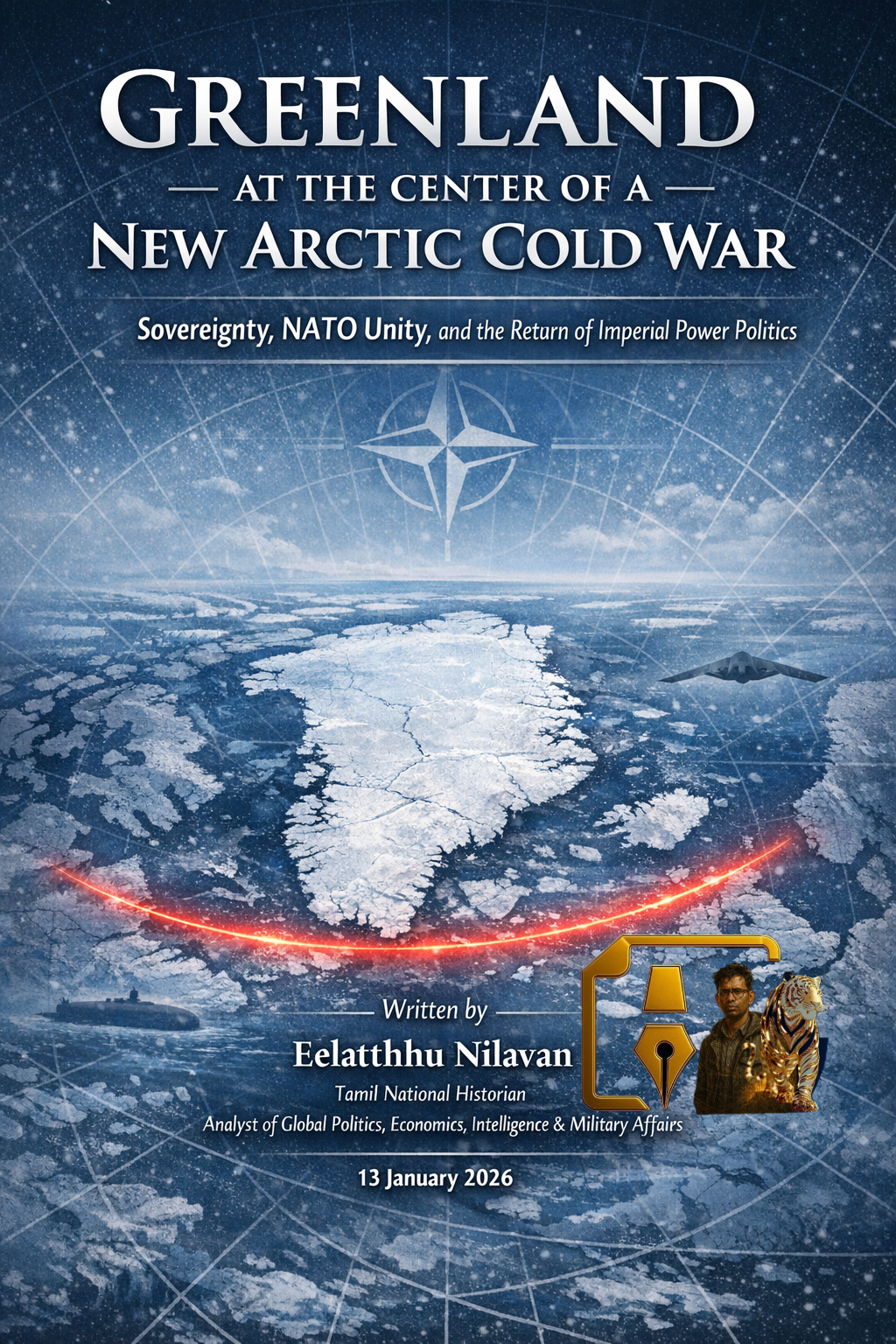
Sovereignty, NATO Unity, and the Return of Imperial Power Politics
✦. 𝐆𝐫𝐞𝐞𝐧𝐥𝐚𝐧𝐝 𝐒𝐩𝐞𝐚𝐤𝐬: “𝐖𝐞 𝐀𝐫𝐞 𝐍𝐨𝐭 𝐅𝐨𝐫 𝐒𝐚𝐥𝐞.”
Greenland has moved from the margins of world politics to its very center.
In a rare and unequivocal assertion of sovereignty, Greenland’s Prime Minister Jens-Frederik Nielsen, standing alongside Danish Prime Minister Mette Frederiksen, firmly rejected renewed American interest in acquiring the Arctic island. Speaking ahead of a critical Washington meeting, Nielsen declared:

“Greenland will not be owned by the United States… we choose the Greenland we know today.”
This statement was not symbolic rhetoric—it was a direct response to mounting geopolitical pressure, particularly after U.S. President Donald Trump once again publicly floated the idea of acquiring Greenland, framing it as a “strategic necessity.”
Frederiksen reinforced this stance, acknowledging that resisting pressure from a superpower has not been easy, but stressed that Denmark and Greenland remain united, committed to dialogue—but not submission.
✦. 𝐒𝐨𝐯𝐞𝐫𝐞𝐢𝐠𝐧𝐭𝐲 𝐚𝐧𝐝 𝐀𝐥𝐥𝐢𝐚𝐧𝐜𝐞: 𝐆𝐫𝐞𝐞𝐧𝐥𝐚𝐧𝐝’𝐬 𝐂𝐡𝐨𝐢𝐜𝐞
The message from Nuuk and Copenhagen is consistent and unmistakable:
**❖ Greenland is not for sale.
❖ Greenland will not be owned or governed by the United States.
❖ Greenland remains part of the Kingdom of Denmark.**
Crucially, Greenland’s leadership reaffirmed its alignment with Denmark, NATO, and the European Union, rejecting narratives that frame the island as a geopolitical orphan or strategic vacuum.
Rather than rejecting cooperation outright, Greenland emphasized a clear distinction:
Security cooperation is welcome.
Ownership and coercion are not.
NATO, Greenland’s leaders insist, must defend the island as it would any other flank of the alliance, against threats from Russia or China—without violating sovereignty.
✦. 𝐓𝐫𝐮𝐦𝐩, 𝐓𝐡𝐞 “𝐃𝐨𝐧𝐫𝐨𝐞 𝐃𝐨𝐜𝐭𝐫𝐢𝐧𝐞,” 𝐚𝐧𝐝 𝐀𝐦𝐞𝐫𝐢𝐜𝐚’𝐬 𝐄𝐱𝐩𝐚𝐧𝐝𝐢𝐧𝐠 𝐒𝐩𝐡𝐞𝐫𝐞
At the heart of the crisis lies a profound shift in U.S. strategic thinking.
Under what analysts describe as the “Donroe Doctrine”—an aggressive expansion of the Monroe Doctrine—the United States is asserting dominance over a vast zone stretching:
From Alaska and the Arctic
to Antarctica and the Southern Ocean
Greenland, under this framework, is no longer viewed merely as a NATO partner’s territory—but as a non-negotiable strategic asset.
Washington’s motivations are clear:

Strategic Geography
Greenland sits directly beneath the projected flight paths of Russian nuclear missiles and anchors the GIUK Gap, a vital naval chokepoint for tracking Russian submarines.
Rare Earth Resources
Greenland hosts massive rare-earth deposits, particularly at Tanbreez, critical for electronics, missiles, and advanced weapons—resources currently dominated by China.
Future Arctic Shipping
Melting ice is opening new Asia-Europe shipping routes. Control of Greenland means leverage over global trade corridors.
What alarms allies is not the analysis, but the refusal to rule out unilateral action.
✦ 𝐍𝐀𝐓𝐎 𝐨𝐧 𝐭𝐡𝐞 𝐄𝐝𝐠𝐞: 𝐀𝐫𝐭𝐢𝐜 𝐃𝐞𝐟𝐞𝐧𝐬𝐞 𝐨𝐫 𝐀𝐥𝐥𝐢𝐚𝐧𝐜𝐞 𝐂𝐨𝐥𝐥𝐚𝐩𝐬𝐞?
Denmark has issued its most severe warning in NATO’s history:
A forced U.S. takeover of Greenland would end NATO.
The reason is existential.
NATO’s foundation rests on Article 5—an attack on one is an attack on all.
If the United States were to take military action against Danish territory, NATO would face the impossible scenario of one member attacking another.
This would not merely fracture NATO—it would invalidate its legal and moral core.
Despite this, European nations face a dilemma:
• Heavy dependence on U.S. intelligence and military technology
• Limited capacity to impose consequences on Washington
The alliance is united—yet fragile.
✦. 𝐑𝐮𝐬𝐬𝐢𝐚 𝐄𝐧𝐭𝐞𝐫𝐬 𝐭𝐡𝐞 𝐒𝐭𝐚𝐠𝐞: 𝐌𝐞𝐝𝐯𝐞𝐝𝐞𝐯’𝐬 𝐒𝐚𝐫𝐜𝐚𝐬𝐭𝐢𝐜 𝐂𝐡𝐚𝐥𝐥𝐞𝐧𝐠𝐞
Into this tension stepped Dmitry Medvedev, Russia’s Deputy Security Council Chairman.
Mocking Trump’s renewed interest, Medvedev sarcastically suggested that Greenland’s 55,000 residents could instead vote to join Russia, instantly ending Washington’s ambitions.
While framed as irony, the message was strategic:
• The Arctic is not America’s playground
• Treating nations as real estate reflects imperial thinking
• Western anxiety over resources and shipping routes is driving instability
The Kremlin’s rhetoric underscores a broader truth:
Greenland has become a symbolic battlefield in a larger contest over global order.
✦ 𝐓𝐡𝐞 𝐍𝐮𝐜𝐥𝐞𝐚𝐫 𝐆𝐡𝐨𝐬𝐭 𝐨𝐟 𝟏𝟗𝟔𝟖
Adding moral weight to Greenland’s resistance is a dark Cold War legacy.
In 1968, a U.S. B-52 bomber carrying nuclear weapons crashed onto Greenland’s ice during Operation Chrome Dome, dispersing plutonium. Historical records indicate that one nuclear component was never recovered.
Key implications:
• Greenland never consented to nuclear deployment
• Danish bans were bypassed
• Environmental consequences remain unresolved
For many Greenlanders, U.S. interest in the island is not security—it is unfinished nuclear history.
✦ 𝐍𝐀𝐓𝐎’𝐬 𝐂𝐚𝐫𝐞𝐟𝐮𝐥 𝐃𝐚𝐧𝐜𝐞
As tensions rose, NATO leaders attempted damage control.
• Secretary General Mark Rutte dismissed claims of crisis, emphasizing Arctic defense coordination.
• He credited Trump with pushing higher defense spending while avoiding sovereignty questions.
• Croatian PM Andrej Plenković did what NATO leadership could not—clearly reaffirming that Greenland belongs to Denmark.
Meanwhile, Denmark is reinforcing its defenses:
• F-35 fighter jets
• P-8 maritime patrol aircraft
• Long-range drones for Arctic surveillance
Unity is projected—but unease is visible.
✦ 𝐂𝐨𝐧𝐜𝐥𝐮𝐬𝐢𝐨𝐧: 𝐀 𝐓𝐞𝐬𝐭 𝐨𝐟 𝐭𝐡𝐞 𝐏𝐨𝐬𝐭-𝐖𝐚𝐫 𝐎𝐫𝐝𝐞𝐫
Greenland is no longer a remote Arctic landmass.
It is a mirror reflecting the world’s shifting power structure.
At stake are fundamental questions:
• Does sovereignty still matter?
• Can alliances survive internal coercion?
• Is international law giving way to “might makes right”?
Greenland’s people have offered a simple answer:
“We are a people, not a product.”
Whether the world respects that answer may define the future of NATO—and the global order itself.

Written by: Eelaththu Nilavan
Tamil National Historian | Analyst of Global Politics, Economics, Intelligence & Military Affairs
