


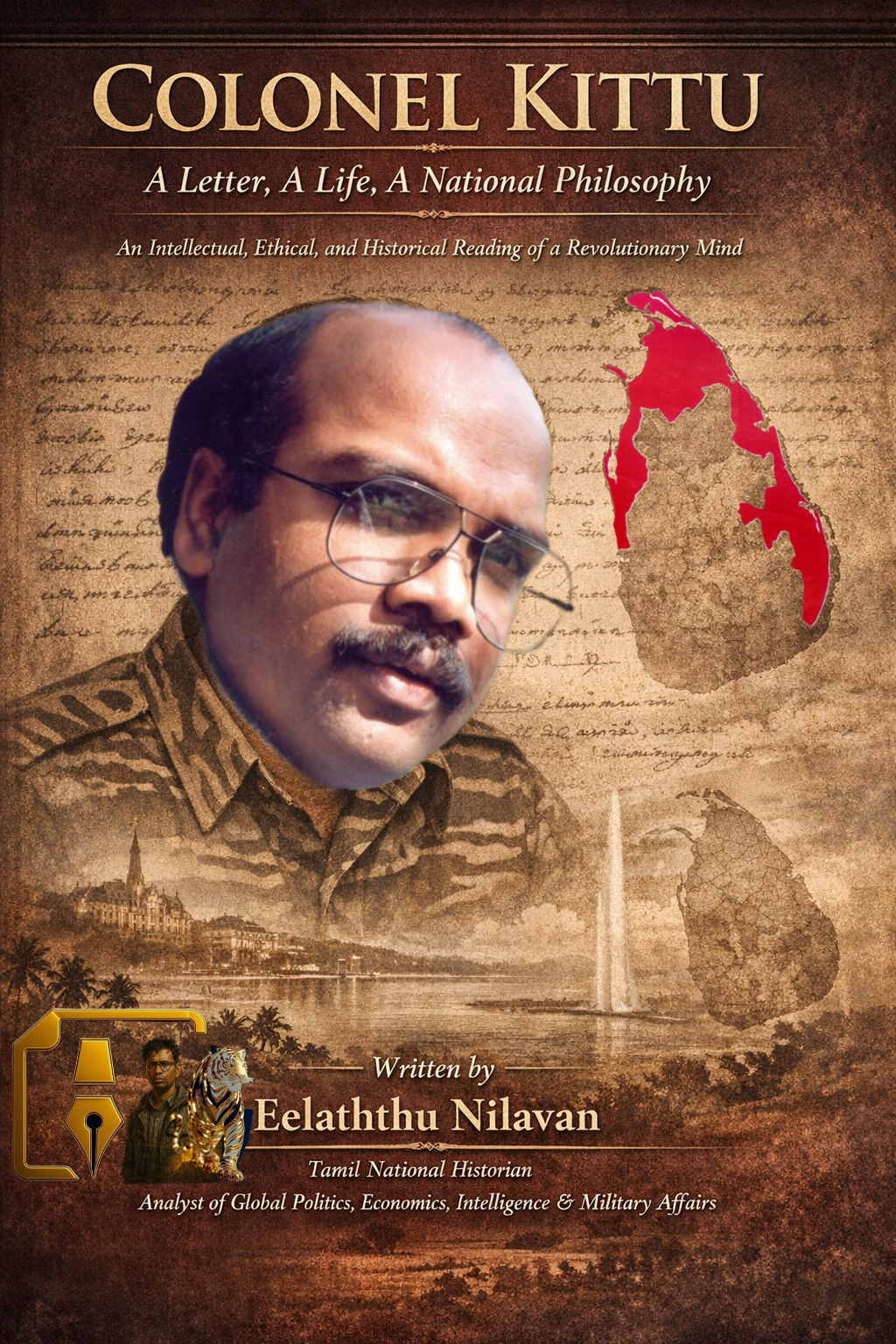
An Intellectual, Ethical, and Historical Reading of a Revolutionary Mind
✦ 𝐈𝐧𝐭𝐫𝐨𝐝𝐮𝐜𝐭𝐢𝐨𝐧: 𝐀 𝐋𝐞𝐭𝐭𝐞𝐫 𝐓𝐡𝐚𝐭 𝐓𝐫𝐚𝐧𝐬𝐜𝐞𝐧𝐝𝐬 𝐓𝐢𝐦𝐞
On 21 October 1991, Senior Commander Colonel Kittu (Sathasivam Krishnakumar) wrote a deeply personal letter from Geneva to his wife Dolly. What appears, at first glance, as an intimate marital correspondence gradually unfolds into something far greater:
a philosophical manifesto, a political testimony, and a moral compass for Tamil national liberation.

Thirty-three years later, on 16 January 2026, this letter stands not merely as a memory, but as a historical document—one that captures the emotional cost of exile, the clarity of revolutionary ethics, and the intellectual maturity of Tamil resistance leadership.
✦ 𝐄𝐱𝐢𝐥𝐞, 𝐆𝐞𝐧𝐞𝐯𝐚, 𝐚𝐧𝐝 𝐭𝐡𝐞 𝐏𝐚𝐫𝐚𝐝𝐨𝐱 𝐨𝐟 𝐁𝐞𝐚𝐮𝐭𝐲
Colonel Kittu describes Geneva as “a very beautiful country”, yet immediately strips that beauty of meaning.
For him, external beauty is hollow without inner peace.
“If the heart is not at peace, nothing can truly be enjoyed.”
This single line exposes the psychological violence of displacement. For a revolutionary leader separated from his land and people, exile is not safety—it is suffering.
Geneva’s quiet streets and polished diplomacy could not soothe a man whose soul remained rooted in the Tamil homeland and its wounded people.
Here, Kittu dismantles a common illusion:

Peace is not geography. Peace is justice.
✦ 𝐈𝐧𝐧𝐞𝐫 𝐏𝐞𝐚𝐜𝐞 𝐚𝐧𝐝 𝐑𝐞𝐯𝐨𝐥𝐮𝐭𝐢𝐨𝐧𝐚𝐫𝐲 𝐄𝐭𝐡𝐢𝐜𝐬
Colonel Kittu elevates inner peace as the highest human gift—greater than aesthetics, comfort, or intellectual vanity.
Yet, crucially, his idea of peace is not passive.
It is earned through purpose, service, and sacrifice.
He asserts a timeless principle:
A human being is born and dies, but the service rendered to humanity alone endures.
This is not rhetoric. It is self-definition.
Kittu does not see himself as a warrior seeking glory, but as a servant of history, accountable to future generations.
✦ 𝐀 𝐂𝐫𝐢𝐭𝐢𝐪𝐮𝐞 𝐨𝐟 𝐏𝐬𝐞𝐮𝐝𝐨-𝐈𝐧𝐭𝐞𝐥𝐥𝐞𝐜𝐭𝐮𝐚𝐥𝐬 𝐚𝐧𝐝 𝐒𝐮𝐫𝐟𝐚𝐜𝐞 𝐈𝐝𝐞𝐨𝐥𝐨𝐠𝐲
One of the most powerful sections of the letter is Kittu’s sharp critique of shallow intellectualism.
He warns Dolly about circles dominated by:
• Self-interest
• Narrow-mindedness
• Superficial ideological posturing
His metaphor is unforgettable:
Like blind men describing an elephant.
Here, Kittu exposes a chronic problem within liberation politics:
People who read ideologies but never read reality.
He condemns those who:
• Speak philosophy without ethical responsibility
• Criticize liberation without offering solutions
• Reduce a people’s struggle into academic abstraction
For Kittu, criticism without direction is meaningless—“a mere leafy vegetable with no substance.”
✦ 𝐓𝐡𝐞 𝐃𝐢𝐬𝐜𝐢𝐩𝐥𝐢𝐧𝐞 𝐨𝐟 𝐓𝐡𝐢𝐧𝐤𝐢𝐧𝐠
Colonel Kittu’s intellectual guidance is rigorous and uncompromising:
Listen to everyone. Think deeply. Think independently.
This is revolutionary epistemology.
He rejects blind obedience, cult thinking, and borrowed consciousness.
He urges:
• Reading books
• Reading the world
• Reading life itself
To Kittu, true wisdom is lived, not quoted.
Every moment, he writes, is teaching us something.
Those who learn become wise; those who merely repeat slogans become frauds.
✦ 𝐇𝐮𝐦𝐚𝐧𝐢𝐬𝐦 𝐚𝐬 𝐭𝐡𝐞 𝐂𝐨𝐫𝐞 𝐨𝐟 𝐓𝐚𝐦𝐢𝐥 𝐍𝐚𝐭𝐢𝐨𝐧𝐚𝐥 𝐒𝐭𝐫𝐮𝐠𝐠𝐥𝐞
A crucial ethical boundary is drawn:
Human thought must be for others and for the advancement of humanity.
Kittu rejects ego-driven activism.
He rejects intellectual showmanship.
He rejects criticism used as a weapon against one’s own people.
For him, Tamil national liberation is inseparable from human dignity.
✦ 𝐓𝐡𝐞 𝐏𝐨𝐥𝐢𝐭𝐢𝐜𝐚𝐥 𝐂𝐥𝐚𝐫𝐢𝐭𝐲 𝐨𝐟 𝐂𝐨𝐥𝐨𝐧𝐞𝐥 𝐊𝐢𝐭𝐭𝐮
The latter part of the letter is a clear political declaration.
Kittu categorically states:
• Tamils are not greedy
• Tamils are not unrealistic
• Tamils are demanding basic survival rights on their own land
He firmly dismisses:
• Provincial councils
• Administrative “solutions” without security
• Power-sharing models that do not guarantee physical safety
The core demand is unmistakable:
A political structure that fully guarantees the security and survival of the Tamil people.
Anything less is deception.
✦ 𝐀 𝐋𝐢𝐟𝐞 𝐂𝐨𝐧𝐬𝐢𝐝𝐞𝐫𝐞𝐝 𝐚 𝐁𝐥𝐞𝐬𝐬𝐢𝐧𝐠
Perhaps the most moving declaration is this:
I consider it a great blessing that I was allowed to fight for my people.
This is not a tragedy.
This is chosen destiny.
Colonel Kittu did not see struggle as a burden—but as a privilege.
✦ 𝐂𝐨𝐧𝐜𝐥𝐮𝐬𝐢𝐨𝐧: 𝐀 𝐋𝐞𝐠𝐚𝐜𝐲 𝐁𝐞𝐲𝐨𝐧𝐝 𝐌𝐞𝐦𝐨𝐫𝐢𝐚𝐥𝐬
On his 33rd remembrance day, Colonel Kittu lives not only in memory but in ideas, ethics, and clarity of purpose.
This letter reminds us:
• Liberation is intellectual before it is military
• Peace is justice, not silence
• Thought without responsibility is betrayal
Colonel Kittu was not merely a commander.
He was a national philosopher in uniform.

Written by
Eelaththu Nilavan
Tamil National Historian | Analyst of Global Politics, Economics, Intelligence & Military Affairs
