


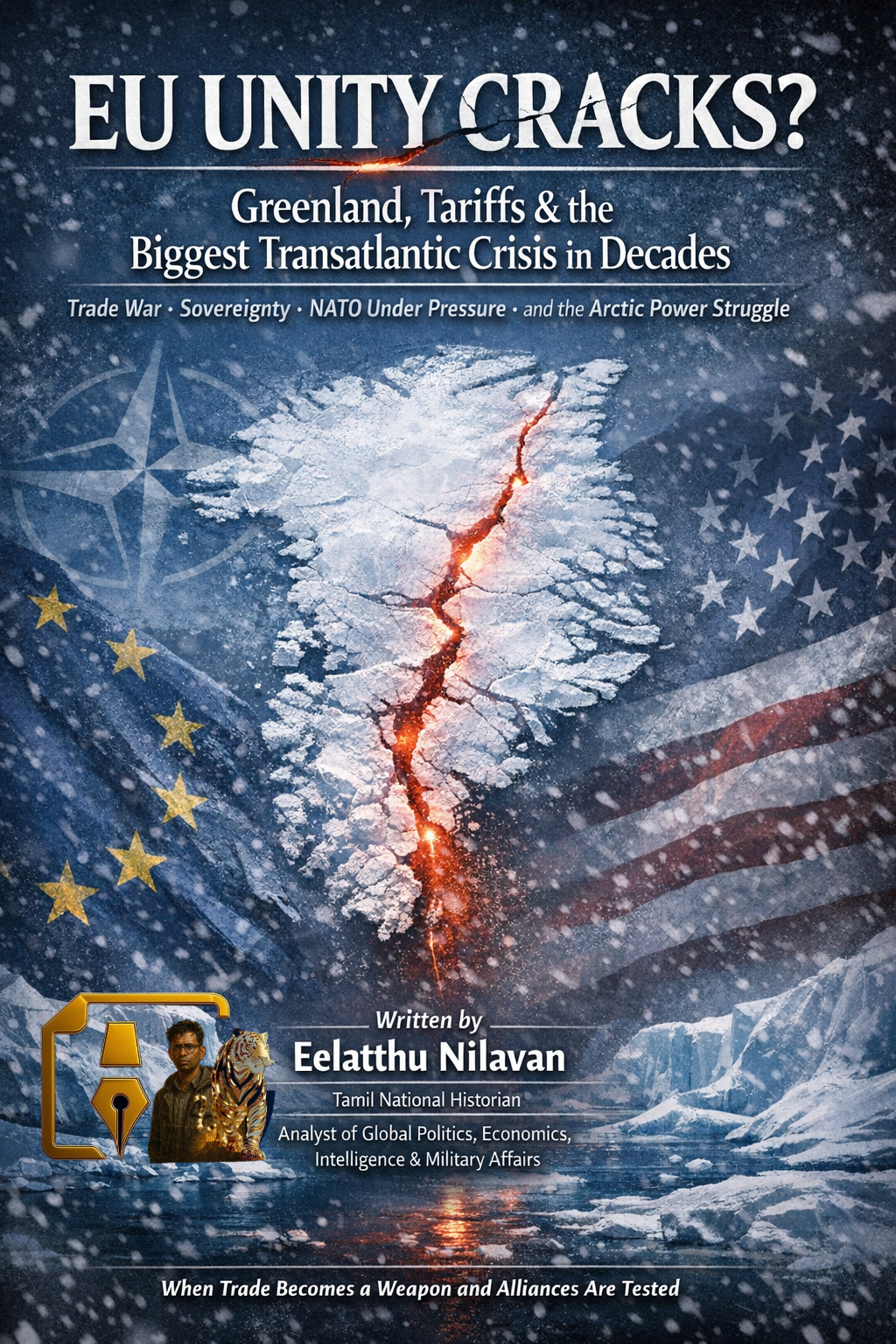
𝐆𝐑𝐄𝐄𝐍𝐋𝐀𝐍𝐃, 𝐓𝐀𝐑𝐈𝐅𝐅𝐒 & 𝐓𝐇𝐄 𝐁𝐈𝐆𝐆𝐄𝐒𝐓 𝐓𝐑𝐀𝐍𝐒𝐀𝐓𝐋𝐀𝐍𝐓𝐈𝐂 𝐂𝐑𝐈𝐒𝐈𝐒 𝐈𝐍 𝐃𝐄𝐂𝐀𝐃𝐄𝐒
✦ 𝐈𝐧𝐭𝐫𝐨𝐝𝐮𝐜𝐭𝐢𝐨𝐧: 𝐅𝐫𝐨𝐦 𝐀𝐥𝐥𝐢𝐞𝐬 𝐭𝐨 𝐀𝐝𝐯𝐞𝐫𝐬𝐚𝐫𝐢𝐞𝐬?
What began as a strategic disagreement over the Arctic has rapidly escalated into a full-blown transatlantic crisis.
U.S. President Donald Trump’s tariff threats and coercive pressure over Greenland have triggered alarm across Europe, testing not only EU unity but the very foundations of NATO cohesion.
Greenland—long viewed as a quiet strategic outpost—has now become the epicenter of a geopolitical confrontation involving trade warfare, alliance politics, Arctic militarization, and the future of international law.

✦ 𝐓𝐡𝐞 𝐂𝐨𝐫𝐞 𝐂𝐨𝐧𝐟𝐥𝐢𝐜𝐭: 𝐓𝐡𝐞 𝐆𝐫𝐞𝐞𝐧𝐥𝐚𝐧𝐝 𝐒𝐭𝐚𝐧𝐝𝐨𝐟𝐟
The crisis erupted after President Trump threatened sweeping tariffs against eight European countries opposing American control of Greenland:
Denmark, Norway, Sweden, France, Germany, the UK, the Netherlands, and Finland
Washington frames Greenland as indispensable for U.S. missile defense, Arctic dominance, and polar security, arguing that any future conflict involving Greenland would automatically draw the U.S. into war—thus justifying what American officials describe as “preemptive strategic control.”
However, Europe sees this as economic coercion masked as security policy.
✦ 𝐔𝐒 𝐓𝐚𝐫𝐢𝐟𝐟 𝐖𝐞𝐚𝐩𝐨𝐧: 𝐄𝐜𝐨𝐧𝐨𝐦𝐢𝐜 𝐂𝐨𝐞𝐫𝐜𝐢𝐨𝐧 𝐚𝐬 𝐆𝐞𝐨𝐩𝐨𝐥𝐢𝐭𝐢𝐜𝐬
The Trump administration has announced:
• 10% tariffs on targeted European nations
• Escalation to 25% by June, unless U.S. demands are met
• Explicit linkage between trade penalties and Greenland’s sovereignty
This marks a dangerous precedent:
➽ Using trade warfare to pressure territorial outcomes among allies
Analysts warn this approach blurs the line between alliance leadership and imperial leverage.
✦ 𝐄𝐔 𝐂𝐨𝐮𝐧𝐭𝐞𝐫𝐬𝐭𝐫𝐢𝐤𝐞: €93 𝐁𝐢𝐥𝐥𝐢𝐨𝐧 𝐓𝐚𝐫𝐢𝐟𝐟 𝐏𝐚𝐜𝐤𝐚𝐠𝐞
Brussels has entered emergency crisis mode.
The European Commission is preparing retaliatory measures worth up to €93 billion, including:
• Targeted tariffs on U.S. exports
• Potential restrictions on American firms operating within the EU single market
• Strategic targeting of sectors linked to Trump’s political base, including technology and finance
EU officials emphasize that:
“Sovereignty and alliance integrity are non-negotiable.”
This signals Europe’s readiness to absorb economic pain rather than concede strategic autonomy.
✦ 𝐕𝐨𝐧 𝐝𝐞𝐫 𝐋𝐞𝐲𝐞𝐧’𝐬 𝐄𝐦𝐞𝐫𝐠𝐞𝐧𝐜𝐲 𝐃𝐢𝐩𝐥𝐨𝐦𝐚𝐜𝐲
European Commission President Ursula von der Leyen has taken the lead in coordinating resistance:
• Emergency calls with NATO leadership
• Consultations with Germany, France, Italy, and the UK
• Firm reaffirmation of Greenland’s sovereignty under the Kingdom of Denmark
Her message is clear:
Europe will not accept territorial pressure through tariffs.
✦ 𝐍𝐀𝐓𝐎 𝐮𝐧𝐝𝐞𝐫 𝐒𝐭𝐫𝐞𝐬𝐬: 𝐂𝐨𝐥𝐥𝐞𝐜𝐭𝐢𝐯𝐞 𝐃𝐞𝐟𝐞𝐧𝐬𝐞 𝐨𝐫 𝐃𝐢𝐯𝐢𝐝𝐞𝐝 𝐀𝐥𝐥𝐢𝐚𝐧𝐜𝐞?
European leaders insist that:
• Greenland’s security is a NATO collective responsibility
• Arctic defense should be managed cooperatively, not coercively
Norway has emphasized increased Arctic presence alongside allies.
Denmark calls for calm, structured dialogue—free from social media theatrics.
Italy warns that tariffs against contributing allies represent a strategic miscalculation.
This crisis exposes a core question:
Is NATO a security alliance—or a hierarchy dominated by unilateral power?
✦ 𝐂𝐚𝐧𝐚𝐝𝐚’𝐬 𝐒𝐭𝐚𝐧𝐜𝐞: 𝐀𝐫𝐜𝐭𝐢𝐜 𝐒𝐭𝐚𝐛𝐢𝐥𝐢𝐭𝐲 𝐎𝐯𝐞𝐫 𝐏𝐨𝐰𝐞𝐫 𝐏𝐨𝐥𝐢𝐭𝐢𝐜𝐬
Canada has aligned with Europe, stating unequivocally:
• Greenland’s future belongs to Greenland and Denmark
• Arctic security must remain under NATO’s collective framework
• Unilateral pressure threatens regional stability
This adds further weight to the perception that Washington is increasingly isolated within its own alliance network.
✦ 𝐓𝐡𝐞 𝐔𝐒 𝐒𝐞𝐜𝐮𝐫𝐢𝐭𝐲 𝐍𝐚𝐫𝐫𝐚𝐭𝐢𝐯𝐞: “𝐏𝐞𝐚𝐜𝐞 𝐓𝐡𝐫𝐨𝐮𝐠𝐡 𝐒𝐭𝐫𝐞𝐧𝐠𝐭𝐡.”
Senior U.S. officials have doubled down:
• Treasury Secretary Scott Bessent argues the U.S. cannot “outsource” Arctic defense
• Stephen Miller frames Greenland as vital in an era of “polar competition.”
• Claims Europe has failed to carry its defense burden
The administration portrays its actions as preventive security, but allies see them as revisionist pressure tactics.
✦ 𝐑𝐮𝐬𝐬𝐢𝐚’𝐬 𝐂𝐚𝐥𝐜𝐮𝐥𝐚𝐭𝐞𝐝 𝐎𝐛𝐬𝐞𝐫𝐯𝐚𝐭𝐢𝐨𝐧
Moscow has described the situation as “extraordinary under international law.”
While reaffirming that Greenland is legally part of Denmark, the Kremlin notes:
• A growing disregard for established norms
• A trajectory where international law is openly sidelined
Russia’s response underscores a troubling reality: Western alliance fractures are being closely monitored—and quietly exploited.
✦ 𝐂𝐨𝐧𝐜𝐥𝐮𝐬𝐢𝐨𝐧: 𝐀 𝐓𝐮𝐫𝐧𝐢𝐧𝐠 𝐏𝐨𝐢𝐧𝐭 𝐟𝐨𝐫 𝐓𝐡𝐞 𝐖𝐞𝐬𝐭
The Greenland crisis is not about an island alone.
It is about:
• The future of alliance-based order
• Whether economic force can override sovereignty
• Whether NATO survives as a partnership of equals
If unresolved, this confrontation risks becoming the most severe transatlantic rupture in decades, reshaping global power alignments far beyond the Arctic.


Written by
Eelaththu Nilavan
Tamil National Historian | Analyst of Global Politics, Economics, Intelligence & Military Affairs
20/01/2026
