


India and UAE Chart a New Geopolitical Horizon, Set Sights on $200 Billion Trade by 2032
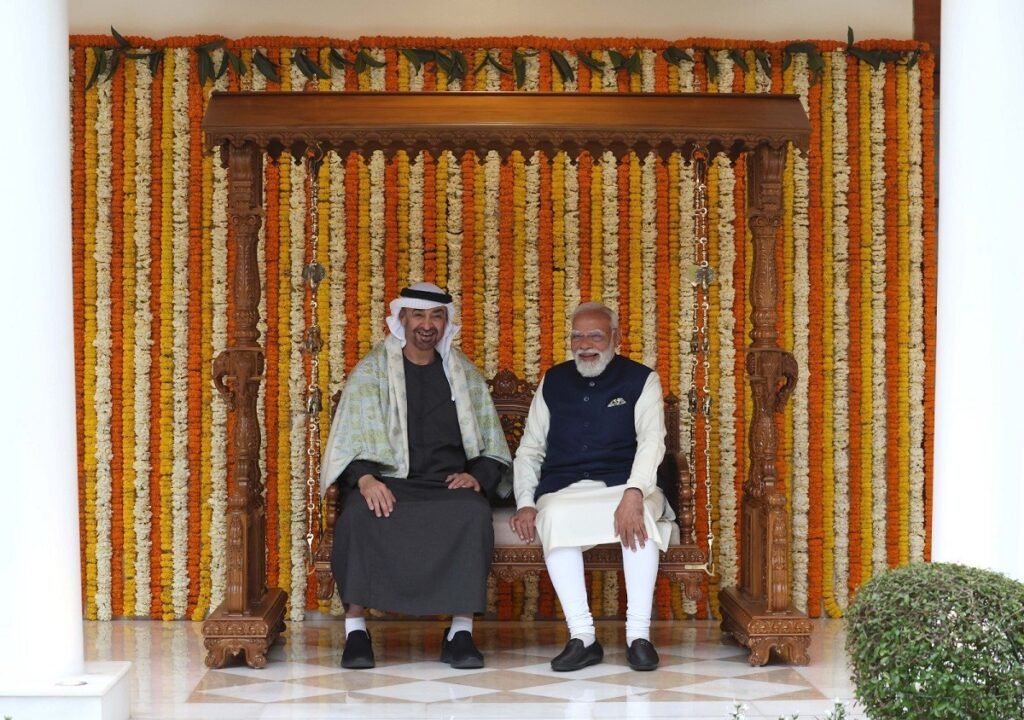
India and the United Arab Emirates on Monday formalised a sweeping expansion of their Comprehensive Strategic Partnership, unveiling new defence, energy, technology, and investment initiatives while setting an ambitious target to double bilateral trade to $200 billion by 2032. The agreements were finalised during a high-level meeting between Prime Minister Narendra Modi and UAE President Sheikh Mohamed bin Zayed Al Nahyan, who arrived in New Delhi for a brief but highly consequential official visit.

The meeting, held at the Prime Minister’s residence, underscored the growing geopolitical and economic convergence between the two nations—an alignment that has accelerated since the signing of the Comprehensive Economic Partnership Agreement (CEPA) in 2022. Bilateral trade has already crossed the $100 billion mark, prompting both sides to push for deeper integration across critical sectors.
Key Agreements and Strategic Outcomes
1. Strategic Defence Partnership Takes Centre Stage
India and the UAE signed a Letter of Intent to establish a Strategic Defence Partnership, marking one of the most significant upgrades in their security cooperation to date.
The proposed framework includes:
- Defence industrial collaboration
- Joint work in advanced technologies
- Cybersecurity and counter-terrorism cooperation
- Special forces training and interoperability
- Defence innovation and joint doctrines
Officials emphasised that the pact is not a reaction to regional tensions but a natural progression of existing defence ties.
2. Long-Term LNG Supply Deal Strengthens Energy Security
A major highlight of the visit was a 10-year LNG supply agreement, under which India will import 0.5 million metric tonnes of liquefied natural gas annually starting in 2028 from ADNOC Gas.
The UAE remains India’s second-largest LNG supplier after Qatar.
This deal is expected to bolster India’s long-term energy security while deepening the UAE’s role in South Asia’s energy landscape.
3. Nuclear, Space, and Technology Cooperation Expands
Both nations agreed to explore collaboration in:
- Large nuclear reactors and Small Modular Reactors (SMRs)
- Advanced reactor systems and nuclear safety
- Joint space missions, satellite fabrication, and launch infrastructure
- AI-driven supercomputing clusters and data centre expansion
These initiatives reflect a shared ambition to position the partnership at the forefront of next-generation technologies.
4. Major Investment Push: Dholera Special Investment Region
The UAE expressed interest in participating in the development of the Dholera Special Investment Region (SIR) in Gujarat. Proposed projects include:
- An international airport
- A greenfield port
- A smart urban township
- Railway connectivity
- Energy infrastructure
- A pilot training school and MRO facilities
This investment aligns with India’s broader push to attract global capital into its infrastructure corridors.
5. Trade Facilitation and MSME Connectivity
To accelerate trade flows, both leaders directed their teams to:
- Interlink national payment platforms for faster cross-border transactions
- Implement Bharat Mart, Virtual Trade Corridor, and Bharat–Africa Setu
- Strengthen MSME linkages across West Asia, Africa, and Eurasia
These measures aim to democratise trade access and expand India’s export footprint.
Geopolitical Context
The visit comes at a time of heightened tensions in West Asia, including instability involving Iran, the Gaza crisis, and shifting alliances among Gulf nations. Analysts note that the India–UAE partnership offers both countries a stabilising anchor amid regional uncertainty.
India’s deep diaspora ties—nearly 4.5 million Indians live in the UAE—and its growing energy needs make the relationship strategically indispensable.
Leaders’ Statements
Prime Minister Modi described the partnership as “future-oriented and anchored in trust”, while President Al Nahyan reaffirmed the UAE’s commitment to expanding cooperation across all sectors.
Foreign Secretary Vikram Misri called the visit “short but extremely substantive,” noting that it reflects the maturity and depth of the bilateral relationship.
Conclusion
The agreements sealed in New Delhi mark a decisive step forward in India–UAE relations, transforming the partnership into a multi-dimensional alliance spanning defence, energy, technology, and global trade. With a $200 billion trade target and a suite of long-term strategic initiatives, both nations have signalled their intent to shape a shared economic and geopolitical future.
