


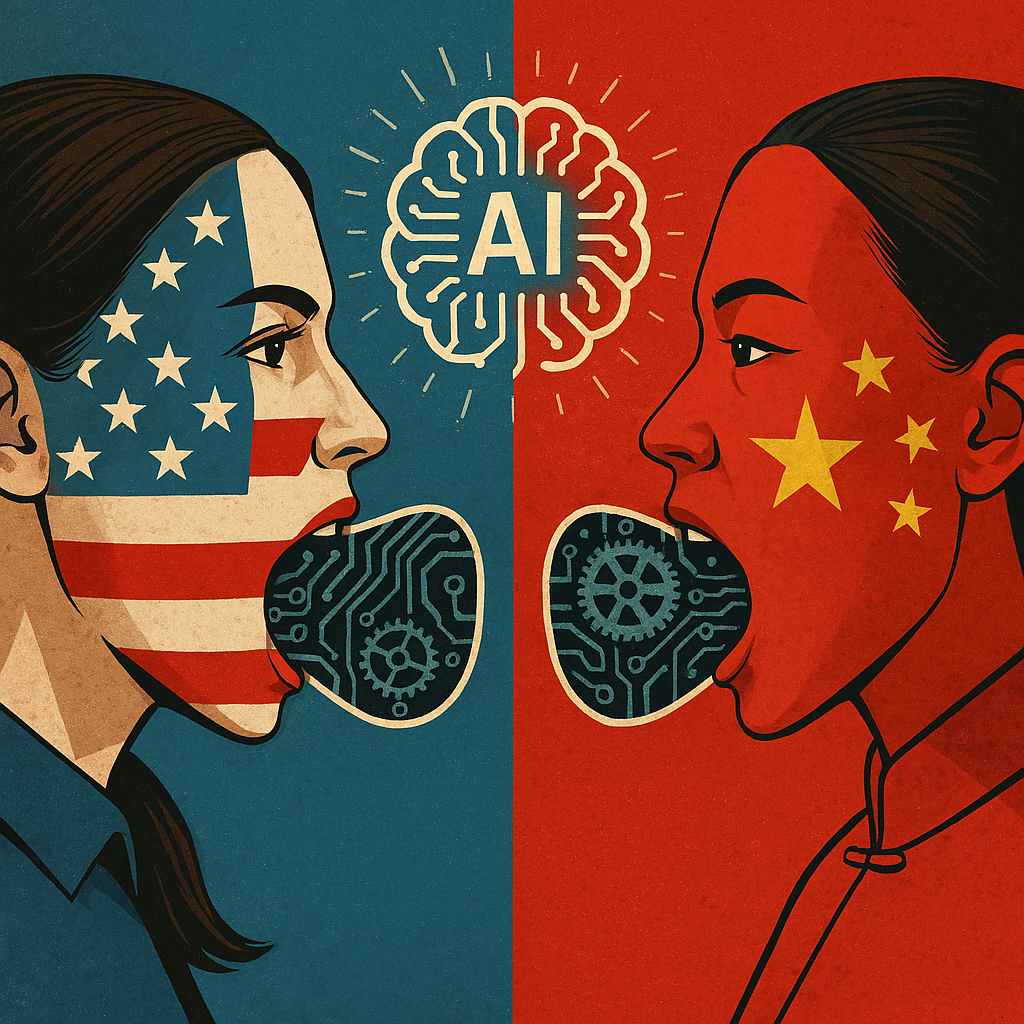

A global debate is intensifying over whether China is on the verge of surpassing the United States in artificial intelligence—a domain long viewed as the backbone of future economic power, military capability, and technological influence. While the U.S. retains deep structural advantages, China’s rapid advances in AI applications, standards-setting, and industrial integration are reshaping the competitive landscape in ways that challenge long‑held assumptions.
A Shift From Raw Power to Access and Application
For years, the AI race was measured by a single metric: scale. Whoever built the largest models, the biggest GPU clusters, and the most powerful compute infrastructure was seen as the global leader. But by early 2026, that narrative had shifted dramatically. Analysts now argue that the real contest is no longer about who has the smartest AI—but who can deploy it most widely and effectively across society.
China’s strategy has evolved from chasing U.S. benchmarks to building AI as a form of national infrastructure. Under its “AI+” Action Plan and the 15th Five‑Year Plan, Beijing is pushing AI into healthcare, manufacturing, transportation, and public services. The goal is not just technological prestige but solving systemic social challenges, such as aging demographics and unequal access to medical care.
This stands in stark contrast to the U.S., where AI is increasingly commercialized through subscription models. Premium tiers—some costing hundreds of dollars per month—have created what analysts call an “AI tax” on American households, raising concerns about unequal access to advanced tools.
The U.S. Still Leads in Core Infrastructure—For Now
Despite China’s momentum, the United States maintains significant advantages in foundational AI enablers. According to comparative analyses across advanced economies, the U.S. continues to dominate in computing capacity, digital infrastructure, and investment conditions. China, while rapidly improving, still lags in several enabling technologies.
Research output and adoption rates in China have surged, but questions remain about its long‑term ability to match U.S. strengths in high‑end chip design, cloud infrastructure, and advanced semiconductor manufacturing.
A New Battleground: Standards and Strategic Control
One of the most consequential developments in the AI rivalry is China’s push to shape global technical standards. In late 2025, Beijing took the unexpected step of restricting domestic access to Nvidia’s advanced H200 chips—even after the U.S. approved limited exports. The move was strategic: China aims to reduce dependence on U.S. technologies like Nvidia’s CUDA, which has become the de facto global standard for AI development.
By promoting Huawei’s Ascend chips and its CANN software ecosystem, China is attempting to build an independent AI stack—one that could eventually challenge U.S. dominance in the global standards arena.
Geopolitical Tensions Intensify the Race
The rivalry is no longer confined to labs and tech firms. It has become a central axis of geopolitical strategy.
In early 2026, Washington expanded restrictions on advanced semiconductor exports to China, aiming to limit Beijing’s ability to train large-scale AI models and develop military applications. China responded by accelerating domestic chip production and investing billions in state-backed semiconductor funds.
This tit-for-tat escalation is reshaping global supply chains, pushing companies to diversify manufacturing into Southeast Asia and India.
Voices From Industry: A Call for U.S. Urgency
U.S. technology leaders warn that America risks falling behind if it fails to harness AI to boost productivity. Palantir CTO Shyam Sankar argues that AI could be a “slingshot” enabling American workers to become dramatically more productive—potentially offsetting China’s long-term economic strategies.
He cautions that if the U.S. does not fully embrace AI-driven productivity gains, China’s steady growth could erode America’s competitive edge.
So, Is China Overtaking the U.S.?
The answer is complex—and depends on the metric.
Where China Is Gaining Ground
- AI application at a national scale
- Integration into public services and industry
- Efforts to set global technical standards
- Rapid growth in research output and adoption
Where the U.S. Still Leads
- High-end compute infrastructure
- Semiconductor technology and design
- Investment environment and innovation ecosystems
- Global influence over AI standards and platforms
The competition is no longer linear. It is multidimensional, with each nation pursuing fundamentally different strategies. The U.S. is focused on maintaining technological supremacy and national security, while China is building AI as a societal utility designed for mass deployment.
Conclusion: A Race Redefined
China is not yet overtaking the United States across the full spectrum of AI capability—but it is rapidly closing the gap in areas that matter for long-term global influence. The race is no longer about who builds the biggest models. It is about who can shape the rules, deploy AI at scale, and integrate it into the fabric of everyday life.
In that contest, China has emerged as a formidable challenger—and the world is watching closely.
