

Table of Contents
✦ The Death of a Shadow Emperor
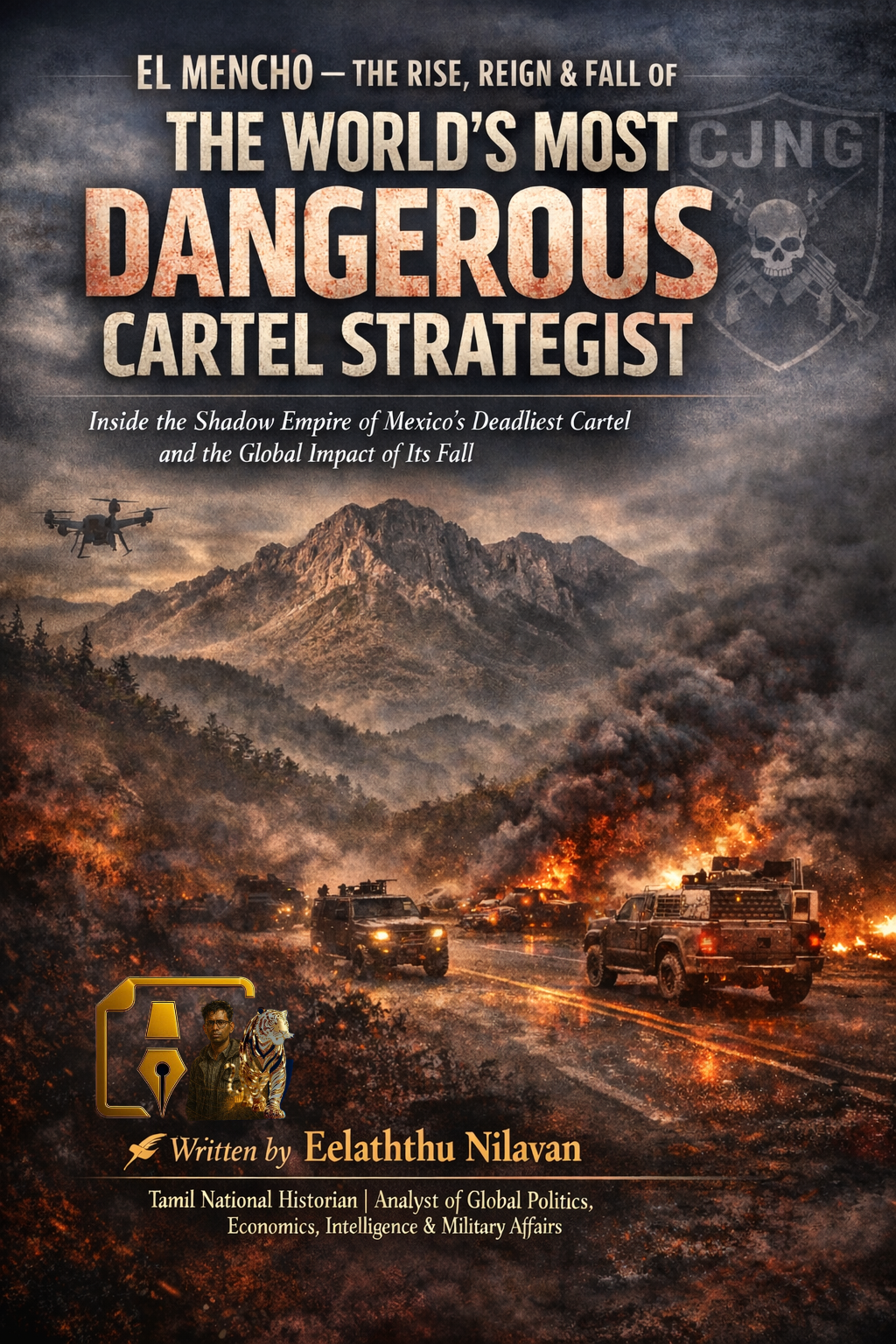
The killing of Nemesio Rubén Oseguera Cervantes, better known as El Mencho, marks one of the most consequential counter-cartel operations of the 21st century. He died after a high-intensity military assault in Tapalpa, a mountainous stronghold long used as a clandestine command zone.
Wounded during the firefight, he reportedly succumbed while being airlifted for emergency treatment. His death instantly triggered a wave of retaliatory violence, demonstrating that even in death, his command network remained operational.
✦ Origins of a Cartel Architect
El Mencho’s story is not merely that of a criminal — it is the blueprint of modern organized crime evolution.
Born in rural western Mexico, he grew up in poverty and migrated to the United States as a young man, where he became involved in low-level narcotics trafficking. Arrests, deportation, and imprisonment hardened him rather than deterring him.

Upon returning to Mexico, he joined local law enforcement — a move that proved decisive. As a police officer, he gained:
• Tactical training
• Intelligence awareness
• Knowledge of institutional weaknesses
He later weaponized that knowledge to outmaneuver authorities and rival cartels alike.
✦ The Birth of a War Machine
El Mencho co-founded the Jalisco New Generation Cartel (CJNG), transforming it from a regional trafficking group into a paramilitary empire.
Unlike older cartels built on patronage networks, his model resembled a hybrid of:
• Insurgent organization
• Corporate hierarchy
• Special-forces doctrine
The cartel implemented:
• Military-grade training camps
• Armored convoy units
• Encrypted communications
• Drone-mounted explosives
This was not simply a criminal enterprise — it was a private army.
✦ Doctrine of Fear: Psychological Warfare Strategy
El Mencho understood that fear is a strategic asset.
CJNG pioneered modern narco-psychological warfare:
• Public displays of weapons convoys
• Highly produced propaganda videos
• Coordinated urban terror attacks
These tactics served a precise purpose: convince civilians, police, and politicians that resistance was futile.
Unlike flamboyant cartel leaders, he almost never appeared publicly. This deliberate invisibility amplified his myth, making him more legend than man.
✦ The Operation That Brought Him Down
Mexican elite forces launched a multi-layered strike combining:
• Signals intelligence
• Informant networks
• Aerial surveillance
• Ground assault teams
When troops closed in, cartel gunmen engaged in a fierce firefight. Several operatives were killed, and weapons caches seized, including heavy arms normally associated with military units.
The operation demonstrated a shift in state strategy: precision targeting of leadership rather than broad offensives.
✦ Nationwide Retaliation: Cartel Shock Doctrine
Within hours of confirmation of his death, coordinated reprisals erupted across western Mexico, particularly in Guadalajara and Puerto Vallarta.
Cartel militants implemented classic insurgent disruption tactics:
• Burning trucks to form road barricades
• Armed ambushes on highways
• Transport shutdowns
• Mass intimidation operations
Authorities declared emergency security alerts across the region. The speed of retaliation indicated pre-planned contingency protocols — a sign of disciplined organizational command.
✦ Why He Was Considered the Most Dangerous Drug Lord Alive
Several factors distinguished El Mencho from previous cartel bosses:
1. Strategic Discipline
He avoided publicity and maintained strict operational secrecy.
2. Corporate-Style Expansion
CJNG established trafficking corridors across multiple continents.
3. Tactical Innovation
His forces adopted battlefield technology faster than many national militaries.
4. Institutional Penetration
The cartel infiltrated police, courts, and local governments.
✦ The International Dimension
The United States government had placed a $15 million bounty on him — one of the highest rewards ever offered for a trafficker.
Washington viewed him as a central architect of synthetic opioid distribution networks, especially fentanyl routes fueling North America’s overdose crisis.
His removal was therefore not just a national victory for Mexico, but a strategic objective shared by multiple governments.
✦ Political Reaction
President Claudia Sheinbaum praised the operation as proof of strengthened state capacity against organized crime.
Security analysts, however, caution that leadership decapitation rarely destroys cartels. Instead, it often triggers succession struggles — historically the bloodiest phase in cartel cycles.
✦ The Power Vacuum Problem
Criminal organizations of this scale rarely collapse overnight. Experts outline three possible trajectories:
Scenario A — Consolidation
A trusted lieutenant assumes command and stabilizes operations.
Scenario B — Fragmentation
Internal factions fight for control, producing regional warlords.
Scenario C — Cartel War
Rivals attempt a territorial invasion while leadership is weakened.
Historically, Scenario B produces the highest violence levels.
✦ Strategic Analysis: What Made Him Different
El Mencho represented a new generation of cartel leadership defined by:
• Intelligence-driven operations
• Militarized command structures
• Global logistics chains
• Corporate-style revenue diversification
He blurred the line between organized crime and irregular warfare.
In intelligence circles, CJNG under his command was often described not as a cartel, but as a non-state armed power.
✦ Long-Term Global Implications
His death will likely produce short-term disruption in drug trafficking flows, but long-term effects are less certain.
Possible outcomes:
• Temporary supply chain instability
• Violent territorial realignment
• Emergence of new criminal coalitions
History shows that removing a dominant underworld figure often decentralizes crime, making it harder to combat.
✦ Legacy of the Invisible Kingpin
El Mencho’s greatest weapon was not violence.
It was structured.
He built an organization capable of functioning without him — the ultimate test of criminal leadership. His myth was cultivated carefully:
• No media theatrics
• No flamboyant lifestyle displays
• Minimal public images
•
He ruled not through spectacle, but through operational efficiency.
𝙁𝙄𝙉𝘼𝙇 𝘼𝙎𝙎𝙀𝙎𝙎𝙈𝙀𝙉𝙏 — 𝙏𝙃𝙀 𝙈𝘼𝙉 𝙄𝙎 𝙂𝙊𝙉𝙀, 𝙏𝙃𝙀 𝙎𝙔𝙎𝙏𝙀𝙈 𝙍𝙀𝙈𝘼𝙄𝙉𝙎
The elimination of El Mencho is undeniably historic. It removes one of the most formidable criminal strategists of modern times.
But his true legacy is structural: a cartel engineered to survive him.
Governments have eliminated a man.
They have not yet eliminated the machine he built.

Written byEelaththu Nilavan
Tamil National Historian | Analyst of Global Politics, Economics, Intelligence & Military Affairs
23/02/2026
