

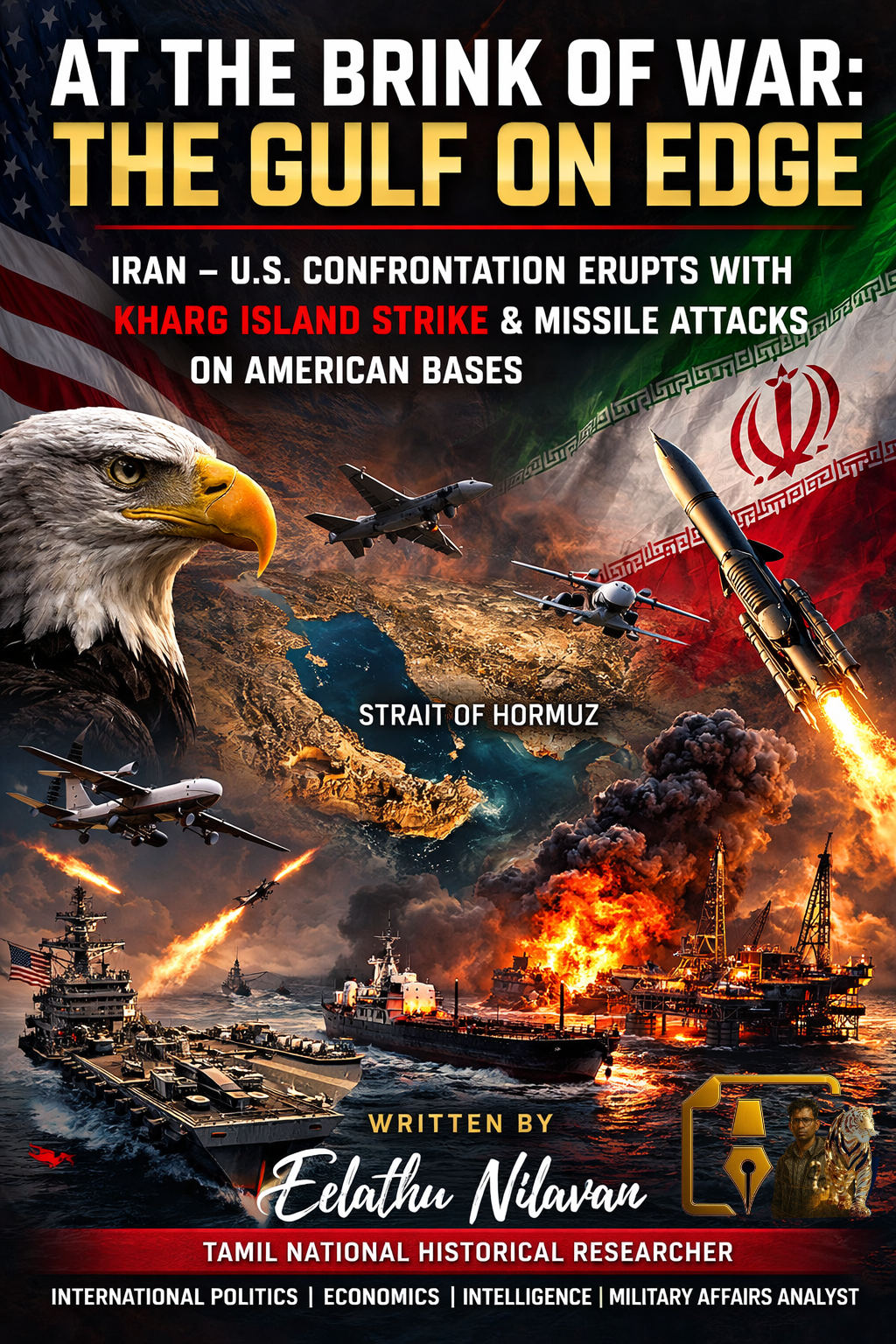
Iran–United States Confrontation Explodes After Kharg Island Strike and Missile Attacks on U.S. Bases
◆ A REGION MOVING TOWARDS A FULL-SCALE WAR
The geopolitical landscape of the Middle East has entered one of its most dangerous phases in decades. The confrontation between the United States and Iran has escalated dramatically following a series of direct military strikes, missile attacks, drone warfare, and threats targeting the world’s most critical energy corridor — the Strait of Hormuz.
What began as a limited confrontation has now evolved into a multi-layered regional crisis, involving missile strikes on military bases, economic warfare threats, and massive military deployments across the Gulf.
At the center of this escalation is the United States airstrike on Kharg Island, Iran’s most critical oil export hub.
◆ THE STRIKE THAT SHOCKED TEHRAN
U.S. Air Raid on Iran’s Oil Lifeline
On March 14, 2026, U.S. forces conducted one of the most significant air operations against Iran in recent years. American bombers targeted military installations on Kharg Island, a small coral island located roughly 27 miles off Iran’s southern coast in the Persian Gulf.
The island is not merely a military outpost — it is the backbone of Iran’s economy.
Strategic Importance of Kharg Island
Kharg Island handles:
• Nearly 90% of Iran’s crude oil exports
• Around 950 million barrels of oil annually
• A loading capacity of roughly 7 million barrels per day
Oil from major Iranian fields such as Ahvaz and Marun flows through pipelines into Kharg Island before being shipped globally.
Because of this, energy analysts often describe the island as:
“The beating heart of Iran’s oil economy.”
◆ TRUMP’S STRATEGIC MESSAGE
According to Donald Trump, the strike deliberately targeted military infrastructure only, including:
• Air defense systems
• Naval facilities
• Helicopter hangars
• Airport control towers
Trump claimed that every military target on the island was “totally obliterated.”
However, the United States intentionally avoided striking oil facilities.
Trump stated this decision was taken:
“for reasons of decency.”
But Washington issued a clear warning:
If Iran disrupts global shipping through the Strait of Hormuz, oil infrastructure could become the next target.
◆ IRAN DECLARES A “RED LINE”
Tehran reacted furiously to the attack.
Iranian military leaders described the strike as crossing a strategic red line and vowed revenge.
The warning came from the Islamic Revolutionary Guard Corps, which stated that future attacks on Iran’s energy infrastructure would trigger direct retaliation across the Gulf region.
Iran also threatened to target:
• Oil facilities
• Industrial complexes
• Energy infrastructure
belonging to companies cooperating with the United States.
This raises the possibility of attacks across Saudi Arabia, the UAE, and Bahrain, where Western energy investments are concentrated.
◆ IRAN’S MISSILE CAMPAIGN: “OPERATION PROMISED TRUTH 4”
In response, Iran launched a series of coordinated missile and drone attacks under the codename:
“Operation Promised Truth 4”
The most recent phase — Wave 51 — reportedly targeted the Prince Sultan Air Base in Saudi Arabia.
Iran claims the base houses some of the most advanced American fighter jets, including:
• F-35 Lightning II
• F-16 Fighting Falcon
According to Iranian statements, liquid-fuel and solid-fuel ballistic missiles struck:
• Aircraft hangars
• Fuel depots
• Maintenance facilities
If verified, such an attack would represent one of the most direct Iranian strikes on U.S. air assets in history.
◆ DRONE SWARMS ACROSS THE GULF
Before the missile attack, Iran launched Wave 50, involving a massive drone swarm targeting American military positions.
Key locations reportedly attacked included:
• Al Dhafra Air Base
• Al Udeid Air Base
• United States Fifth Fleet
Iranian air defense forces claim they have shot down 118 hostile drones since the conflict escalated on February 28.
One of the intercepted aircraft was reportedly a Hermes 450 reconnaissance drone.
◆ THE STRAIT OF HORMUZ: GLOBAL ENERGY AT RISK
Iranian strategist Mohsen Rezaee issued a stark warning:
The Strait of Hormuz may be closed.
This narrow maritime corridor is one of the most important shipping lanes in the world.
Approximately:
• 20% of global oil supply
• One-third of global LNG shipments
pass through the strait.
If the strait is blocked, global oil prices could skyrocket beyond $100 per barrel, triggering an international economic crisis.
◆ U.S. MILITARY BUILD-UP IN THE REGION
Washington has responded by rapidly increasing its military presence.
The United States has deployed:
• 2,500 Marines
• The amphibious assault ship USS Tripoli (LHA-7)
• Strategic bombers including B-52 Stratofortress
These forces are drawn from the 31st Marine Expeditionary Unit, which specializes in rapid crisis response.
Their mission includes:
• Maritime security
• Amphibious operations
• Emergency evacuations
• Direct combat operations if war expands
◆ RUSSIA ENTERS THE DIPLOMATIC ARENA
Amid the growing crisis, Vladimir Putin may soon meet Iran’s emerging political leader Mojtaba Khamenei.
The meeting is expected during the upcoming Caspian Sea Summit in Tehran scheduled for August 12, 2026.
Russia has already taken a step toward supporting Iran by delivering humanitarian aid via an Ilyushin Il-76.
Reports also suggest that Putin once proposed transferring 450 kg of enriched Iranian uranium to Russia as part of a potential peace agreement involving Trump — though the proposal was rejected.
◆ EUROPEAN TENSIONS AND PUBLIC PROTESTS
The conflict is also causing political fractures across Europe.
Thousands of protesters gathered in Rome, condemning support for U.S. military operations.
Demonstrators burned posters of:
• Giorgia Meloni
• Donald Trump
Activists warned that European governments are shifting towards a “war economy,” diverting funding away from public services such as healthcare and education.
◆ A GLOBAL ECONOMIC SHOCK LOOMING
Energy analysts warn that the crisis could trigger major global consequences:
Possible outcomes include:
• Severe oil price spikes
• Disruption of global shipping
• Attacks on energy infrastructure
• Economic instability in Asia and Europe
If the Strait of Hormuz becomes a war zone, the global economy could face a shock comparable to the 1973 oil crisis.
◆ A NEW PHASE OF MODERN WARFARE
The confrontation is also revealing a new type of warfare.
Instead of traditional ground battles, the conflict is increasingly defined by:
• Missile saturation attacks
• Drone swarm warfare
• Cyber operations
• Economic and energy warfare
Iran’s strategy focuses on asymmetric warfare, targeting infrastructure and logistics rather than engaging U.S. forces in direct conventional battles.
◆ THE WORLD WATCHES A TINDERBOX
With missile attacks targeting U.S. bases, massive American airstrikes on Iranian territory, and threats to close the Strait of Hormuz, the Persian Gulf now stands on the brink of a major regional war.
The situation remains extremely volatile.
A single miscalculation — or another major strike — could ignite a conflict that spreads across the Middle East and shakes the foundations of the global economy.
For now, the Gulf remains a tinderbox, waiting for the next spark.

Written by Eelaththu Nilavan
Tamil National Historian.
Analyst of Global Politics, Economics, Intelligence & Military Affairs
15/03/2026
