


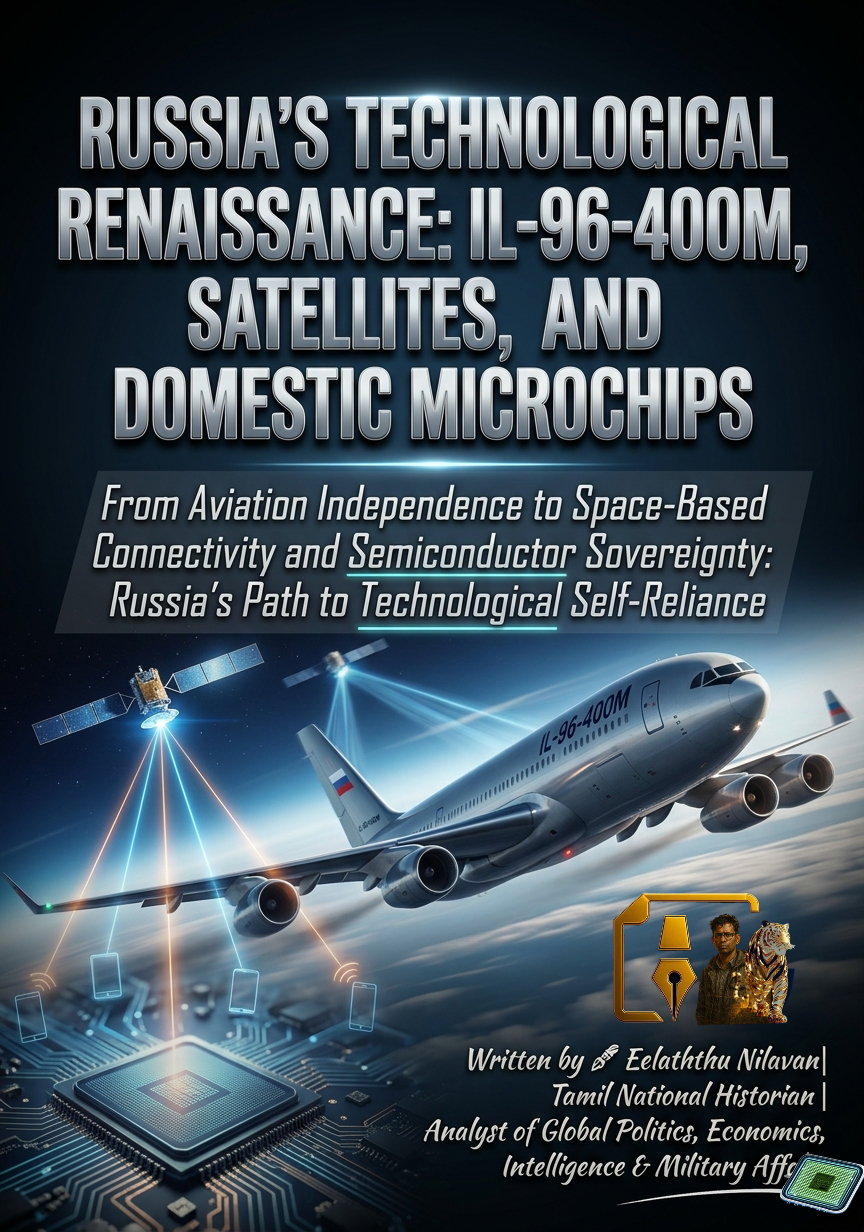

Written by 𝐸𝑒𝓁𝒶𝓉𝒽𝓉𝒽𝓊 𝒩𝒾𝓁𝒶𝓋𝒶𝓃Tamil National Historian | Analyst of Global Politics, Economics, Intelligence & Military Affairs
THE IL-96-400M COMEBACK: RUSSIA’S WIDE-BODY ASPIRATION
Russia has officially resumed flight testing of its long-haul wide-body aircraft, the Il-96-400M, marking a milestone in its pursuit of aviation independence. After a six-month pause, the aircraft completed a 9-hour non-stop flight from Zhukovsky to Novosibirsk and back, demonstrating both endurance and system reliability.
This test signals that Russia remains committed to reducing reliance on Western aircraft despite international sanctions and technological restrictions.
Key Highlights of the Test Flight
• The Mission: Prototype aircraft tail number 96115 completed the long-duration test.
• Significance: Return to testing after a six-month hiatus highlights the program’s resilience.
• Technical Goals: Evaluation of engines, avionics, and overall stability in real-world flight conditions.
Aircraft Specifications & Design
• Legacy & Modernization: The Il-96-400M is a modernized evolution of the Soviet-era Il-96, with a longer fuselage, updated systems, and enhanced avionics.
• Capacity: Designed to carry 350–370 passengers on long-haul routes.
• Performance: Powered by four PS-90A1 engines, it has a range exceeding 10,000 km with a cruising speed of ~870 km/h.
• Independence: Relies heavily on domestically produced components, ensuring operational continuity without foreign dependency.
Strategic & Economic Challenges
While symbolic of national resilience, the aircraft faces hurdles:
• Production Speed: Manufacturing remains slow due to heavy reliance on manual labor and limited automation.
• Efficiency Concerns: Its four-engine design is less fuel-efficient than modern twin-engine aircraft, driving higher operational costs.
• Market Role: Commercial adoption may be limited; primary applications may include government transport, cargo, and strategic operations.
Future Outlook
Modernizing production, and possibly introducing a twin-engine variant, could enhance market viability. For now, the Il-96-400M represents a critical link for Russia’s domestic long-haul aviation.
DIRECT-TO-DEVICE SATELLITE CONNECTIVITY: A HYBRID COMMUNICATION FUTURE
Russia is also taking bold steps in telecommunications by authorizing domestic companies to develop low Earth orbit (LEO) satellite constellations. These aim to enable Direct-to-Device (D2D) connectivity, letting smartphones, tablets, and IoT devices connect directly to satellites, bypassing terrestrial cell towers.
Strategic Goals
• Expand coverage in remote regions.
• Ensure resilient communication during disasters.
• Strengthen technological sovereignty through fully domestic hardware.
Technical Breakdown
• Bureau 1440: Frequencies 1,610–2,500 MHz, ideal for handheld devices and mobile satellite services.
• Sputnik: Frequencies 10.7–30 GHz for high-throughput broadband services.
• R&D Timeline: Authorization until 2029, emphasizing safe, non-interfering operation.
Practical Applications
• Rural Access: Connectivity in regions lacking traditional infrastructure.
• Emergency Resilience: Operates as a backup during natural disasters or infrastructure failure.
• Global Competitiveness: Focuses on domestic control, contrasting international players’ strategies.
MICROELECTRONICS SOVEREIGNTY: RUSSIA’S CHIP REVIVAL
Microelectronics has returned as a strategic national priority. After decades of decline post-USSR, Russia aims to build a full domestic semiconductor ecosystem capable of competing globally.
Strategic Importance
• National Security: Microchips are critical for secure communications, AI, quantum computing, and space exploration.
• Historical Context: Geopolitical pressures in 2026 accelerated the shift toward technological independence.
Real-World Applications
• Telecommunications: Domestic SIM chips for secure communication.
• Infrastructure: Smart meters and RFID tech for energy, water, and asset tracking.
• Aerospace: Radiation-hardened chips for satellites and spacecraft.
• Industrial & Servers: 65nm chip production for industrial automation and servers.
Technological Trends
• Open Architecture: Adoption of RISC-V processors to reduce foreign dependency.
• Advanced Materials:Gallium nitride and silicon carbide for high-voltage and extreme-environment applications.
• Chiplet Design: Modular approach improves scalability and cost efficiency.
Challenges
• High Costs: Semiconductor fabrication requires billions in investment.
• Talent Shortage: Skilled engineers and designers remain in limited supply.
• Technical Complexity: Maintaining cutting-edge production is challenging amidst global competition.
CONCLUSION: STRATEGIC SOVEREIGNTY IN THE AGE OF TECHNOLOGY
Russia’s coordinated push across aviation, satellite communications, and microelectronics reflects a larger vision: technological sovereignty. From the Il-96-400M enabling domestic air travel to LEO satellites and homegrown chips powering critical systems, these initiatives aim to secure Russia’s autonomy in strategic sectors.
While challenges remain—economic efficiency, production speed, and global competitiveness—the trajectory is clear: Russia is betting on self-reliance, resilience, and strategic modernization to ensure it remains a major player in the high-tech global arena.
The views expressed in this article are the author’s own and do not necessarily reflect Amizhthu’s editorial stance.
