


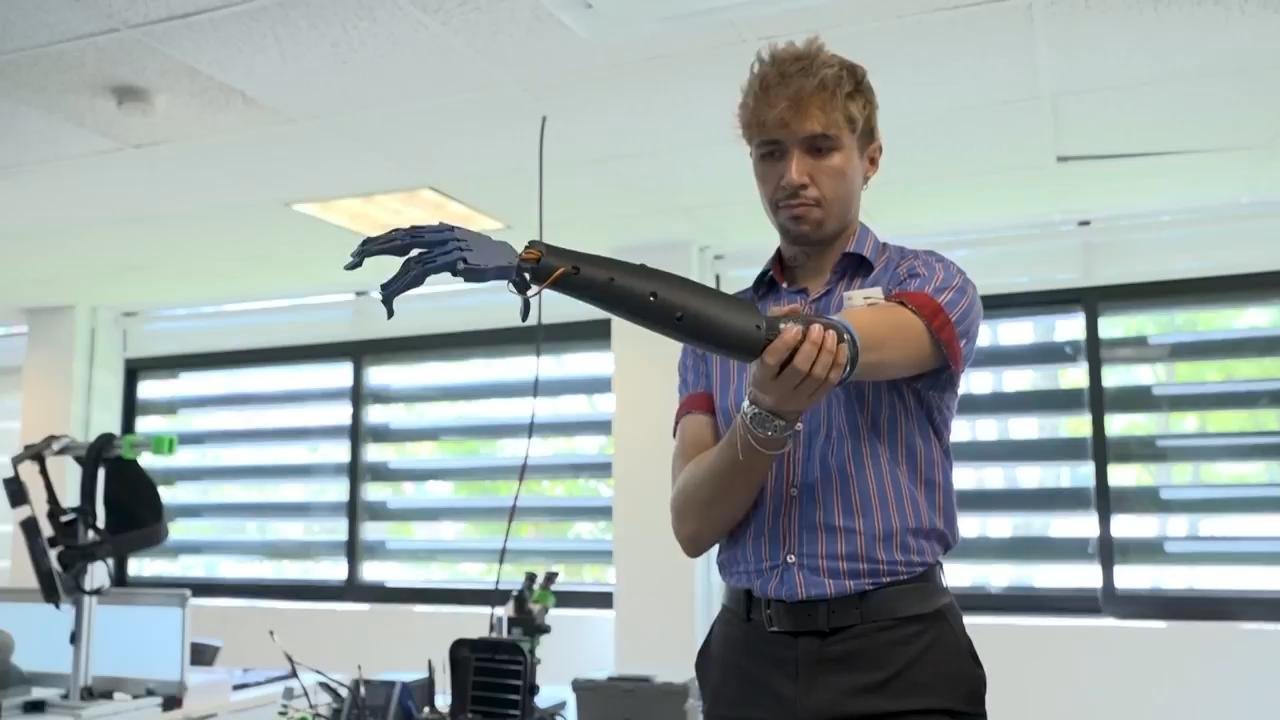
MEXICO CITY, Mexico — April 7, 2026 — A team of Mexican engineers has unveiled a lightweight, low‑cost robotic arm whose design was inspired by a simple childhood gesture: the pinky promise.
Researchers at the National Polytechnic Institute (IPN) said the idea emerged during early brainstorming sessions, when one engineer recalled how children often link fingers to signal trust. According to the team, that memory led them to explore simplified mechanical linkages that mimic the natural, intuitive motion of a small hand gesture.
The resulting prototype, presented this week at a public demonstration in Mexico City, uses a minimal set of joints and tension cables to replicate basic grasping and pointing movements. Lead researcher Dr. Alejandra Ruiz explained that the goal was not to compete with high‑end industrial robotic arms, but to create an accessible tool for education, rehabilitation, and small‑scale tasks.
“We wanted to show that robotics doesn’t always have to be complex or expensive,” Ruiz said during the presentation. “A familiar gesture helped us rethink how to design a mechanism that is both functional and easy to build.”
The arm is constructed from lightweight composite materials and can be assembled using off‑the‑shelf components. According to the research team, the simplified structure reduces production costs by more than half compared to typical entry‑level robotic arms used in classrooms and labs.
Early tests suggest the device could be useful in physical therapy settings, where patients practice repetitive hand and wrist movements. The researchers are currently collaborating with clinicians at a local rehabilitation center to evaluate whether the arm can support motor‑skills training for children recovering from injuries.
Robotics specialists not involved in the project say the design reflects a growing trend toward “human‑inspired minimalism,” where engineers draw from everyday gestures or natural movements to create more intuitive machines. Dr. Luis Martínez, a robotics lecturer at the Autonomous University of Mexico, said the project demonstrates how cultural or personal memories can influence engineering in unexpected ways.
“It’s a reminder that innovation often begins with something small and relatable,” Martínez noted. “A childhood promise becomes a mechanical principle — that’s a powerful narrative.”
The IPN team plans to publish its full technical findings later this year and hopes to release open‑source schematics so students and hobbyists can build their own versions.
The project was supported by the National Council of Humanities, Science and Technology (CONAHCYT), which has encouraged research groups to explore low‑cost robotics for public education.
As the prototype continues to evolve, the researchers say they will keep refining the design — but the original inspiration, the pinky promise, will remain at the heart of the project.
