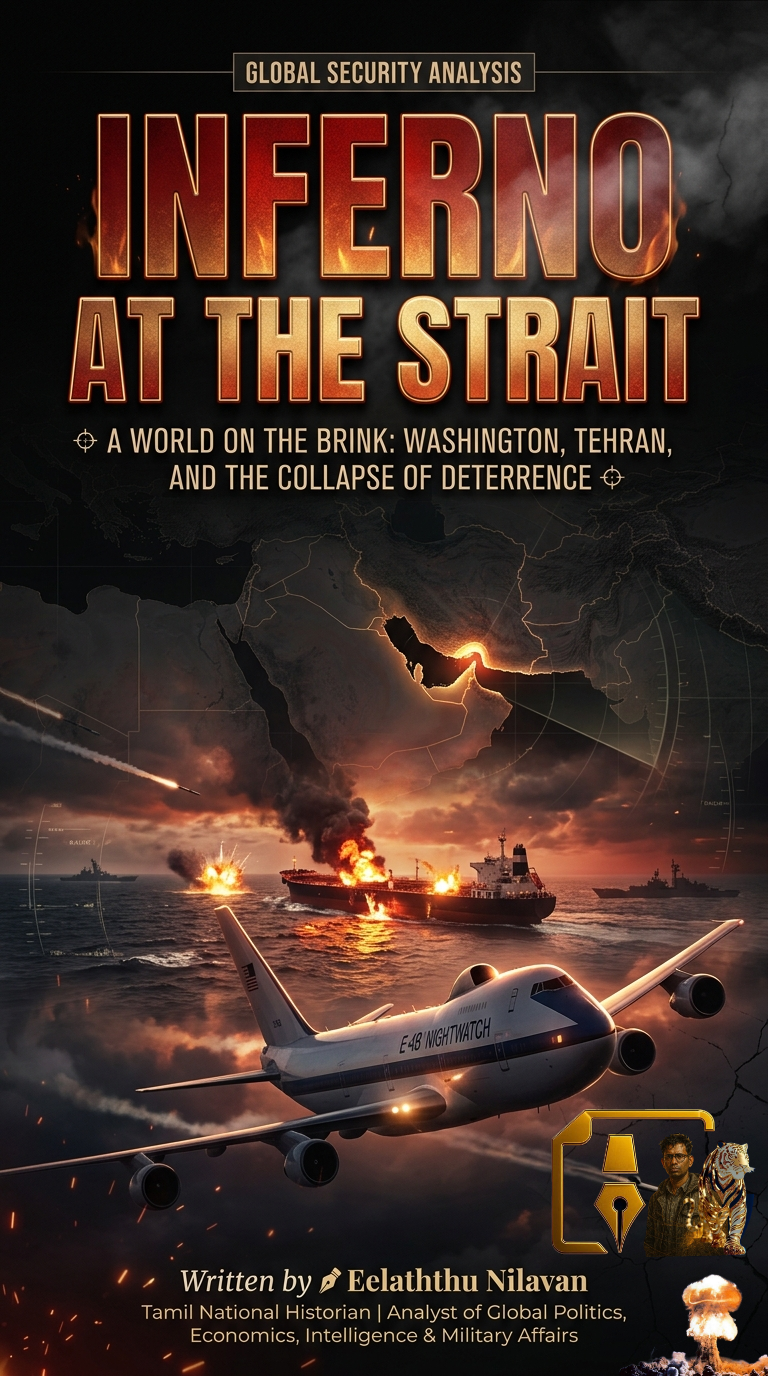

THE DOOMSDAY SIGNAL: NIGHTWATCH IN THE SKY
The sighting of the Boeing E-4B “Nightwatch”—often called the “Doomsday Plane”—circling above Offutt Air Force Base marks a chilling escalation in strategic signaling. Operated by the United States Strategic Command, this airborne command post is designed to function during nuclear war, ensuring continuity of government under catastrophic conditions.
While such flights can occur during routine readiness drills, the timing—just hours before a high-stakes ultimatum—transforms this into a calculated message. Analysts interpret the deployment as a visible assertion that Washington is preparing for worst-case scenarios, including large-scale conflict.
THE ULTIMATUM CLOCK: PRESSURE ON TEHRAN
At the center of the crisis is a hard deadline issued by Donald Trump demanding that Iran reopen the Strait of Hormuz and accept U.S.-backed peace conditions.
The warning was unambiguous: failure to comply could trigger overwhelming military force, with rhetoric suggesting Iran could be neutralized “in one night.” This language signals a shift from deterrence to coercive brinkmanship—where diplomacy is backed by an immediate military threat.
Simultaneously, U.S. officials confirmed high-risk aerial operations inside hostile airspace, including complex rescue missions involving over 20 aircraft—demonstrating both capability and willingness to operate deep within contested zones.
TEHRAN STRIKES BACK: FROM RESTRAINT TO RETALIATION
Iran has decisively abandoned its long-standing doctrine of “strategic patience.” Through its elite force, the Islamic Revolutionary Guard Corps (IRGC), Tehran launched “Wave 99”—a coordinated barrage of missile and drone strikes targeting U.S.-linked energy infrastructure across the Gulf.
Key developments include:
• Strikes on petrochemical facilities tied to ExxonMobil and Chevron Phillips
• Attacks on maritime assets linked to Israeli supply routes
• Threats against U.S. naval forces in the Indian Ocean
Iran has warned that any escalation will trigger unrestricted retaliation, including long-term disruption of energy supplies to U.S. allies.
INFRASTRUCTURE WARFARE: ISRAEL ENTERS FULL FORCE
The conflict has expanded beyond proxy engagements into direct, large-scale infrastructure warfare. The Israel Defense Forces (IDF) has launched sweeping strikes across Iran, targeting:
• Railway networks from Tabriz to Mashhad
• Strategic bridges and highways
• Critical logistics corridors
This campaign aims to paralyze Iran’s internal mobility and military logistics. In response, Tehran has shut down nationwide rail operations, signaling the severity of the disruption.
Iran’s counter-response includes preparation for advanced missile deployments, including Fattah and Khaibar Shekan systems—indicating a transition toward high-intensity, sustained conflict.
THE STRAIT OF HORMUZ: GLOBAL ECONOMY AT RISK
The Strait of Hormuz remains the most critical geopolitical chokepoint in the world, handling a significant portion of global oil shipments.
Iran’s warning that vessels linked to adversaries may lose “innocent passage” status has triggered alarm across global markets. Even partial disruption could:
• Spike global oil prices dramatically
• Disrupt supply chains across Europe and Asia
• Trigger inflationary shocks worldwide
Energy markets are already reacting nervously, with traders pricing in the risk of prolonged instability.
DIPLOMATIC BREAKDOWN: THE UN DIVIDED
At the United Nations, divisions among global powers have become stark. Russia’s envoy, Vasily Nebenzya, sharply criticized U.S. and Israeli actions, accusing them of escalating the crisis.
Backed by China, Russia vetoed a proposed resolution aimed at securing maritime routes, arguing it would legitimize further Western military expansion.
Iran’s UN ambassador, Amir Saeid Iravani, went further—accusing the U.S. and Israel of:
• War crimes against civilians
• Targeting nuclear and energy infrastructure
• Violating international law
Tehran has rejected temporary ceasefires, insisting that only a complete halt to aggression with enforceable guarantees is acceptable.
BEYOND SHADOW WAR: A NEW PHASE OF CONFLICT
What began as a shadow war of covert strikes and proxy battles has now evolved into:
• Direct state-on-state confrontation
• Open targeting of infrastructure and energy systems
• Expanded geographic scope—from the Persian Gulf to the Indian Ocean
Reports of advanced missile deployments, including MIRV-capable systems, suggest that defensive systems may soon be overwhelmed, raising the stakes even further.
STRATEGIC OUTLOOK: THE EDGE OF ESCALATION
The convergence of military signaling, active combat operations, and diplomatic paralysis places the world at a dangerous inflection point.
Key risk factors include:
• Miscalculation leading to full-scale war
• Closure or disruption of the Strait of Hormuz
• Direct confrontation between global powers
• Spillover into neighboring states and global markets
The presence of the “Doomsday Plane” is not just symbolic—it is a reminder that contingency planning has already moved into its most extreme phase.
CONCLUSION: A FRACTURED WORLD ORDER
This crisis is no longer confined to the Middle East—it is a test of the global order itself.
With diplomacy stalled, military operations intensifying, and economic risks mounting, the situation is approaching a tipping point where containment may no longer be possible.
The coming hours will be decisive. Whether through negotiation or escalation, the outcome will shape not only regional stability, but the future of global power dynamics.

Written by 𝐄𝐞𝐥𝐚𝐭𝐡𝐭𝐡𝐮 𝐍𝐢𝐥𝐚𝐯𝐚𝐧
Tamil National Historian | Analyst of Global Politics, Economics, Intelligence & Military Affairs
08/04/2026
The views expressed in this article are the author’s own and do not necessarily reflect Amizhthu’s editorial stance.