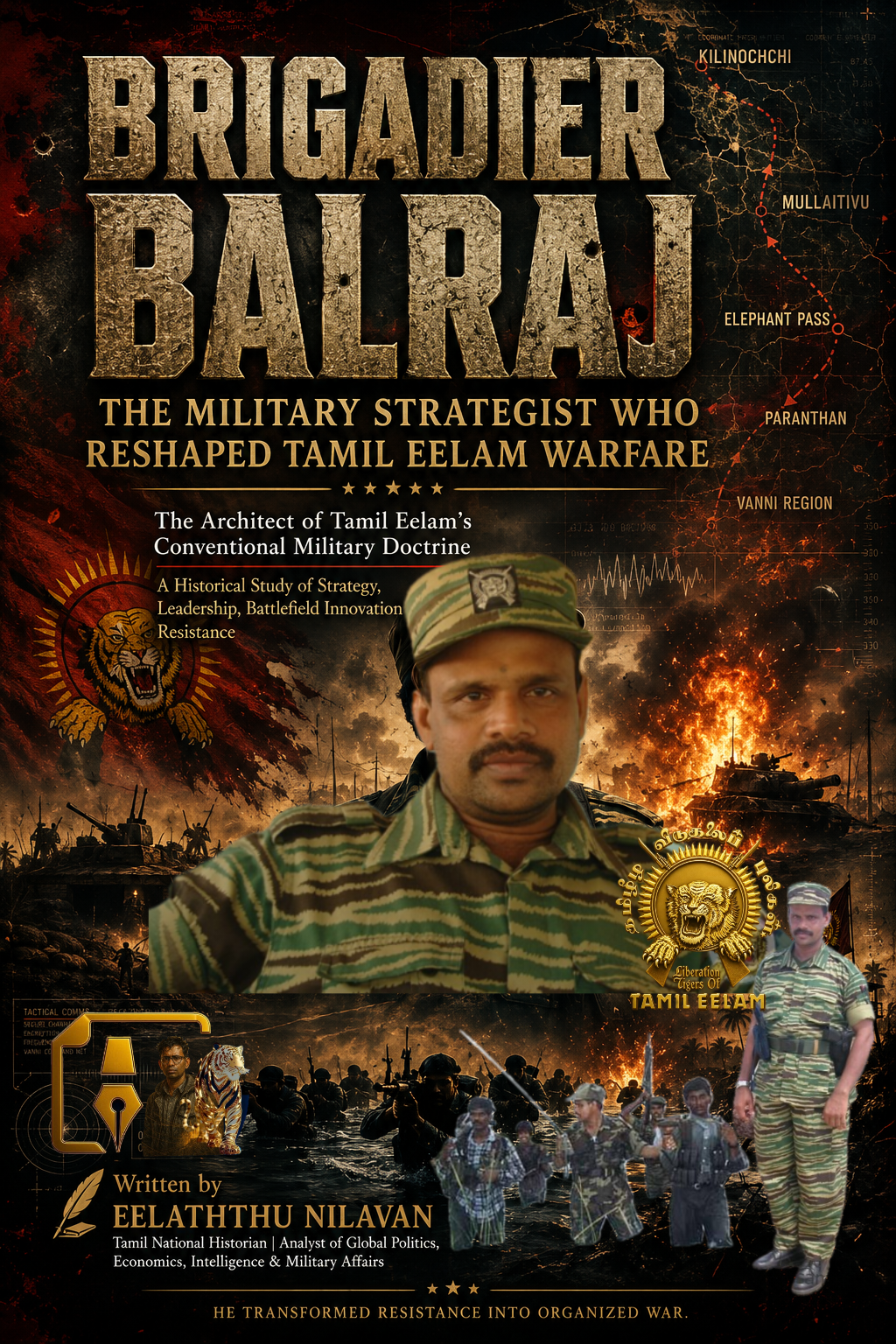

A NAME ENGRAVED IN THE HISTORY OF WAR
Within the long and painful history of the Tamil Eelam liberation struggle, many commanders emerged, many warriors fell, and countless battles were fought. Yet only a few individuals transcended the role of a battlefield commander and became embodiments of an entire military philosophy. Brigadier Balraj was one such figure.
He was not merely a commander of the Liberation Tigers of Tamil Eelam (LTTE); he was one of the principal architects of Tamil Eelam’s modern military doctrine.
The evolution of the LTTE from a guerrilla movement into a highly disciplined conventional fighting force did not occur by accident. It emerged through years of battlefield experimentation, strategic adaptation, relentless sacrifice, and innovative military thinking. At the centre of that transformation stood Brigadier Balraj.
His methods of deep penetration assaults, rear-flank infiltration, rapid defensive overruns, amphibious warfare coordination, battlefield mobility, supply-line disruption, and decentralised tactical command fundamentally altered the military balance in the North-East of Sri Lanka during the 1990s and early 2000s.
Even the Tamil National Leader himself reportedly described Balraj as:
“A fighter who surpassed even me.”
That statement was not symbolic praise. It reflected the extraordinary confidence placed in Balraj’s battlefield instincts, operational leadership, and unwavering courage.
THE MAKING OF A WARRIOR: CHILDHOOD IN KOKKUTHODUVAI
Brigadier Balraj was born on 27 November 1964 in the coastal village of Kokkuthoduvai in Mullaitivu District. The environment in which he grew up played a decisive role in shaping the man he would become.
Surrounded by lagoons, dense forests, open fields, coconut groves, and the vast ocean, his childhood was deeply connected to nature and survival. Hunting became one of his earliest passions. Yet what appeared to be a rural pastime would later evolve into a foundation for advanced military skills.
Through hunting, he naturally developed:
• patience,
• stealth movement,
• environmental awareness,
• tracking abilities,
• endurance,
• terrain reading,
• tactical observation,
• and the psychological discipline required for combat.
These qualities later distinguished him as one of the most effective battlefield reconnaissance commanders within the LTTE.
ETHNIC OPPRESSION AND THE BIRTH OF RESISTANCE
The Tamil homeland regions surrounding Manal Aru, Kokkilai, Pulmoddai, Thennamaravadi, and Mullaitivu became targets of systematic Sinhala colonisation projects initiated by the Sri Lankan state. Tamil communities were displaced from fertile lands and strategically important regions to alter demographic realities and weaken Tamil territorial continuity.
Balraj’s own family, along with thousands of others, experienced displacement, dispossession, and insecurity firsthand. Homes were abandoned. Villages were militarised. Families became refugees overnight.
These experiences deeply shaped his political consciousness. He came to believe that without armed resistance, the Tamil people would possess neither security nor dignity.
His father reportedly advised him:
“If you are determined to fight, join Prabhakaran’s movement. That movement alone is fighting in the correct path.”
Those words would alter the course of his life.
JOINING THE LTTE AND EARLY MILITARY DEVELOPMENT
Balraj joined the LTTE in 1983.
Because he possessed intimate knowledge of the forests, waterways, and hidden routes of the Vanni region, he initially served as a guide and field operative.
In 1984, during an ambush near Othiyamalai in which several LTTE cadres, including Lt. Kandipan, were killed, Balraj was wounded in the shoulder. After receiving treatment in India, he underwent formal military training at the India-09 training camp before returning to the battlefield.
Upon his return, he worked closely with Major Basilan, one of the LTTE’s most respected early commanders. Under Basilan’s mentorship, Balraj absorbed advanced battlefield planning methods, reconnaissance principles, offensive manoeuvre tactics, and operational discipline.
Within a short time, Basilan reportedly recognised Balraj as one of the movement’s most capable young commanders.
THE INDIAN PEACEKEEPING FORCE WAR: THE RISE OF BALRAJ
The arrival of the Indian Peace Keeping Force (IPKF) transformed the Tamil homeland into one of the most intense battlefields in South Asia during the late 1980s.
It was during this brutal phase of warfare that Balraj’s military abilities became fully visible.
He participated in numerous operations against Indian forces, including:
• anti-armour engagements,
• ambushes,
• reconnaissance missions,
• rapid assault operations,
• and counter-insurgency resistance campaigns.
One of the most notable moments came during battles near Kopay, where Balraj reportedly destroyed an Indian armoured vehicle using an RPG launcher.
However, the defining episode of this era was his response to an Indian commando ambush operation in the forests near Nedunkerni.
Upon identifying signs that Indian special forces had prepared a kill zone ahead, Balraj refused to retreat. Instead, he devised an immediate counter-ambush strategy.
Rather than becoming victims of the ambush, his unit manoeuvred around the Indian commandos, attacked from the flanks and rear, and annihilated the entire ambush formation before the enemy could recover.
This battle became legendary because it demonstrated:
• exceptional battlefield intuition,
• rapid tactical adaptation,
• psychological aggression,
• and the ability to reverse battlefield disadvantage instantly.
It also reportedly shocked Indian military planners, who did not expect guerrilla fighters to counter elite commando tactics so effectively.
THE CREATION OF A CONVENTIONAL MILITARY FORCE
By the early 1990s, the LTTE leadership understood that guerrilla warfare alone would not be sufficient to permanently challenge the Sri Lankan military.
A transition toward conventional warfare was necessary.
In 1991, the Charles Anthony Brigade — the LTTE’s first conventional fighting formation — was officially established. Brigadier Balraj was chosen to lead it.
This appointment reflected enormous trust in his abilities.
Balraj possessed a rare combination of:
• tactical creativity,
• operational discipline,
• reconnaissance expertise,
• battlefield courage,
• and the ability to inspire fighters psychologically.
Under his command, the Charles Anthony Brigade evolved into one of the most formidable Tamil military formations of the war.
REVOLUTIONIZING TAMIL EELAM WARFARE
One of Balraj’s greatest contributions was the development of new assault doctrines designed to overwhelm heavily fortified Sri Lankan military positions.
Traditional frontal assaults often resulted in heavy casualties. Balraj, therefore, developed new methods emphasising:
• rapid infiltration,
• rear-flank penetration,
• simultaneous assaults,
• mobility,
• and surprise.
His doctrine focused on breaking through defensive bunkers quickly, bypassing frontline resistance, infiltrating behind enemy positions, severing supply routes, isolating command centres, and collapsing defensive coordination from within.
These methods later became foundational to many successful LTTE military operations across the North-East.
THE ELEPHANT PASS STRATEGIC VISION
Balraj’s operational brilliance became globally recognised during operations connected to Elephant Pass and the Kudaarappu amphibious assault.
The Tamil Leader reportedly told him:
“You will command the battle for Elephant Pass. This is the greatest test I have given you.”
Balraj then led one of the most daring military operations in the history of the conflict.
With approximately 1,500 fighters, LTTE forces infiltrated deep behind Sri Lankan military lines and disrupted critical supply routes while confronting a vastly superior military force supported by:
• air power,
• naval power,
• artillery,
• tanks,
• and tens of thousands of troops.
For over a month, these units held their positions under extreme pressure, demonstrating extraordinary endurance and discipline.
Military observers worldwide were astonished by the scale, coordination, and effectiveness of the operation.
THE FALL OF MULLAITIVU: A TURNING POINT
The 1996 Mullaitivu base assault remains one of the most significant military victories in LTTE history.
At a time when the Sri Lankan state believed the LTTE was weakening, the movement launched a massive offensive designed to reassert its military strength.
Balraj played a central role in planning and executing the assault.
The operation combined:
• amphibious coordination,
• rapid penetration,
• concentrated firepower,
• tactical mobility,
• and battlefield isolation strategies.
The base eventually collapsed, and the LTTE captured enormous quantities of heavy weaponry, including over one hundred artillery systems.
The psychological impact of this victory was enormous. It shattered the myth of Sri Lankan military invincibility and demonstrated the LTTE’s growing conventional warfare capabilities.
LEADERSHIP STYLE: COMMAND FROM THE FRONT
Perhaps the defining feature of Brigadier Balraj was his leadership style.
He did not command battles from distant headquarters. He moved among fighters, visited frontline bunkers personally, inspected terrain himself, and frequently advanced dangerously close to enemy defences despite severe leg injuries sustained in battle.
He believed that:
“A commander can only issue accurate battlefield orders if he personally understands the terrain, positions, and realities of combat.”
This philosophy earned him extraordinary respect among cadres.
Whenever fighters heard that Balraj himself was directing an operation, morale reportedly surged immediately.
HUMANITARIAN CHARACTER DURING THE 2004 TSUNAMI
During the 2004 Indian Ocean tsunami, Balraj was stationed near the eastern coast.
After noticing the ocean rapidly receding, he immediately sensed impending danger and ordered fighters to fire warning shots into the air to alert nearby civilians. Many people reportedly escaped because of those warnings.
Even after surviving the tsunami himself, he immediately organised rescue and relief operations for affected civilians.
This revealed another side of Balraj:
• not merely a military commander,
• but a leader deeply connected to the people.
MULLIVAIKKAL AND THE INTERNATIONAL DIMENSION OF THE WAR
The final military defeat at Mullivaikkal cannot be understood purely as a confrontation between the Sri Lankan military and the LTTE.
The war’s final phase involved:
• extensive foreign military assistance,
• international intelligence cooperation,
• technological support,
• naval surveillance,
• arms embargoes,
• geopolitical realignments,
• and internal betrayals.
From the Tamil nationalist perspective, the military setback emerged not from a lack of courage or fighting ability, but from overwhelming international intervention and severe logistical isolation.
A MILITARY LEGACY THAT ENDURES
Brigadier Balraj was more than a battlefield commander.
He was:
• a military innovator,
• a strategist,
• a field tactician,
• a disciplined organiser,
• and one of the most influential architects of Tamil Eelam military doctrine.
His life represented the transformation of Tamil armed resistance from scattered guerrilla actions into coordinated military warfare.
Even today, his name survives in Tamil political memory not merely because of victories won, but because of the discipline, sacrifice, leadership, and strategic imagination he embodied.
In the history of Tamil Eelam warfare, Brigadier Balraj remains remembered as: The commander who turned battlefield adversity into military opportunity and transformed resistance into organised war.

𝐄𝐞𝐥𝐚𝐭𝐡𝐭𝐡𝐮 𝐍𝐢𝐥𝐚𝐯𝐚𝐧
Tamil National Historian | Analyst of Global Politics, Economics, Intelligence & Military Affairs