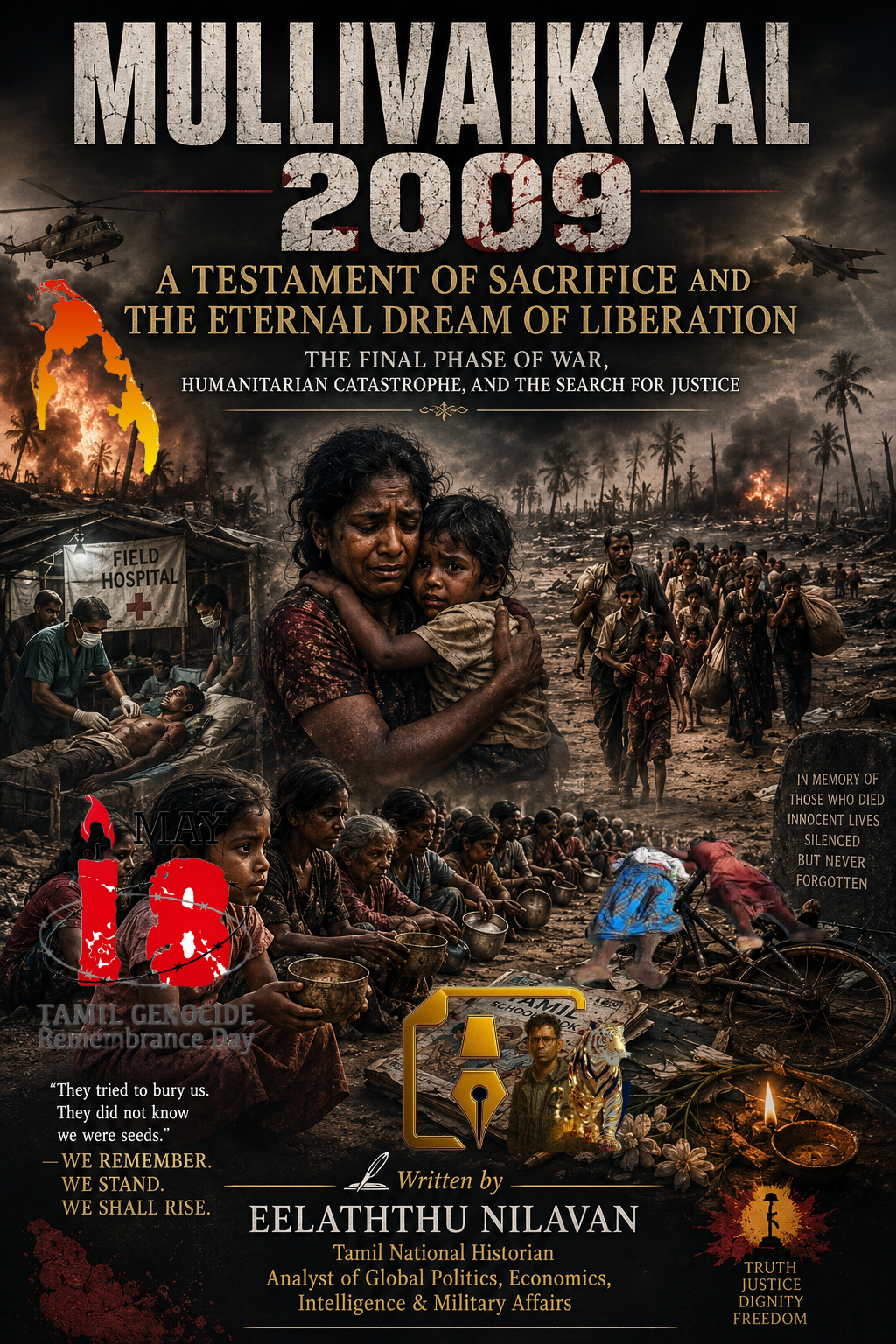
The Final Phase of War, Humanitarian Catastrophe, and the Search for Justice
THE SILENCED SIEGE
The Final War Hidden from the World
The final months of 2009 remain among the most painful and controversial periods in modern South Asian history. For many Tamils across the world, Mullivaikkal is not remembered merely as the end of a military conflict, but as the symbol of an immense humanitarian catastrophe in which civilians became trapped between advancing military forces and a collapsing war zone.
The roots of the conflict stretched back decades. Political tensions, disputes over language policy, ethnic violence, militarization, and competing national aspirations had shaped Sri Lanka’s post-independence history. By 2006, the ceasefire agreement had effectively collapsed, and the island returned to full-scale war.
As the conflict intensified, government forces advanced steadily into the North after retaking the Eastern Province. International observers, humanitarian organizations, and independent journalists later argued that access to the war zone became increasingly restricted during the final phase of the conflict. Because of this isolation, many events from the last months of the war remain heavily debated and emotionally charged.
The Vanni region gradually became a shrinking enclave filled with displaced civilians. Families abandoned homes, farms, and possessions, carrying only what they could survive with. Schools became refugee shelters. Temples transformed into emergency medical centers. Open fields became burial grounds.
The roads through Kilinochchi, Visuamadu, Puthukkudiyiruppu, and finally Mullivaikkal were crowded with endless columns of displaced civilians moving under fear, uncertainty, and exhaustion.
THE SIEGE OF THE VANNI
The Heart of a Humanitarian Disaster
By late 2008 and early 2009, hundreds of thousands of civilians were trapped inside rapidly shrinking territory as government troops pushed deeper into areas previously controlled by the LTTE.
Food supplies became critically limited. Medical shortages intensified. Humanitarian agencies repeatedly warned of a looming catastrophe.
Hospitals and makeshift medical points in Kilinochchi, Vallipunam, Puthukkudiyiruppu, and Mullivaikkal operated under extreme conditions. Doctors later described performing surgeries with inadequate anesthesia and treating patients on overcrowded floors with almost no medical equipment.
According to survivor testimonies and later human rights investigations, areas densely populated with civilians came under repeated shelling during the final months of the war. Particular controversy surrounded attacks allegedly impacting hospitals and designated “No Fire Zones.”
Families dug bunkers into sand embankments for survival. Children spent nights listening to explosions. Parents attempted to shield their children from artillery fire while searching desperately for safety.
THE “NO FIRE ZONES”
Civilian Casualties and International Controversy
The “No Fire Zones” declared during the final months of the war remain one of the most controversial aspects of the conflict.
Civilians were instructed to move into designated safe areas. However, survivors later reported that shelling continued within or near those zones. United Nations panels and international human rights organizations documented allegations that densely populated civilian areas came under attack during the final stages of the war.
Survivor accounts describe scenes of immense devastation:
• Children crying beside dead parents
• Families searching for missing relatives among debris
• Elderly civilians waiting in long food lines
• Civilians digging bunkers with bare hands
As civilians became concentrated along the Mullivaikkal coastline, conditions deteriorated further. There was little access to clean water, food, sanitation, or shelter.
One of the most enduring memories from the period is the sight of civilians waiting for hours in line to receive small portions of porridge in coconut shells or damaged containers. For many survivors, these images became lasting symbols of desperation and endurance.
LIFE INSIDE THE TRAP
Fear, Hunger, and Psychological Trauma
Life inside Mullivaikkal was dominated by constant fear and uncertainty. Families survived inside shallow bunkers dug into sandy ground. During rainstorms, some bunkers collapsed. Others were destroyed by nearby explosions.
Hunger became part of daily existence. Minor injuries turned fatal because medicines were unavailable. Malnutrition spread among children. Disease and exhaustion became widespread.
Many survivors later described life during those months as a constant state of waiting — waiting for the next shelling, the next meal, the next chance to survive.
The smell of blood, smoke, burning debris, and overcrowded conditions became deeply embedded in the memories of those who survived.
THE MEDICAL WARRIORS OF MULLIVAIKKAL
Saving Lives Amid Destruction
Doctors, Medical warriors, nurses, and volunteers who worked during the final days of the war are remembered by many Tamils as symbols of extraordinary human dedication.
Working with almost no supplies, medical workers attempted to save lives under relentless pressure. Witnesses later described surgeries performed inside bunkers and wounds treated under flashlight illumination.
Saris were torn into bandages. Wooden poles became makeshift stretchers. Even while facing hunger and fear themselves, many medical volunteers continued treating the wounded.
Reports later emerged that some medical personnel were themselves killed during the fighting.
THE PORRIDGE LINES
A Silent Symbol of Survival
Among the most haunting memories of Mullivaikkal are the long lines of civilians waiting for porridge.
Elderly people, widows, and children stood holding coconut shells, rusted tins, and broken containers, hoping to receive a small serving of food. That porridge was more than nourishment; it represented survival itself.
Survivors remember young girls like Deepa waiting patiently in line, hoping to bring a little food back to their families.
Today, “Mullivaikkal porridge” has become more than a memory of starvation. For many Tamils, it symbolizes collective endurance, dignity, and the human instinct to share even in the darkest circumstances.
THE FINAL DAYS
Nandikadal and the End of the War
By May 2009, the conflict had reached its final stage around Mullivaikkal and the Nandikadal Lagoon.
Survivors recall constant explosions, smoke-filled skies, cries of grief, and scenes of overwhelming devastation.
On May 18, 2009, the Sri Lankan government officially declared military victory. The death of LTTE leader Velupillai Prabhakaran marked the end of the organization’s armed campaign.
Yet for many Tamils, Mullivaikkal did not represent closure. Instead, it became the beginning of a continuing search for justice, accountability, and historical recognition.
Estimates of civilian deaths remain disputed. However, international organizations, including the United Nations, expressed grave concern regarding the scale of civilian casualties during the final months of the conflict.
MEMORY, JUSTICE, AND THE INTERNATIONAL DEBATE
Unanswered Questions of 2009
The events of 2009 continue to be debated in international legal and political forums. Some Tamil organizations, activists, and legal scholars describe the events at Mullivaikkal as genocide, while the Sri Lankan government rejects those allegations.
United Nations reports and human rights investigations documented allegations including:
• Indiscriminate shelling of civilian areas
• Attacks impacting hospitals
• Restrictions on humanitarian aid
• Allegations of enforced disappearances and unlawful killings
Calls for independent international investigations continue to be raised by various advocacy groups and human rights organizations.
THE CHALLENGE OF A NEW GENERATION
Language, Memory, and Identity
Today, many Tamils believe the greatest struggle is no longer fought only on battlefields, but within memory, identity, and culture itself.
Writers, activists, and educators have expressed concern that younger generations risk becoming disconnected from their language, history, and collective historical consciousness.
For many, forgetting the language means forgetting the historical experience that shaped an entire people. Mullivaikkal remains not only a memory of suffering, but also part of a continuing discussion about identity, dignity, political aspirations, and cultural survival.
CONCLUSION
The Memories That Refuse to Fade
For many Tamils around the world, Mullivaikkal is more than a historical event. It is the memory of lost families, unanswered questions, destroyed communities, and immense human suffering.
It is also the memory of doctors treating the wounded without medicine, parents protecting children amid shelling, and civilians struggling to survive under unimaginable conditions.
Every year, Tamils across the globe commemorate Mullivaikkal. For them, remembrance is not only an act of mourning, but also a declaration that history, identity, and memory must not disappear.
Any lasting peace and reconciliation, many believe, can emerge only through truth, accountability, and an honest examination of the past.

𝐄𝐞𝐥𝐚𝐭𝐡𝐭𝐡𝐮 𝐍𝐢𝐥𝐚𝐯𝐚𝐧
Tamil National Historian | Analyst of Global Politics, Economics, Intelligence & Military Affairs
15/05/2026