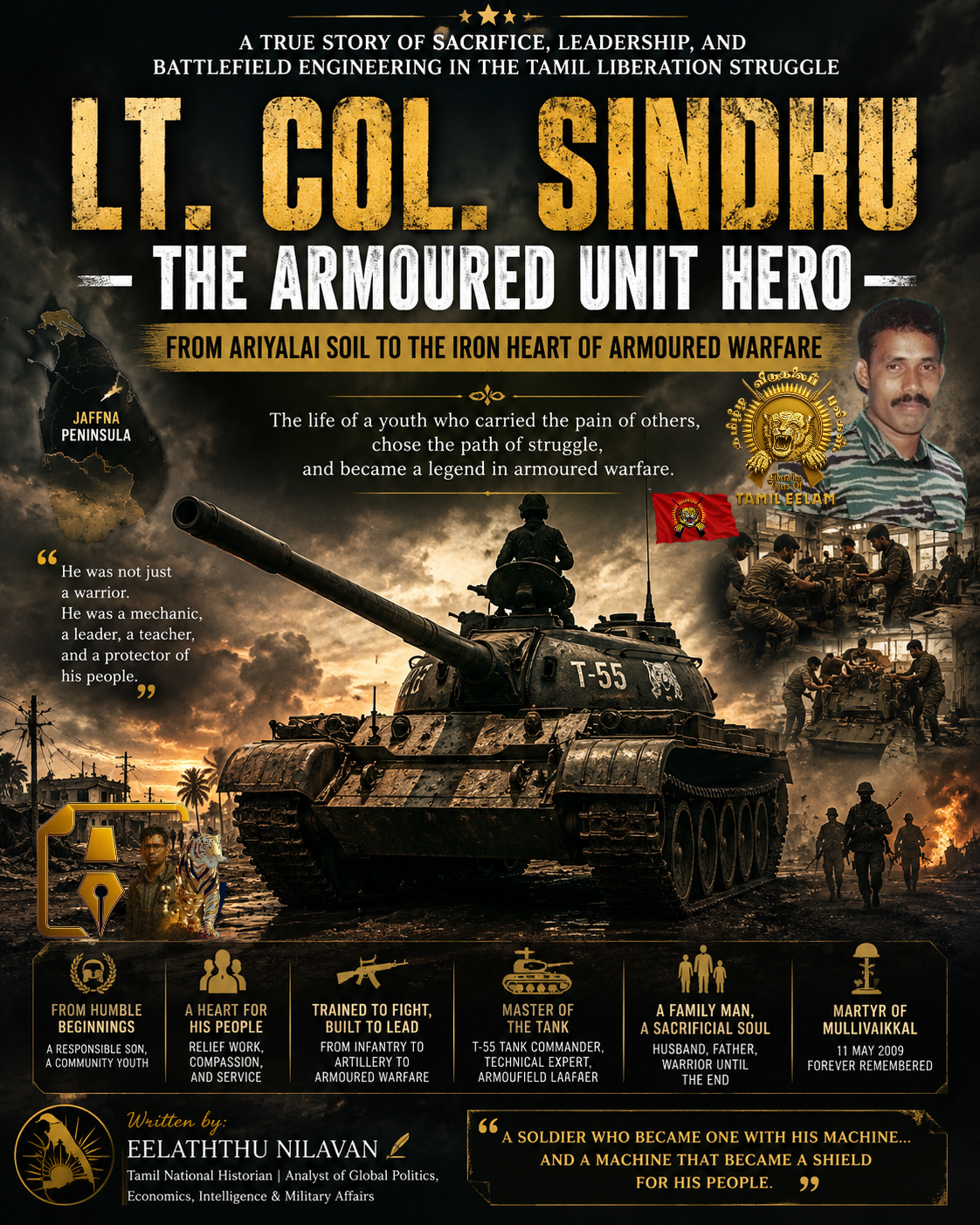

From the Soil of Ariyalai to the Iron Heart of Armoured Warfare
“A man who carried the pain of others more than his own…
INTRODUCTION — THE TRANSFORMATION OF AN ORDINARY YOUTH INTO AN EXTRAORDINARY FIGURE
Within the historical narrative of the Tamil liberation struggle, certain individuals stand out not merely for their battlefield roles but for the depth of their human journey. Among them, Lieutenant Colonel Sindhu occupies a distinctive place as one of the most committed and technically skilled members of the Armoured Unit.
Born in Ariyalai, Jaffna, he rose from a modest background to become a highly capable armoured warfare specialist. His life was not simply that of a combatant, but also that of a family caretaker, a community contributor, a cultural participant, and ultimately a soldier shaped by the circumstances of war.
Sindhu’s story reflects the transformation of a socially responsible youth into a disciplined fighter whose life became inseparably linked with armoured warfare and battlefield engineering.
EARLY LIFE — A CHILD OF ARIYALAI
Sindhu, originally named Dayalan, was born on 29 June 1975 in Ariyalai, Jaffna, as the sixth son of Mayilvaganam and Thilagavathy. From his early childhood, he displayed a balance of intelligence, physical ability, and social engagement.
He received his primary education at Sri Parvathy Vidyalayam in Ariyalai. During his school years, he was known not only for academic ability but also for exceptional sporting talent. He excelled in school and community sports such as traditional games and volleyball, earning respect among peers.
His athletic skills made him a well-recognised figure in his village. His ability to dominate in traditional games led to a popular local saying that when he played, no one dared cross boundaries against him. His presence was always associated with energy, confidence, and leadership.
EARLY CULTURAL AND SOCIAL INVOLVEMENT
Beyond sports, Sindhu was deeply involved in cultural activities. He participated in theatre performances organised for educational and social development in the village.
He trained at Saraswathi Kalaiyakam under community initiatives aimed at enhancing children’s education through arts. He actively participated in stage dramas, comedy performances, and historical plays.
At the Arunodaya Social Centre, he acted in several productions, including historical dramas such as “Aayiram Thalaivangiya Apoorva Chinthamani.” He also performed in comedic productions that brought laughter to large village gatherings.
His artistic talent was not merely entertainment-based; it reflected discipline, teamwork, and respect for mentors. These experiences shaped his leadership qualities and emotional intelligence.
THE BURDEN OF FAMILY RESPONSIBILITY
Sindhu’s life took a serious turn during his adolescence due to his family’s financial difficulties. He was forced to leave formal education early and take up small jobs to support his household.
He worked at a local shop and delivered newspapers during early morning hours. Despite the hardship, he saved money with the intention of supporting his family. One notable act of affection was his effort to buy a small piece of jewellery for his mother using his savings.
Eventually, he made the difficult decision to abandon his formal education at Grade 10 to fully support his family. This sacrifice shaped his character into one defined by responsibility, endurance, and selflessness.
THE IMPACT OF WAR — A TURNING POINT
In 1995, large-scale military operations in the Jaffna peninsula resulted in widespread displacement and civilian suffering. Thousands of families were forced to relocate, and many sought refuge in Ariyalai and the surrounding areas.
Sindhu, already sensitive to human suffering due to his upbringing, became actively involved in assisting displaced civilians. He helped distribute food, coordinate relief, and support families in distress.
However, the turning point in his life came after the aerial bombing of St. Peter’s Church in Jaffna, where civilians lost their lives in a devastating attack. This incident deeply affected him emotionally and psychologically.
It was at this moment that he decided to join the armed resistance, believing that passive assistance alone was no longer sufficient to protect his people.
ENTRY INTO MILITARY TRAINING
On 8 August 1995, Sindhu formally joined the Tamil liberation movement. He underwent training at the Jeevan Training Camp in the Mannar district, specifically at the Kenedy-01 training wing of the Imran Pandian Battalion.
During training, he stood out for his discipline, adaptability, physical strength, and enthusiasm. He also actively participated in sports and cultural events within the training environment.
He was soon deployed into active combat zones, including operations against major military offensives aimed at capturing northern territories.
FIRST BATTLEFIELD EXPERIENCES
Sindhu first saw active combat during operations involving the defence of Jaffna University and the surrounding regions. His ability to remain composed under pressure impressed senior commanders.
Despite being relatively new, he fought with the confidence and coordination of a seasoned soldier. His performance in these early battles marked him as a promising combatant within the unit.
After these engagements, he returned for further training and specialisation, particularly in heavy weapon systems.
SPECIALISATION IN HEAVY WEAPONS AND ARTILLERY
Sindhu was later selected for the 120mm mortar unit, a critical component of long-range artillery operations. He participated in the “Unceasing Waves 01” operation, where his technical precision and battlefield coordination were widely recognised.
His role in artillery operations demonstrated his ability to manage complex weapon systems under high-pressure combat conditions.
This phase of his career marked his transition from infantry-level combat to specialised warfare.
ENTRY INTO THE ARMOURED UNIT — THE DEFINING STAGE
Sindhu’s most defining military phase began when he was absorbed into the Armoured Unit. His technical aptitude and mechanical understanding made him an ideal candidate for armoured warfare.
He was appointed as a driver for a South African–manufactured armoured vehicle equipped with a 23mm cannon system. This role required precision driving, battlefield awareness, and coordination with weapon operators.
He was not merely a driver; he was a battlefield tactician inside the vehicle, ensuring optimal positioning during attacks and withdrawals.
THE T-55 TANK ERA — A SOLDIER AND HIS MACHINE
Sindhu’s career reached its peak when he became the driver of a captured T-55 tank. This position elevated him into one of the most critical operational roles in the armoured division.
He mastered every technical aspect of the tank — from engine mechanics to weapon deployment systems. His relationship with the tank became deeply symbolic; it was treated as a living companion.
He participated in major operations such as “Unceasing Waves 02, 03, and 04,” where armoured units played a decisive role.
In one major incident at Paranthan chemical factory, his tank became stuck in marshland under heavy enemy fire. Despite the danger, he remained in position for hours until the vehicle was recovered safely.
His dedication to the tank was absolute, even prioritising its safety over his own survival.
TECHNICAL MASTERY AND TRAINING ROLE
Sindhu was not only a combat operator but also a technical expert. He played a key role in repairing damaged armoured vehicles, modifying weapon systems, and preparing vehicles for combat readiness.
He also trained other fighters in tank operation, maintenance, and battlefield deployment strategies.
His leadership extended beyond command; it was rooted in hands-on technical expertise and mentorship.
FINAL PHASE OF WAR — HUMANITARIAN STRUGGLE AND LOSS
During the final stages of the war (2008–2009), civilian areas came under intense bombardment. Massive displacement and humanitarian crises unfolded across the region.
Sindhu continued to operate under extremely dangerous conditions, attempting to protect both civilians and military assets.
His unit faced continuous aerial strikes, artillery bombardments, and overwhelming military pressure.
In this phase, he also suffered personal loss within his family, yet continued his operational duties without withdrawal.
MULLIVAIKKAL — THE FINAL SACRIFICE
In the final phase of the conflict, intense shelling and aerial bombardment targeted densely populated civilian areas.
On 11 May 2009, Lieutenant Colonel Sindhu was killed in an artillery strike during the final battle at Mullivaikkal.
At the time of his death, he was a father of two children. His family life, like that of many others, was consumed by the final catastrophe of war.
His death marked the end of a journey that began in a small village schoolyard and ended on one of the most devastating battlefields in modern history.
CONCLUSION — THE LEGACY OF AN ARMOURED WARRIOR
Lieutenant Colonel Sindhu’s life represents more than a military biography. It reflects the transformation of an ordinary youth into a technically skilled and deeply committed armoured warfare specialist.
He was a soldier, a technician, a trainer, a caretaker, and a symbol of resilience within his unit.
His story is remembered not only for battlefield actions but for the emotional depth of a man who carried the suffering of his people as his own responsibility.
Though his life ended in war, his legacy continues as part of a broader historical memory shaped by sacrifice, conflict, and endurance.

┏━━━━━━━━•❅•⊰❉⊱•❅•━━━━━━━━┓
Written by 𝐄𝐞𝐥𝐚𝐭𝐡𝐭𝐡𝐮 𝐍𝐢𝐥𝐚𝐯𝐚𝐧
Tamil National Historian | Analyst of Global Politics, Economics, Intelligence & Military Affairs
┗━━━━━━━━•❅•⊰❉⊱•❅•━━━━━━━━┛
11/05/2026