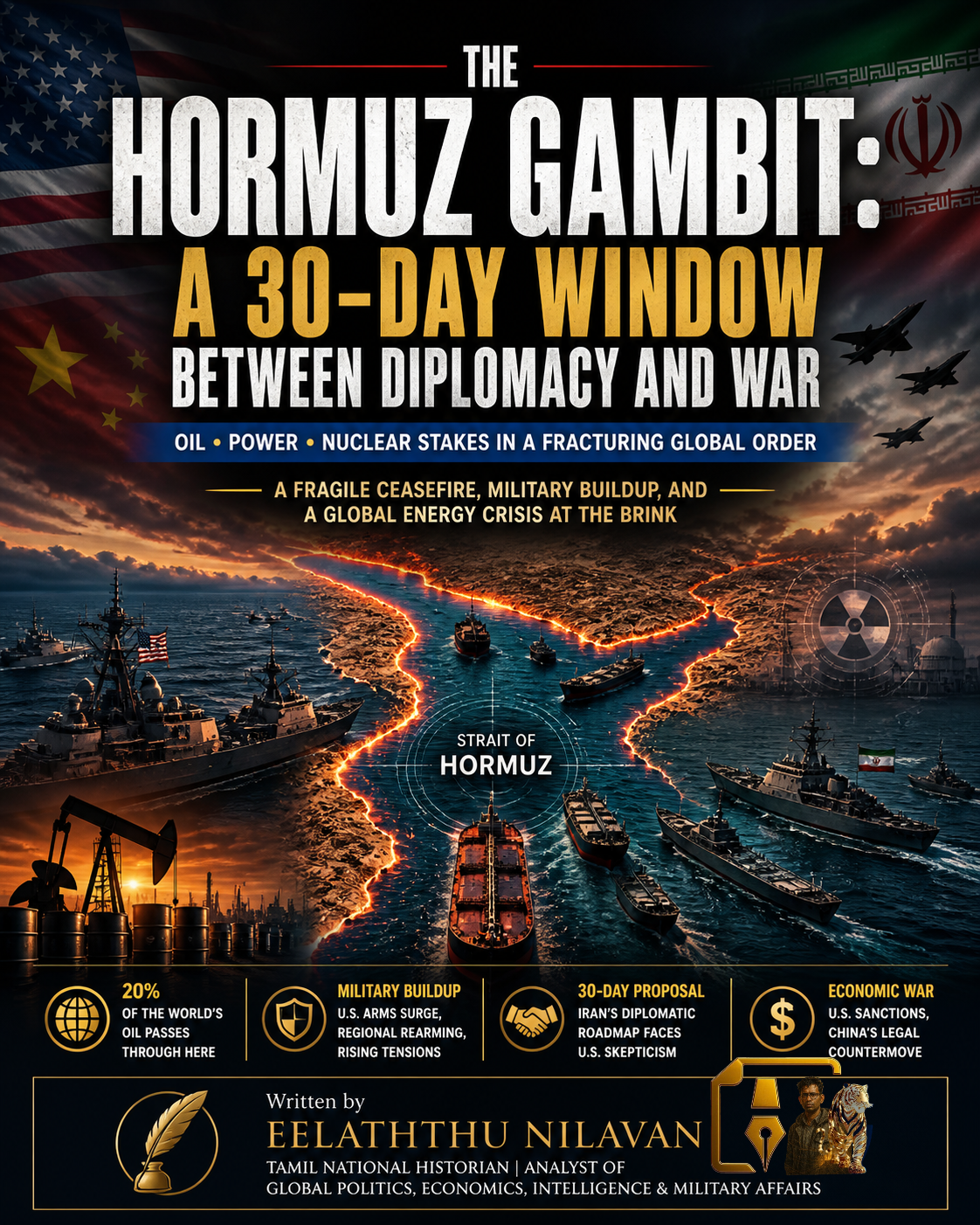

Oil, Power, and Nuclear Stakes in a Fracturing Global Order
INTRODUCTION: A WORLD HOLDING ITS BREATH
The unfolding crisis centered on the Strait of Hormuz has rapidly evolved into one of the most dangerous geopolitical flashpoints of 2026. What began as a maritime confrontation has now expanded into a multidimensional conflict involving military escalation, economic warfare, nuclear brinkmanship, and great-power rivalry.
At the heart of this volatile moment lies a fragile diplomatic opening: Iran’s proposed 30-day framework agreement to the United States. This initiative, though met with skepticism by Donald Trump, represents perhaps the last viable off-ramp before a broader regional—or even global—confrontation.
THE 30-DAY PROPOSAL: DIPLOMACY UNDER PRESSURE
Iran’s roadmap outlines a structured two-phase approach aimed at de-escalation.
In the first phase, Tehran seeks an immediate ceasefire and the reopening of maritime routes through the Strait of Hormuz. This includes demands for the lifting of the U.S. naval blockade, which Iran views as an act of economic warfare. The urgency of this phase reflects the immense global dependence on this narrow waterway, through which nearly 20% of the world’s oil supply flows.
The second phase shifts toward long-term strategic issues, particularly Iran’s nuclear programme. Tehran has signaled openness to structured negotiations, but only within a broader framework that includes sanctions relief and guarantees against future military escalation.
However, Washington remains unconvinced. President Trump has openly questioned the proposal’s credibility, suggesting that Iran has yet to face sufficient consequences to justify concessions. This skepticism underscores a deeper trust deficit that continues to undermine diplomatic progress.
MILITARY ESCALATION: PREPARING FOR THE WORST
Even as diplomacy flickers, military developments suggest preparation for a far more destructive scenario.
The United States has dramatically increased its military support to Israel, transferring thousands of tonnes of munitions and combat systems in a matter of hours. Total wartime assistance has now surpassed 115,000 tonnes, signaling not just support, but readiness for sustained conflict.
Simultaneously, U.S. Central Command (CENTCOM) has reportedly prepared multiple operational scenarios targeting Iran. These include large-scale airstrikes, naval dominance operations in the Gulf, and potential actions against Iran’s nuclear infrastructure.
Iran, under President Masoud Pezeshkian, has responded with deep suspicion. Tehran argues that past diplomatic engagements have often been followed by military escalation, eroding any remaining confidence in negotiations. This cycle of distrust is now one of the greatest obstacles to peace.
THE CHINA FACTOR: ECONOMIC WARFARE GOES LEGAL
While military tensions escalate in the Middle East, a parallel confrontation is unfolding in the economic domain—particularly between the United States and China.
Beijing has taken an unprecedented step by invoking its 2021 “Blocking Statute,” effectively ordering Chinese firms to ignore U.S. sanctions on Iranian oil. This move directly challenges Washington’s “maximum pressure” campaign and creates a legal dilemma for global corporations.
International banks and insurers now face a stark choice: comply with U.S. sanctions and risk penalties in China, or follow Chinese law and face American retaliation. This legal collision marks a significant shift toward the decoupling of the world’s two largest financial systems.
China’s actions are not merely defensive—they are strategic. As the world’s largest importer of oil, Beijing has a direct stake in keeping Iranian crude flowing. By shielding its refiners, China is not only supporting Iran economically but also reshaping the global sanctions architecture.
BEIJING’S WARNING: THE SUMMIT AT RISK
China’s diplomatic posture has also hardened in response to the crisis.
Ahead of a planned summit between President Trump and Chinese leadership, Beijing has issued a clear warning: the Strait of Hormuz must be reopened, or the summit’s agenda will be overtaken by crisis management.
Chinese officials have called for “synchronized de-escalation”—a simultaneous rollback of Iranian restrictions and U.S. military measures. This reflects Beijing’s broader strategy of positioning itself as a stabilizing force while protecting its economic interests.
The message is unmistakable: global energy security is now inseparable from great-power diplomacy.
THE STRAIT OF HORMUZ: A GLOBAL ECONOMIC LIFELINE
The centrality of the Strait of Hormuz cannot be overstated.
This narrow corridor connects the Persian Gulf to global markets, serving as a critical artery for oil exports from major producers. Any disruption sends shockwaves through global energy markets, driving price volatility, inflation, and supply chain instability.
European leaders, including Italy’s Foreign Minister, have warned that prolonged disruption could even trigger food security crises, as energy costs ripple through agricultural production and transportation systems.
In this sense, the Hormuz crisis is not a regional issue—it is a global economic emergency.
REGIONAL REARMAMENT: A PRELUDE TO PROLONGED CONFLICT
Despite the ceasefire, the Middle East is rapidly rearming.
The United States has approved over $8.6 billion in military sales to regional allies, including Israel, Qatar, Kuwait, and the UAE. These packages include advanced missile defense systems, precision-guided munitions, and integrated command networks.
This surge in defense procurement suggests that regional powers are preparing not for peace, but for a prolonged and potentially multi-front conflict. At the same time, the strain on U.S. military stockpiles is becoming evident, with concerns emerging about supply limitations and delivery delays.
EUROPE’S POSITION: RED LINES AND WARNINGS
European nations find themselves in a delicate position.
While seeking to preserve diplomatic channels, they have issued firm warnings regarding Iran’s nuclear ambitions. Italy, in particular, has declared that any move toward a military nuclear capability would constitute a “red line,” potentially triggering a regional arms race.
At the same time, European diplomats are urging Iran to de-escalate tensions with Israel and restrain allied groups such as Hezbollah. These efforts reflect Europe’s broader concern: that the conflict could expand beyond control.
CONCLUSION: A 30-DAY COUNTDOWN TO HISTORY
The next 30 days may prove निर्णற்றமான (decisive) in shaping the future of the Middle East—and perhaps the global order itself.
Iran’s proposal offers a narrow diplomatic pathway, but it is overshadowed by deep mistrust, military escalation, and competing global interests. The United States remains cautious, China is assertively intervening in economic terms, and regional actors are preparing for the worst.
The Strait of Hormuz stands not just as a geographic chokepoint, but as a symbol of a world at a crossroads—between diplomacy and destruction, cooperation and confrontation.
Whether this fragile moment leads to de-escalation or disaster will depend on decisions made in the coming weeks. The stakes could not be higher.

Written by 𝐄𝐞𝐥𝐚𝐭𝐡𝐭𝐡𝐮 𝐍𝐢𝐥𝐚𝐯𝐚𝐧
Tamil National Historian | Analyst of Global Politics, Economics, Intelligence & Military Affairs
04/05/2026
The views expressed in this article are the author’s own and do not necessarily reflect Amizhthu’s editorial stance.