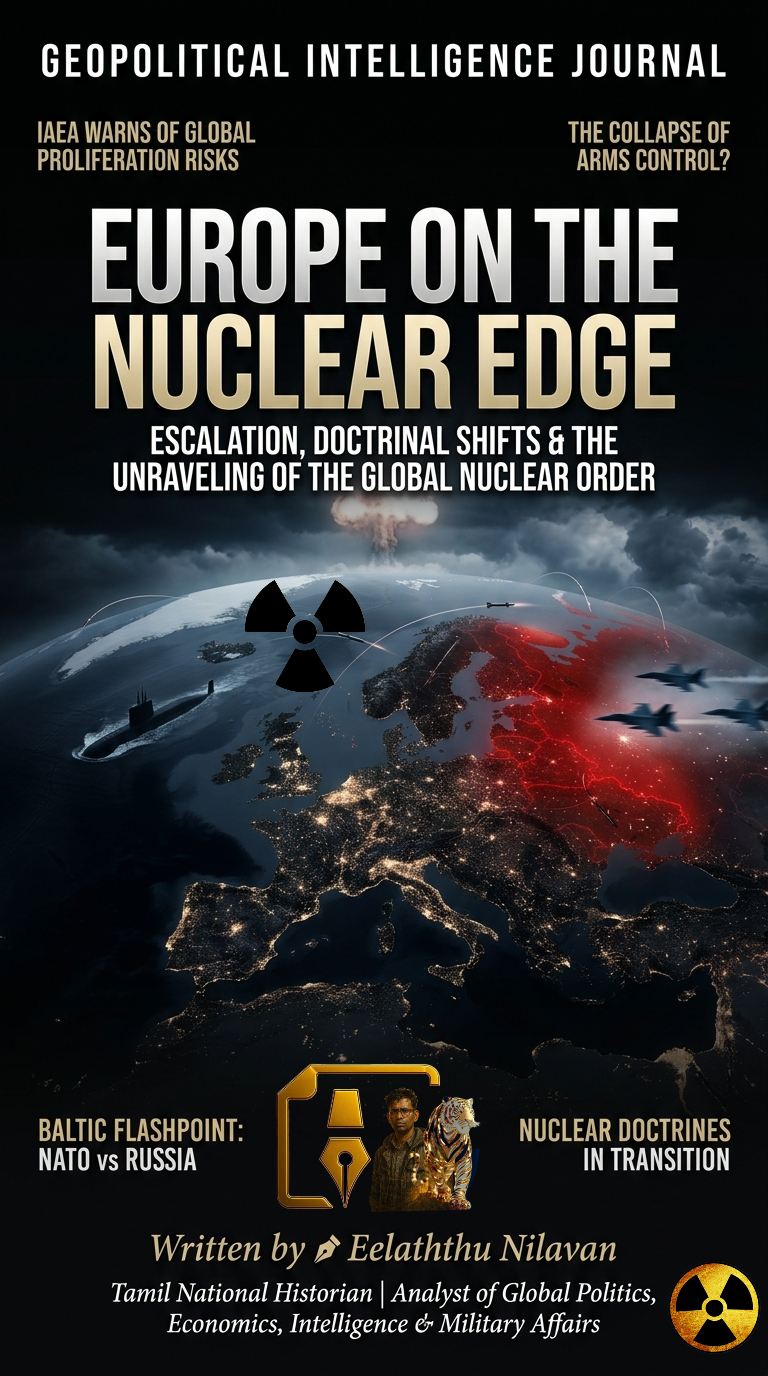
INTRODUCTION: A SYSTEM UNDER PRESSURE
The global nuclear order is entering one of its most unstable phases since the end of the Cold War. What was once a structured system—anchored by treaties, predictable doctrines, and strategic restraint—is now fragmenting under the pressure of geopolitical rivalry, technological change, and declining trust between major powers.
Recent statements by Alexander Grushko, Russia’s Deputy Foreign Minister, highlight Moscow’s growing concern that Europe is undergoing a significant and potentially dangerous transformation. According to Russian officials, the nuclear policies of the United Kingdom and France are shifting beyond traditional deterrence toward a posture that risks escalation and instability.
These concerns align with warnings from Rafael Grossi, Director General of the International Atomic Energy Agency, who has cautioned that the international nuclear system is becoming increasingly fragile and may be approaching a critical tipping point.
THE EROSION OF STRATEGIC STABILITY
For decades, nuclear stability depended on a balance between capability and restraint. This balance was maintained through agreements such as the New START Treaty and the Nuclear Non-Proliferation Treaty, as well as through norms of transparency and communication.
However, several developments have disrupted this balance:
• The expiration of the New START Treaty in 2026 has removed verifiable limits on U.S. and Russian strategic arsenals
• The Nuclear Non-Proliferation Treaty is facing increasing skepticism from both nuclear and non-nuclear states
• Confidence in arms control as a stabilizing mechanism is declining
This erosion has shifted the system from one based on predictability to one characterized by uncertainty. Without clear limits or mutual trust, states are more likely to adopt precautionary or expansionist policies.
THE UK AND FRANCE: EVOLVING NUCLEAR POSTURES
The nuclear strategies of the United Kingdom and France have become central to the current debate over European security.
The United Kingdom’s Strategic Recalibration
The United Kingdom’s decision to increase its nuclear warhead ceiling marks a significant departure from the post-Cold War trend of gradual reduction. While justified as a response to evolving threats, this move carries broader implications:
• It signals a willingness to expand nuclear capabilities
• It introduces greater uncertainty into strategic calculations
• It may influence other states to reassess their own policies
From Russia’s perspective, this development is viewed as part of a wider NATO military buildup.
France’s Strategic Ambiguity
France’s nuclear doctrine has long emphasized independence and flexibility. Recent developments suggest a shift toward greater ambiguity:
• Reduced transparency regarding arsenal size and deployment
• Increased flexibility in potential use scenarios
• Discussions about extending nuclear deterrence to European allies
This ambiguity can strengthen deterrence by complicating adversary calculations, but it also increases the risk of misinterpretation during crises.
MILITARY SIGNALING IN THE BALTIC REGION
The Baltic Sea has become a critical area of interaction between NATO and Russia. Its strategic importance makes it a focal point for military signaling and operational activity.
A recent incident illustrates rising tensions:
• Russian Tu-22M3 bombers, capable of carrying nuclear weapons, conducted a four-hour flight over the Baltic Sea
• The aircraft were escorted by Su-35 fighter jets
• NATO responded by scrambling interceptors from Sweden and Denmark
Strategic locations such as Gotland and Bornholm are vital due to their roles in maritime control, surveillance, and defense.
These encounters are deliberate demonstrations of capability, but they carry risks:
• Miscommunication or technical errors
• High-pressure decision-making environments
• Reduced response time for political leaders
In a nuclear context, even limited incidents can escalate rapidly.
THE GLOBAL DIMENSION: A FRAGMENTING NON-PROLIFERATION SYSTEM
The challenges facing Europe reflect broader global trends. The international nuclear framework is under strain from multiple directions.
Weakening of the Non-Proliferation Regime
The Nuclear Non-Proliferation Treaty remains a cornerstone of global stability, but its effectiveness is increasingly questioned. Many states believe it no longer guarantees security in a changing geopolitical environment.
The Rise of Threshold States
An increasing number of countries possess the technological capability to develop nuclear weapons quickly if needed. These “threshold states” represent a form of latent proliferation that is difficult to regulate.
Expansion of Nuclear Capabilities
• China is expanding its nuclear arsenal
• North Korea continues advancing its nuclear and missile programs
• Other regions are experiencing growing debates over nuclear deterrence
This shift toward a multipolar nuclear environment introduces greater complexity and instability.
THE ROLE OF PERCEPTION AND MISCALCULATION
Nuclear strategy is shaped not only by capabilities but also by perception. States act based on how they interpret the intentions of others.
Key dynamics include:
• Threat Perception: States may exaggerate external threats to justify policy decisions
• Security Dilemma: Defensive measures are often perceived as offensive
• Time Pressure: Crisis situations reduce decision-making time, increasing the risk of error
These factors create an environment where misunderstandings can escalate quickly, especially in the absence of effective communication channels.
THE UNCERTAIN FUTURE OF ARMS CONTROL
The decline of traditional arms control agreements raises critical questions about the future of global security.
Possible developments include:
• New agreements with limited transparency and verification
• Greater reliance on national deterrence strategies
• Integration of emerging technologies into nuclear planning
However, as emphasized by Rafael Grossi, effective verification remains essential for any agreement to be meaningful.
CONCLUSION: A SYSTEM AT A CROSSROADS
The global nuclear order is at a critical juncture. Europe is once again becoming a central arena for strategic competition, while the broader international system faces increasing instability.
The convergence of arms control erosion, doctrinal change, military signaling, and global proliferation has created a highly uncertain environment. Although no major power appears to seek direct conflict, the risk of unintended escalation is growing.
Addressing these challenges will require renewed commitment to transparency, dialogue, and international cooperation. Without such efforts, the world may be entering a new nuclear era defined not by stability, but by uncertainty and heightened risk.

Written by 𝐸𝑒𝓁𝒶𝓉𝒽𝓉𝒽𝓊 𝒩𝒾𝓁𝒶𝓋𝒶𝓃
Tamil National Historian | Analyst of Global Politics, Economics, Intelligence & Military Affairs
22/04/2026