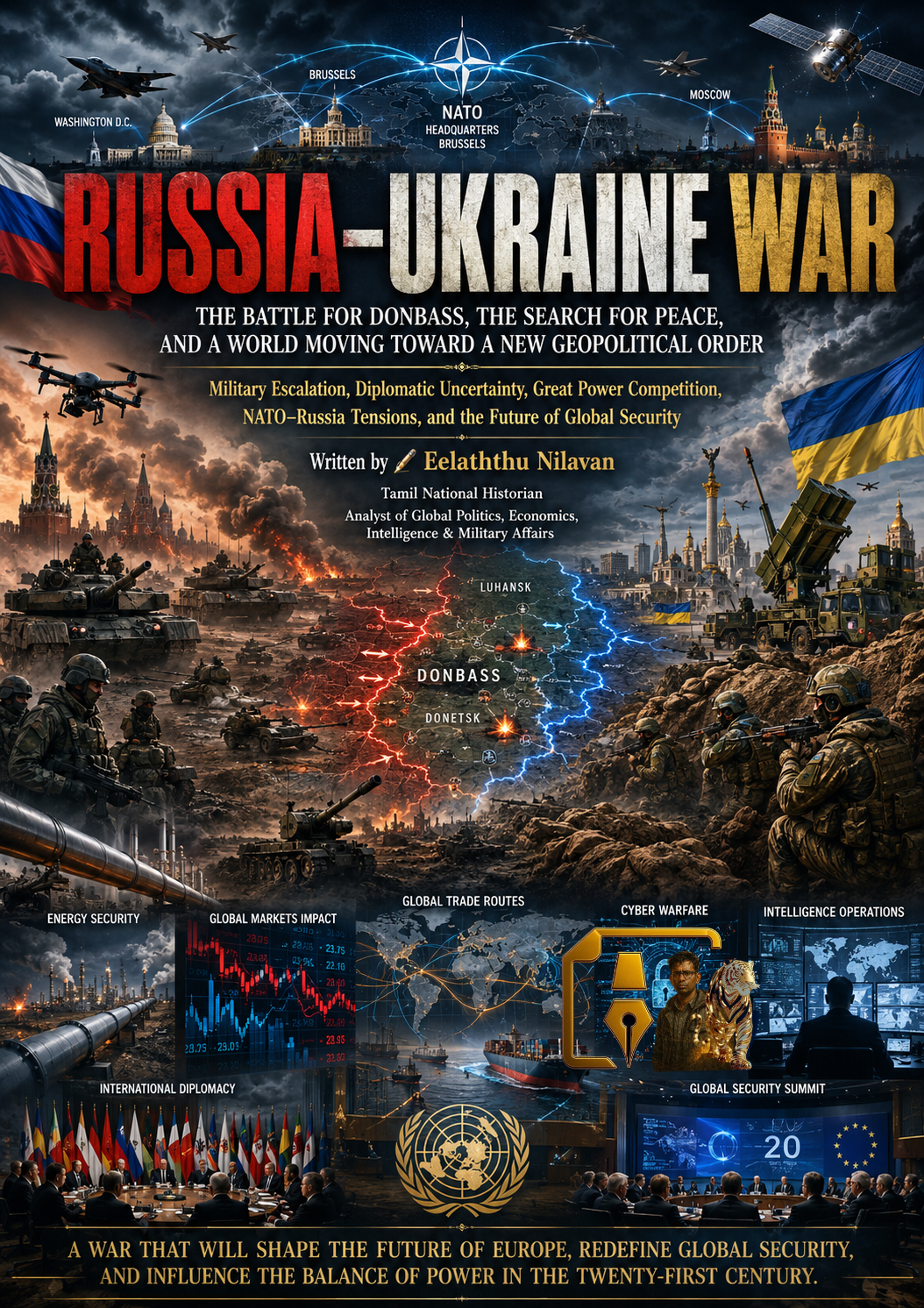

A Conflict Approaching a Decisive Phase Amid Military Escalation and Diplomatic Uncertainty
INTRODUCTION: A WAR THAT CONTINUES TO RESHAPE THE WORLD
More than four years after the full-scale Russian invasion of Ukraine began, the Russia–Ukraine War remains one of the defining geopolitical conflicts of the twenty-first century. What started as a regional military confrontation has evolved into a wider strategic struggle involving Russia, Ukraine, NATO, the United States, the European Union, and numerous regional powers.
Recent statements from Russian President Vladimir Putin, Ukrainian President Volodymyr Zelensky, U.S. President Donald Trump, senior Russian diplomats, NATO officials, and European political leaders suggest that the conflict may be entering a critical new phase. Military operations continue across the front lines, while diplomatic initiatives, sanctions, military aid packages, and competing visions for peace increasingly shape the future of the war.
At the center of the current debate stands one question: can peace be achieved without resolving the status of Donbass?
DONBASS: THE HEART OF THE PEACE DEBATE
Russian President Vladimir Putin has repeatedly emphasized that the future of the Donbass region will be central to any eventual peace agreement.
According to Moscow, Russian forces continue to make gradual advances across eastern Ukraine while consolidating control over territories already occupied. Russian officials argue that battlefield realities must be reflected in any negotiated settlement.
The Kremlin maintains that Russia’s military-industrial capacity, manpower reserves, and weapons production provide Moscow with long-term strategic advantages. Russian leaders also claim that Ukrainian forces face increasing personnel shortages after years of intense combat.
Ukraine strongly rejects these assertions and insists that internationally recognized Ukrainian territory cannot be surrendered as part of any peace arrangement. Kyiv continues to view the recovery of occupied territories as a fundamental objective, even as battlefield conditions remain difficult.
As a result, Donbass has become both the military center of gravity and the political obstacle preventing a breakthrough in negotiations.
THE UNITED STATES REAFFIRMS SUPPORT FOR UKRAINE
Washington remains Ukraine’s most important military supporter.
President Donald Trump recently stated that Ukraine would not have survived without American military assistance, arguing that U.S.-supplied weapons played a decisive role in stopping Russia’s initial advances.
At the same time, the U.S. House of Representatives approved a major Ukraine Support Act, authorizing approximately $8 billion in military financing loans for Ukraine and NATO allies while extending sanctions against Russia.
The bipartisan vote demonstrated that despite political disagreements inside Washington, significant support for Ukraine remains within both major American political parties.
However, debates continue regarding the long-term sustainability of aid packages, future military commitments, and America’s broader strategic priorities.
The legislation must still pass through the Senate before reaching the president for final approval.
MOSCOW ACCUSES THE WEST OF BLOCKING PEACE EFFORTS
Russian Foreign Minister Sergey Lavrov has accused the United States and European governments of undermining attempts to negotiate an end to the war.
Speaking at international forums, Lavrov argued that Western powers continue to prioritize military assistance over diplomatic compromise. According to Moscow, previous discussions involving potential peace frameworks were never fully implemented because of Western resistance.
Russian officials maintain that they remain open to negotiations but claim that neither Kyiv nor Western capitals are currently prepared for meaningful compromise.
Western governments reject these accusations and argue that any genuine peace process must respect Ukrainian sovereignty and territorial integrity.
The disagreement highlights one of the central challenges of the conflict: both sides claim to support peace while fundamentally disagreeing on the conditions required to achieve it.
ZELENSKY’S CALL FOR DIRECT TALKS WITH PUTIN
One of the most significant recent developments came when Ukrainian President Volodymyr Zelensky publicly proposed a direct meeting with Vladimir Putin.
The proposal included calls for a ceasefire and face-to-face negotiations aimed at exploring possible pathways toward ending the war.
The Kremlin responded cautiously, indicating that such a meeting remains theoretically possible but emphasizing that substantial disagreements remain unresolved.
While both sides occasionally signal openness to diplomacy, the gap between Russian and Ukrainian negotiating positions remains enormous.
Questions regarding territorial control, security guarantees, NATO membership, sanctions, reconstruction costs, and accountability for wartime actions continue to complicate any path toward a settlement.
BELARUS ENTERS THE SPOTLIGHT AGAIN
Tensions expanded beyond Ukraine when senior Ukrainian presidential adviser Mykhailo Podolyak issued strongly worded remarks directed at Belarusian President Alexander Lukashenko.
The comments reflected growing concerns in Kyiv regarding Belarus’s strategic role as Russia’s closest military ally.
Belarus has provided logistical support, military infrastructure, and political backing to Moscow since the beginning of the conflict.
Although Belarusian forces have not directly entered the war on a large scale, analysts continue to monitor the possibility of deeper Belarusian involvement.
The exchange illustrates how the conflict increasingly affects the broader security architecture of Eastern Europe.
THE DRONE WAR IS CHANGING THE BATTLEFIELD
Ukraine’s military leadership has warned that Russia plans to dramatically expand the use of jet-powered strike drones.
Drones have become one of the most important technologies shaping modern warfare. They are used for surveillance, targeting, reconnaissance, and direct attacks against military and infrastructure targets.
Russian production of Geran-series drones and other unmanned systems has increased significantly, allowing Moscow to conduct large-scale drone campaigns.
Meanwhile, Ukraine continues to develop its own drone industry and has demonstrated increasing effectiveness in striking military facilities, fuel depots, command centers, and logistics networks deep inside Russian-controlled territory.
The result is a rapidly evolving technological arms race that may influence the future course of the war as much as traditional artillery and armored warfare.
NATO, EUROPE, AND PUTIN’S MESSAGE TO THE WEST
Putin has once again rejected claims that Russia intends to attack NATO countries or invade Europe.
According to the Russian president, such allegations are designed to justify increased military spending and strengthen political support for NATO expansion.
Western governments strongly disagree, pointing to Russia’s actions in Ukraine as evidence of broader security concerns.
The issue remains one of the most important fault lines in European security policy.
For NATO members, strengthening deterrence is viewed as necessary protection.
For Moscow, NATO’s continued expansion is portrayed as a direct threat to Russian security interests.
These competing perspectives continue to fuel mistrust and make long-term security arrangements increasingly difficult.
GERMANY, AfD, AND RUSSIA’S POLITICAL OUTREACH
Another notable development involves Russia’s growing engagement with Germany’s opposition party, the Alternative for Germany (AfD).
Putin recently praised the party’s popularity and suggested that its rise reflects public concerns about economic policy, energy security, and Germany’s relationship with Russia.
Meetings between senior AfD figures and Russian officials have intensified debate within Germany about foreign influence, energy policy, and the future of Europe-Russia relations.
The issue is particularly sensitive given ongoing disputes surrounding sanctions, energy imports, and the destruction of the Nord Stream pipeline system.
As Europe navigates economic challenges and security concerns, political movements advocating renewed dialogue with Moscow are likely to remain influential.
INFORMATION WARFARE AND COMPETING NARRATIVES
The conflict continues to be accompanied by an intense information war.
Russian representatives have rejected allegations contained in various international reports concerning war crimes and conflict-related abuses.
At the same time, Ukraine, Western governments, and international organizations continue to document and investigate alleged violations committed during the war.
The dispute over events such as Bucha, accountability mechanisms, and competing historical narratives demonstrates that the battle for international opinion is nearly as important as the fighting on the battlefield itself.
Public perception, diplomatic support, and international legitimacy remain strategic objectives for all parties involved.
THE ORESHNIK MISSILE AND RUSSIA’S STRATEGIC SIGNALING
Recent attention has also focused on Russia’s Oreshnik missile program.
Putin described previous launches as tests designed to evaluate performance and gather operational data.
Military analysts view such statements as part of Russia’s broader strategy of strategic signaling.
By highlighting advanced missile capabilities, Moscow seeks to demonstrate technological strength, deter adversaries, and reinforce its position during ongoing geopolitical confrontations.
The emergence of increasingly sophisticated missile systems underscores the growing role of advanced weapons technology in modern warfare.
PUTIN’S POSITION ON THE MIDDLE EAST AND PALESTINE
Beyond Ukraine, Putin has reaffirmed Russia’s support for the creation of an independent Palestinian state.
He argued that long-term peace in the Middle East cannot be achieved without a viable Palestinian state and emphasized Russia’s longstanding support for United Nations-backed diplomatic frameworks.
The statements highlight Moscow’s broader effort to position itself as a major diplomatic actor not only in Europe but also across the Middle East.
As tensions involving Iran, Israel, Palestine, and the wider region continue, Russia seeks to maintain influence through diplomatic engagement and strategic partnerships.
CONCLUSION: A WAR WITH NO SIMPLE ENDING
The Russia–Ukraine War remains a complex struggle involving military power, diplomacy, economics, ideology, technology, and competing visions of international order.
Russia believes battlefield momentum is gradually shifting in its favor.
Ukraine remains determined to preserve its sovereignty and recover occupied territory.
The United States and NATO continue to support Kyiv while balancing broader strategic priorities.
Meanwhile, Europe faces growing political, economic, and security challenges as the conflict enters another uncertain chapter.
Whether future negotiations emerge through diplomacy, military exhaustion, international pressure, or a combination of all three remains unclear.
What is certain is that the decisions made in Donbass, Kyiv, Moscow, Washington, Brussels, and other global capitals during the coming months may shape not only the future of Ukraine and Russia, but also the geopolitical landscape of the twenty-first century itself.
𝐖𝐫𝐢𝐭𝐭𝐞𝐧 𝐛𝐲:


𝐄𝐞𝐥𝐚𝐭𝐡𝐭𝐡𝐮 𝐍𝐢𝐥𝐚𝐯𝐚𝐧
Tamil National Historian | Analyst of Global Politics, Economics, Intelligence & Military Affairs
05/06/2026