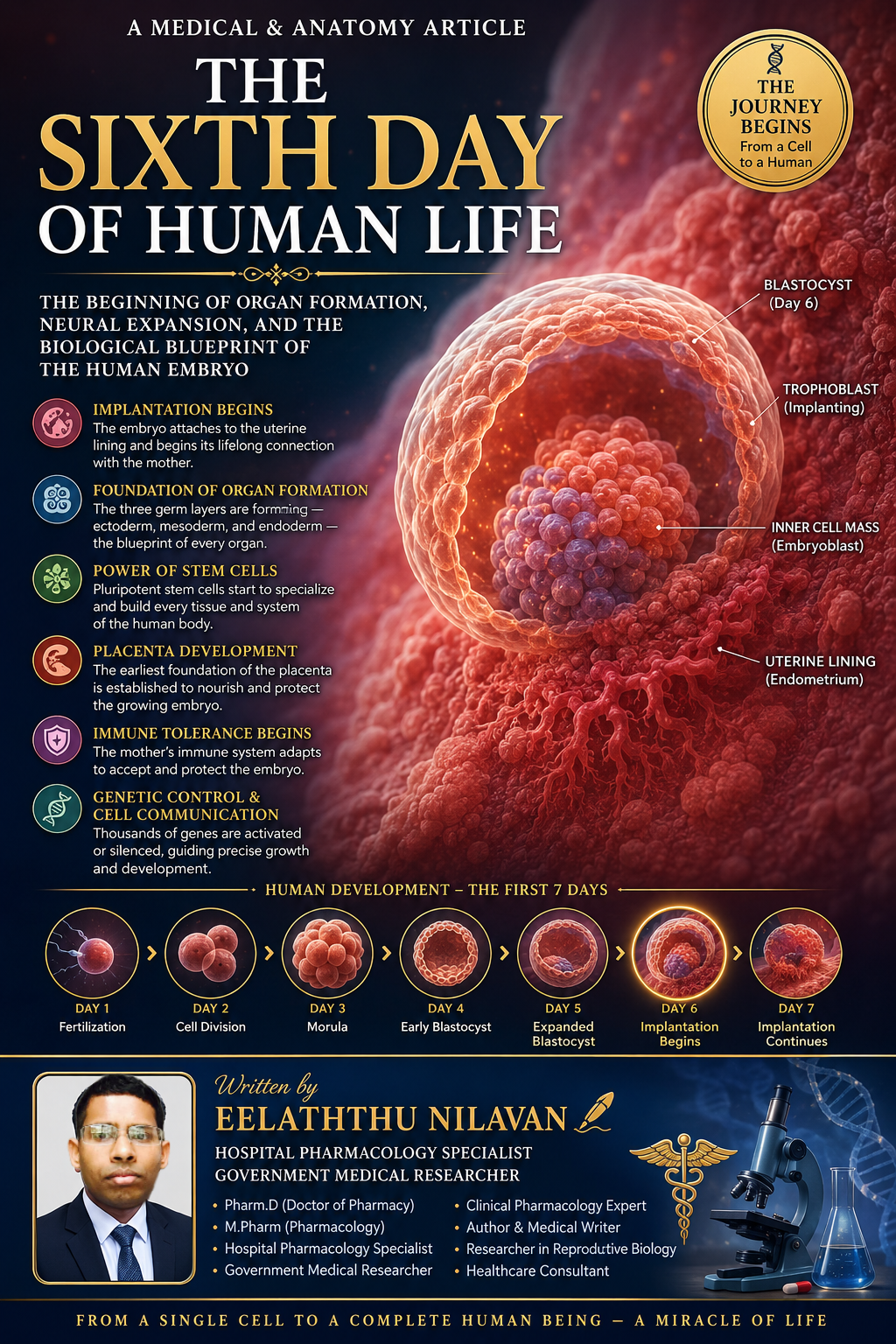

The Beginning of Organ Formation, Neural Expansion, and the Biological Blueprint of the Human Embryo
𝗜𝗡𝗧𝗥𝗢𝗗𝗨𝗖𝗧𝗜𝗢𝗡
The sixth day of human life represents one of the most remarkable stages in early embryonic development. Although the embryo is still microscopic—measuring only a fraction of a millimeter—countless biological events are occurring with extraordinary precision. By this stage, the embryo has successfully reached the uterus, escaped from its protective outer shell (the zona pellucida), and is now preparing for one of the most critical events in human development: implantation into the uterine lining.
The embryo at this stage is no longer merely a cluster of dividing cells. It has already established distinct cell populations that will eventually give rise to every tissue and organ of the human body. Every heartbeat, every nerve impulse, every bone, every organ, and every system that will sustain life begins with the biological instructions being organized during these first few days.
𝗧𝗛𝗘 𝗘𝗠𝗕𝗥𝗬𝗢 𝗕𝗘𝗖𝗢𝗠𝗘𝗦 𝗥𝗘𝗔𝗗𝗬 𝗙𝗢𝗥 𝗜𝗠𝗣𝗟𝗔𝗡𝗧𝗔𝗧𝗜𝗢𝗡
Around the sixth day after fertilization, the blastocyst comes into direct contact with the endometrium, the specialized inner lining of the uterus. This interaction is not accidental. Hormonal signals, particularly progesterone, have transformed the uterine lining into a nutrient-rich environment capable of supporting embryonic life.
The outer layer of the blastocyst, known as the trophoblast, begins attaching itself to the maternal tissue. This marks the beginning of implantation—a process that allows the embryo to establish communication with the mother’s body.
Without successful implantation, pregnancy cannot continue. Thus, Day Six marks the transition from an independently developing embryo to one that begins a lifelong biological partnership with its mother.
𝗧𝗛𝗘 𝗙𝗜𝗥𝗦𝗧 𝗦𝗧𝗘𝗣𝗦 𝗧𝗢𝗪𝗔𝗥𝗗 𝗢𝗥𝗚𝗔𝗡 𝗙𝗢𝗥𝗠𝗔𝗧𝗜𝗢𝗡
Although recognizable organs have not yet appeared, the blueprint for organ development is becoming increasingly organized.
The inner cell mass, also called the embryoblast, contains pluripotent stem cells. These extraordinary cells possess the ability to develop into virtually every specialized cell found in the adult human body.
Within the coming days these cells will begin differentiating into the three primary germ layers:
• Ectoderm
• Mesoderm
• Endoderm
These germ layers eventually produce the brain, spinal cord, heart, lungs, liver, kidneys, muscles, bones, digestive tract, skin, blood vessels, endocrine glands, and reproductive organs.
Thus, even before visible organs exist, their biological foundation is already being established.
𝗦𝗧𝗘𝗠 𝗖𝗘𝗟𝗟𝗦: 𝗧𝗛𝗘 𝗨𝗟𝗧𝗜𝗠𝗔𝗧𝗘 𝗔𝗥𝗖𝗛𝗜𝗧𝗘𝗖𝗧𝗦 𝗢𝗙 𝗧𝗛𝗘 𝗛𝗨𝗠𝗔𝗡 𝗕𝗢𝗗𝗬
The sixth day showcases the incredible power of embryonic stem cells.
Each stem cell contains the complete human genome, yet different genes are selectively activated or suppressed according to developmental signals.
Through highly regulated genetic pathways, these cells gradually specialize into:
• Neurons
• Muscle fibers
• Cardiac cells
• Blood cells
• Bone-forming cells
• Liver cells
• Kidney cells
• Skin cells
This remarkable cellular specialization ensures that every organ develops with extraordinary precision.
𝗧𝗛𝗘 𝗘𝗔𝗥𝗟𝗜𝗘𝗦𝗧 𝗙𝗢𝗨𝗡𝗗𝗔𝗧𝗜𝗢𝗡 𝗢𝗙 𝗧𝗛𝗘 𝗣𝗟𝗔𝗖𝗘𝗡𝗧𝗔
As implantation begins, trophoblast cells continue differentiating into specialized structures that will later develop into the placenta.
The placenta will eventually become one of the most complex temporary organs in human biology. It performs numerous essential functions, including oxygen exchange, nutrient transport, waste removal, hormone production, immune regulation, and protection of the growing fetus.
Although fully functional placental circulation has not yet formed on Day Six, its earliest biological foundation is already being established.
𝗚𝗘𝗡𝗘𝗧𝗜𝗖 𝗖𝗢𝗡𝗧𝗥𝗢𝗟 𝗔𝗡𝗗 𝗖𝗘𝗟𝗟𝗨𝗟𝗔𝗥 𝗖𝗢𝗠𝗠𝗨𝗡𝗜𝗖𝗔𝗧𝗜𝗢𝗡
Every second, thousands of genes are activated or silenced within embryonic cells.
Specialized signaling pathways coordinate cellular communication, ensuring that cells divide, migrate, and differentiate at exactly the right time and location.
Any disruption in these signaling mechanisms can interfere with normal embryonic development, highlighting the extraordinary precision required for healthy human growth.
𝗜𝗠𝗠𝗨𝗡𝗢𝗟𝗢𝗚𝗜𝗖𝗔𝗟 𝗧𝗢𝗟𝗘𝗥𝗔𝗡𝗖𝗘 𝗕𝗘𝗚𝗜𝗡𝗦
One fascinating feature of Day Six is the beginning of maternal immune adaptation.
Although the embryo contains genetic material from both parents, the mother’s immune system normally does not reject it. Complex molecular signals from the trophoblast help create an immune-tolerant environment, allowing implantation and pregnancy to proceed successfully.
This represents one of the most remarkable examples of immune regulation in human biology.
𝗖𝗟𝗜𝗡𝗜𝗖𝗔𝗟 𝗦𝗜𝗚𝗡𝗜𝗙𝗜𝗖𝗔𝗡𝗖𝗘
The sixth day is critically important in reproductive medicine.
Successful implantation during this period determines whether pregnancy continues. Specialists in reproductive endocrinology and assisted reproductive technologies closely monitor embryos at this developmental stage during in vitro fertilization (IVF).
Understanding Day Six development has improved embryo selection techniques, implantation success rates, infertility treatment, stem-cell research, developmental biology, and prenatal medicine.
𝗪𝗛𝗬 𝗧𝗛𝗘 𝗦𝗜𝗫𝗧𝗛 𝗗𝗔𝗬 𝗜𝗦 𝗔 𝗠𝗜𝗟𝗘𝗦𝗧𝗢𝗡𝗘
Although invisible to the naked eye, the sixth day marks the beginning of one of life’s greatest biological transitions.
The embryo begins establishing its permanent connection with the mother while simultaneously organizing the cellular blueprint that will eventually produce more than 37 trillion cells, over 200 specialized cell types, dozens of organs, and every physiological system required for human survival.
In many respects, Day Six is where the future human body begins transforming from genetic potential into biological reality.
𝗖𝗢𝗡𝗖𝗟𝗨𝗦𝗜𝗢𝗡
The sixth day of human life is a masterpiece of developmental biology. Implantation begins, stem cells continue their remarkable specialization, placental development is initiated, immune tolerance is established, and the foundations of every future organ system become increasingly organized.
Although the embryo remains microscopic, it already possesses the complete biological instructions required to create a fully developed human being. Each precisely regulated cellular event occurring on this day reflects the extraordinary complexity, coordination, and elegance of human embryonic development.
The sixth day reminds us that the journey of human life is built upon countless microscopic events, each essential to the formation of the remarkable human body.

Written by 𝐄𝐞𝐥𝐚𝐭𝐡𝐭𝐡𝐮 𝐍𝐢𝐥𝐚𝐯𝐚𝐧
Hospital Pharmacology Specialist | Government Medical Researcher