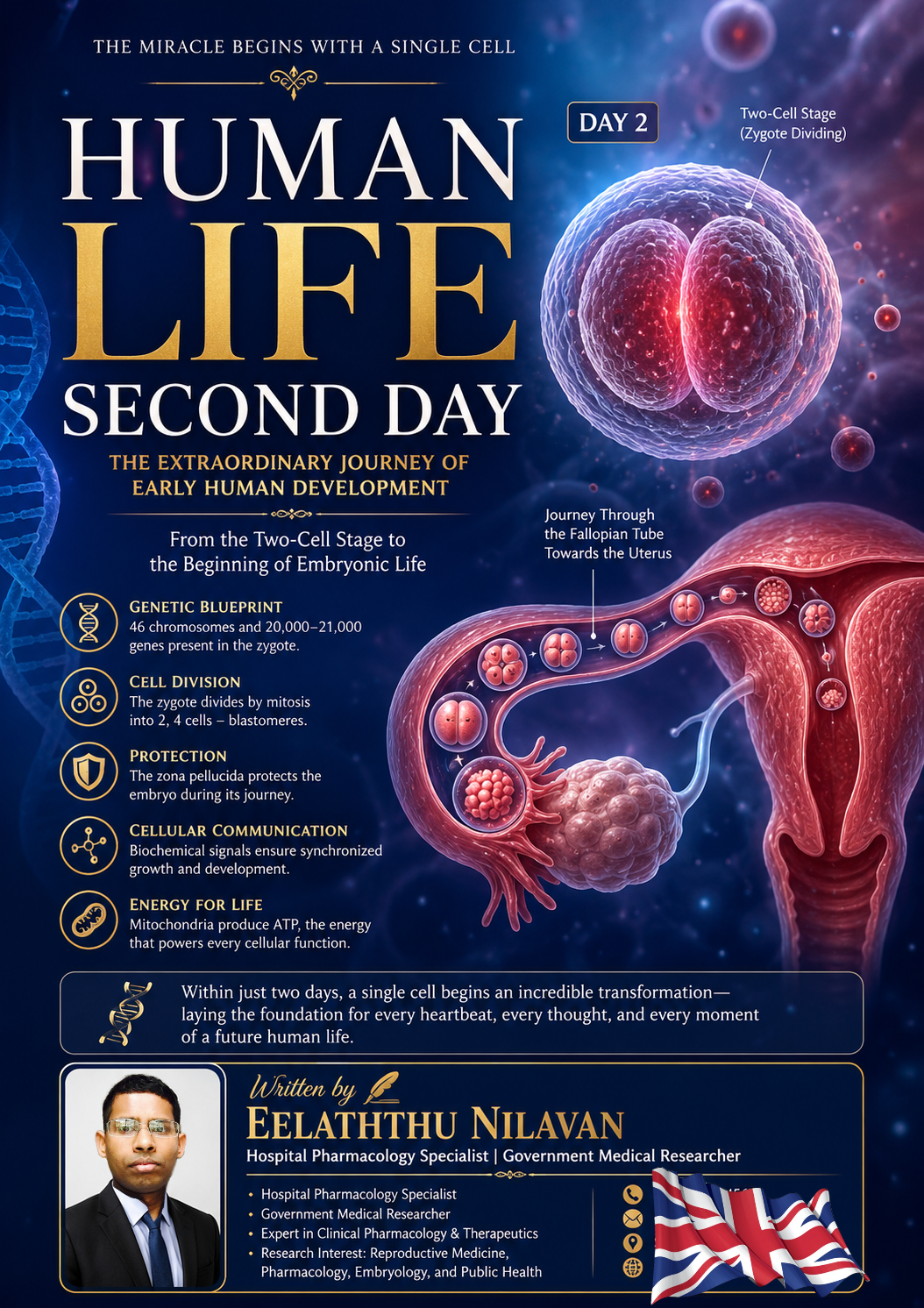

The Extraordinary Journey of Early Human Development
From the Two-Cell Stage to the Beginning of Embryonic Life
Introduction
The second day of human life is one of the most remarkable yet invisible stages of human development. Although the embryo is still microscopic and cannot be seen without advanced laboratory equipment, an incredible series of biological events is already taking place. Every cell division, every molecular signal, and every genetic instruction follows an astonishingly precise sequence that has been refined through millions of years of evolution.
This stage lays the foundation for every organ, tissue, and system that will eventually develop into a complete human being. The embryo’s survival depends upon flawless communication between DNA, proteins, hormones, and the maternal reproductive system.
Fertilization Has Already Been Completed
By the beginning of the second day, fertilisation has successfully united the father’s sperm and the mother’s egg into a single cell known as the zygote.
Inside this tiny cell are 46 chromosomes, containing approximately 20,000–21,000 genes that determine every inherited characteristic of the future individual. Eye colour, blood type, metabolism, immune function, and countless biological traits have already been genetically programmed.
Although these genes are present, many remain inactive until specific developmental stages require them.
The First Cell Division Begins
During the second day, the zygote undergoes its first major transformation through mitosis, the process of normal cell division.
One cell becomes two.
Soon afterwards, those two became four.
Each daughter cell contains an identical copy of the complete human genome.
These early embryonic cells are called blastomeres.
At this stage, every blastomere is totipotent, meaning each cell still possesses the extraordinary ability to develop into an entire human body under the right conditions.
This remarkable biological flexibility gradually decreases as development progresses.
DNA Directs Every Biological Event
The embryo does not divide randomly.
Every second is controlled by genetic instructions stored inside DNA.
Specific genes are activated while others remain silent.
Proteins are produced.
RNA molecules carry genetic information.
Enzymes regulate metabolism.
Cell membranes communicate continuously with neighbouring cells.
This highly organised process ensures that development proceeds with astonishing precision.
Even tiny errors in chromosome separation or DNA replication during these earliest stages may result in developmental abnormalities or pregnancy loss.
Maternal Support Continues
Although implantation has not yet occurred, the mother’s body already provides an ideal environment for embryonic survival.
The embryo continues travelling through the fallopian tube toward the uterus.
Tiny hair-like structures called cilia gently move the embryo forward.
Meanwhile, smooth muscle contractions within the fallopian tube assist this journey.
Hormones such as progesterone maintain favourable conditions by supporting the reproductive tract and preparing the uterus for implantation several days later.
Cellular Communication Begins
Even though only a few cells exist, they constantly exchange biochemical messages.
Cells communicate through signalling proteins, calcium ions, and molecular receptors.
This communication ensures synchronised cell division and proper timing of embryonic development.
Scientists consider these signalling pathways among the earliest examples of organised biological communication in human life.
Energy Production During Day Two
The rapidly dividing embryo requires continuous energy.
Its cells produce ATP through highly active mitochondria inherited exclusively from the mother.
These microscopic energy-producing organelles convert nutrients into usable cellular fuel, enabling DNA replication, protein synthesis, and cell division.
Without adequate mitochondrial function, normal embryonic development cannot continue.
Protection of the Early Embryo
Throughout the second day, the embryo remains enclosed within the zona pellucida, a transparent protective shell surrounding the developing cells.
This specialised structure prevents premature implantation, protects against physical damage, and maintains the embryo’s structural integrity during its journey toward the uterus.
Several days later, the embryo will naturally emerge from this protective covering before implantation.
Medical Importance of Day Two
Modern reproductive medicine closely observes embryos at this stage during in vitro fertilisation (IVF) procedures.
Embryologists carefully evaluate:
• Cell number
• Cell symmetry
• Fragmentation
• Division timing
• Overall embryo quality
Healthy embryos usually demonstrate regular, symmetrical divisions with minimal cellular fragmentation.
These observations help specialists determine which embryos have the greatest chance of successful implantation and a healthy pregnancy.
Factors That Can Influence Early Development
The earliest stages of embryonic development are highly sensitive.
Several factors may interfere with normal development, including:
• Chromosomal abnormalities
• Genetic mutations
• Advanced parental age
• Exposure to radiation
• Toxic chemicals
• Certain medications
• Alcohol consumption
• Smoking
• Severe nutritional deficiencies
• Uncontrolled maternal illnesses
Many abnormal embryos naturally stop developing before implantation, representing one of nature’s mechanisms for preventing severe genetic disorders.
Why the Second Day Matters
Although only two days old, the embryo already demonstrates extraordinary biological complexity.
Within only a handful of microscopic cells exists the complete blueprint for a future human being capable of thought, emotion, creativity, and life itself.
Every heartbeat, every neuron, every muscle fibre, every organ, and every future experience begins with these first perfectly coordinated cellular divisions.
The second day is therefore not merely another step in pregnancy—it is one of the most scientifically fascinating moments in all of human development.
Conclusion
The second day of human life marks the beginning of organised multicellular development. Through precise genetic programming, controlled cell division, sophisticated molecular communication, and maternal biological support, the embryo continues its remarkable journey toward becoming a fully developed human being.
Understanding these earliest developmental stages not only deepens our appreciation of human biology but also advances our understanding of reproductive medicine, genetics, embryology, pharmacology, and medical research. Every healthy life begins with these microscopic yet profoundly significant events.
Written by


𝐄𝐞𝐥𝐚𝐭𝐡𝐭𝐡𝐮 𝐍𝐢𝐥𝐚𝐯𝐚𝐧
Hospital Pharmacology Specialist | Government Medical Researcher