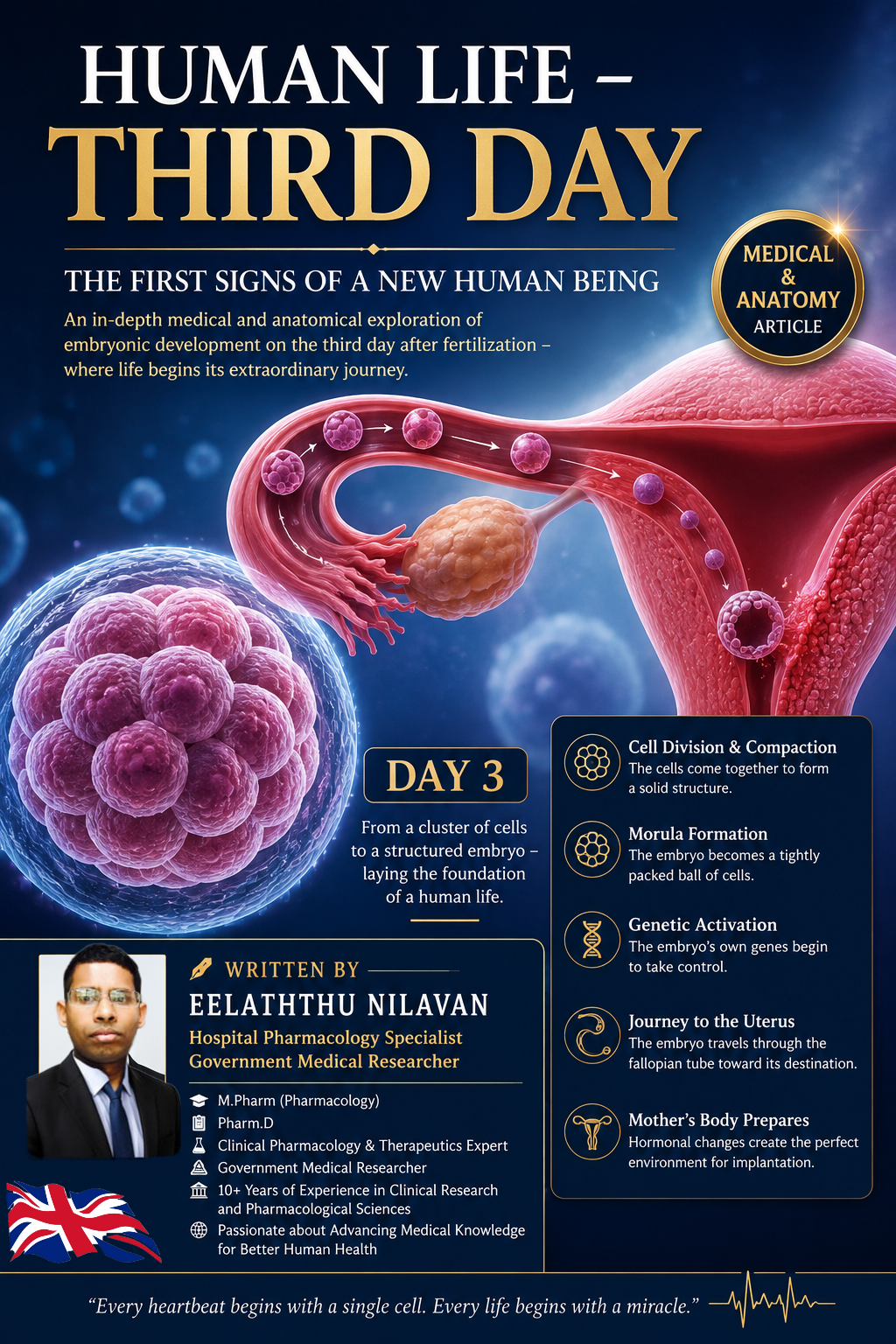

The First Signs of a New Human Being
The third day of human life is one of the earliest yet most remarkable stages in human development. Although the embryo remains microscopic and invisible to the naked eye, an extraordinary series of biological events is already unfolding. Every hour brings new cellular divisions, molecular communications, and genetic regulation that will eventually shape every organ, tissue, and system of the human body.
At this stage, the embryo is no longer simply a fertilized egg. It has become a rapidly developing collection of highly specialized cells that are preparing for one of the most critical journeys in human existence—the movement from the fallopian tube toward the uterus. This journey is carefully coordinated by anatomy, physiology, genetics, and biochemistry.
𝗧𝗛𝗘 𝗘𝗠𝗕𝗥𝗬𝗢 𝗢𝗡 𝗧𝗛𝗘 𝗧𝗛𝗜𝗥𝗗 𝗗𝗔𝗬
By the third day after fertilization, the embryo has undergone multiple rounds of mitotic cell division. Instead of remaining a single fertilized cell, it now consists of approximately 8–16 individual cells known as blastomeres.
Remarkably, despite the increasing number of cells, the embryo itself has not increased significantly in overall size. Each successive cell division creates smaller daughter cells enclosed within the original protective outer membrane called the zona pellucida. This efficient packaging allows the embryo to continue traveling safely through the narrow fallopian tube toward the uterus.
Every blastomere still contains the complete genetic blueprint inherited from both parents, ensuring that each cell possesses the information required to form every tissue and organ in the future body.
𝗖𝗘𝗟𝗟𝗨𝗟𝗔𝗥 𝗖𝗢𝗠𝗣𝗔𝗖𝗧𝗜𝗢𝗡 — 𝗧𝗛𝗘 𝗙𝗜𝗥𝗦𝗧 𝗦𝗧𝗘𝗣 𝗧𝗢𝗪𝗔𝗥𝗗 𝗢𝗥𝗚𝗔𝗡𝗜𝗭𝗔𝗧𝗜𝗢𝗡
One of the most important events occurring around the third day is a process known as compaction.
During compaction, the blastomeres begin to adhere tightly to one another through specialized adhesion molecules. The cells flatten against each other, strengthening communication and creating the first organized structure of the future embryo.
This event represents the embryo’s transition from a loose cluster of independent cells into a coordinated biological unit capable of increasingly complex development.
Compaction is considered a major milestone because it establishes the cellular interactions that later determine the formation of distinct tissues and organs.
𝗧𝗛𝗘 𝗠𝗢𝗥𝗨𝗟𝗔 — 𝗧𝗛𝗘 𝗙𝗜𝗥𝗦𝗧 𝗦𝗢𝗟𝗜𝗗 𝗦𝗧𝗔𝗚𝗘
As cell division continues, the embryo develops into a structure called the morula.
The morula resembles a tiny mulberry under the microscope, consisting of tightly packed cells enclosed within the zona pellucida.
Although measuring less than one millimeter in diameter, the morula already possesses remarkable developmental potential. Within this compact sphere, the earliest distinction between inner and outer cell populations begins to emerge. These differences will later determine which cells become the fetus and which contribute to the placenta and supporting structures.
𝗚𝗘𝗡𝗘𝗧𝗜𝗖 𝗔𝗖𝗧𝗜𝗩𝗜𝗧𝗬 𝗜𝗡𝗖𝗥𝗘𝗔𝗦𝗘𝗦
During the third day, the embryo increasingly activates its own genome.
Initially, early development is directed primarily by maternal proteins and messenger RNA stored within the egg before fertilization. However, by approximately the third day, embryonic genes become highly active, allowing the embryo to begin directing its own growth and development.
Thousands of genes coordinate cell division, DNA repair, protein synthesis, metabolism, and communication between neighboring cells.
This genetic activation marks the embryo’s first steps toward biological independence.
𝗖𝗘𝗟𝗟 𝗖𝗢𝗠𝗠𝗨𝗡𝗜𝗖𝗔𝗧𝗜𝗢𝗡
Every cell continuously exchanges biochemical signals with neighboring cells.
These signaling pathways regulate when cells divide, where they move, and how they specialize during later stages of development.
Growth factors, calcium signaling, and numerous molecular pathways ensure that development remains highly organized and remarkably accurate.
Failures in these communication systems can prevent normal embryonic development.
𝗧𝗛𝗘 𝗝𝗢𝗨𝗥𝗡𝗘𝗬 𝗧𝗢𝗪𝗔𝗥𝗗 𝗧𝗛𝗘 𝗨𝗧𝗘𝗥𝗨𝗦
The embryo continues traveling through the fallopian tube toward the uterus.
Tiny hair-like structures called cilia, together with rhythmic muscular contractions of the fallopian tube, gently transport the embryo over several days.
The embryo itself contributes by producing signaling molecules that help coordinate this journey.
This transportation is essential because successful implantation can occur only after the embryo reaches the uterine cavity.
𝗧𝗛𝗘 𝗠𝗢𝗧𝗛𝗘𝗥’𝗦 𝗕𝗢𝗗𝗬 𝗣𝗥𝗘𝗣𝗔𝗥𝗘𝗦
Even though implantation has not yet occurred, the mother’s reproductive system is already preparing for pregnancy.
Progesterone, secreted by the corpus luteum in the ovary, continues transforming the uterine lining into a nutrient-rich environment capable of supporting implantation.
Blood vessels expand, glandular secretions increase, and the endometrium becomes progressively more receptive to the arriving embryo.
𝗧𝗛𝗘 𝗙𝗢𝗨𝗡𝗗𝗔𝗧𝗜𝗢𝗡 𝗢𝗙 𝗙𝗨𝗧𝗨𝗥𝗘 𝗢𝗥𝗚𝗔𝗡𝗦
Although no recognizable organs exist on the third day, every future structure—including the brain, spinal cord, heart, lungs, liver, kidneys, muscles, bones, skin, and nervous system—will ultimately arise from these few microscopic cells.
The precision of these earliest developmental events determines the healthy formation of the human body during the coming weeks.
𝗠𝗘𝗗𝗜𝗖𝗔𝗟 𝗜𝗠𝗣𝗢𝗥𝗧𝗔𝗡𝗖𝗘
Understanding the third day of embryonic development is essential in reproductive medicine, embryology, obstetrics, gynecology, genetics, fertility treatment, pharmacology, and developmental biology.
Knowledge of this stage helps physicians improve assisted reproductive technologies such as in vitro fertilization (IVF), diagnose developmental abnormalities, and better understand the earliest origins of human disease.
𝗖𝗢𝗡𝗖𝗟𝗨𝗦𝗜𝗢𝗡
The third day of human life represents one of nature’s most extraordinary achievements. From a single fertilized cell, the embryo has already become a highly organized multicellular structure capable of directing its own genetic program. Though invisible to the naked eye, it carries within it the complete blueprint of an entire human being.
Every heartbeat, every thought, every movement, and every breath that will occur throughout a lifetime begins with these microscopic events. The third day reminds us that the complexity of human life is built upon astonishing precision, cooperation, and biological harmony from the very beginning.
Written by


𝐄𝐞𝐥𝐚𝐭𝐡𝐭𝐡𝐮 𝐍𝐢𝐥𝐚𝐯𝐚𝐧
Hospital Pharmacology Specialist | Government Medical Researcher