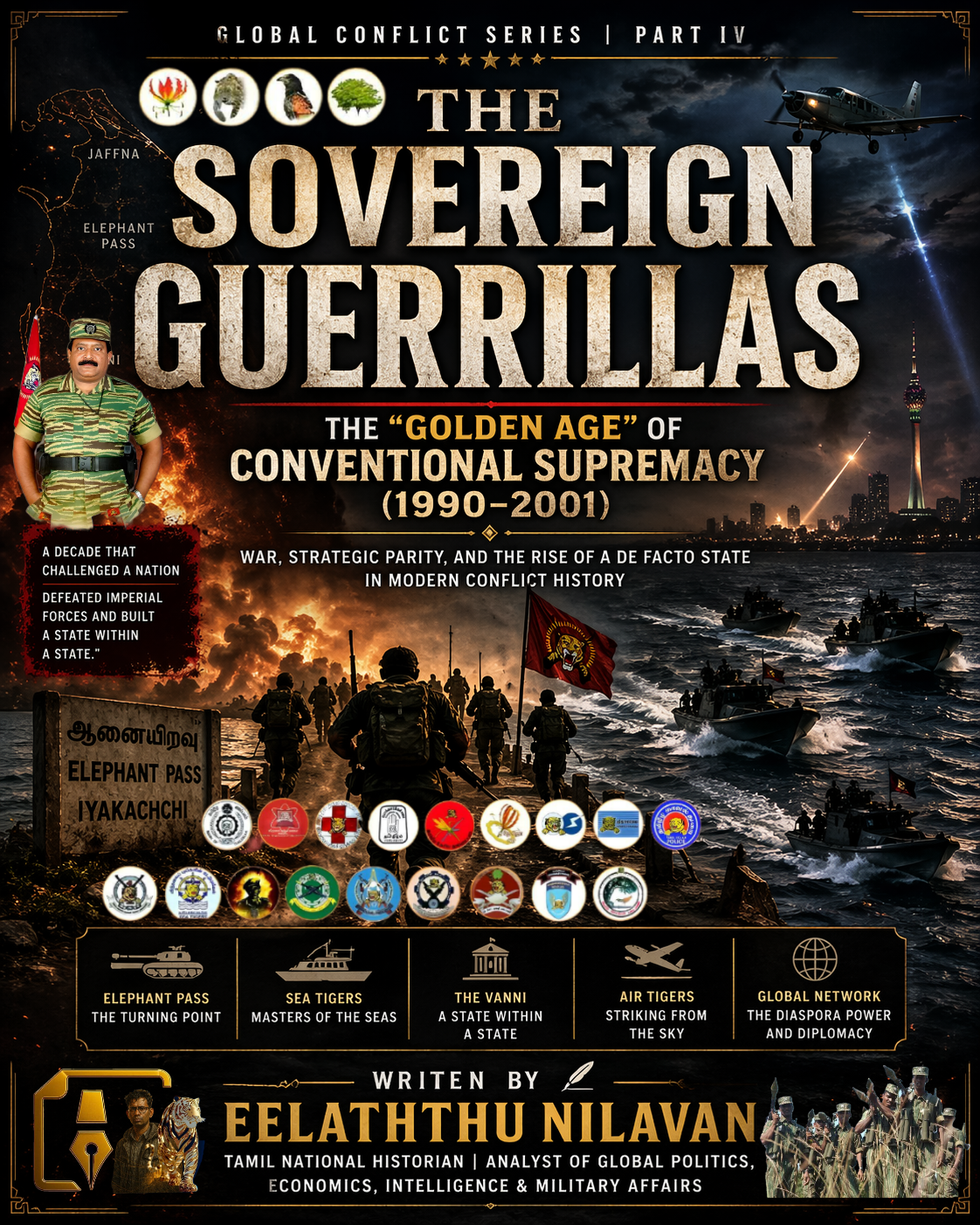

INTRODUCTION: FROM INSURGENCY TO STRUCTURED POWER
The decade following the withdrawal of the Indian Peace Keeping Force in 1990 marked a defining transformation in the conflict in Sri Lanka. During this period, the Liberation Tigers of Tamil Eelam evolved from a guerrilla movement into a complex and highly organized politico-military force.
This phase is widely regarded as a rare moment in modern conflict history when a non-state actor demonstrated the capacity to engage in sustained, high-intensity warfare while simultaneously building administrative systems that resembled those of a functioning state. The result was a condition often described as strategic parity, where neither side could secure decisive victory without significant cost.
THE SIEGE OF ELEPHANT PASS: A TURNING POINT IN MODERN WARFARE
One of the most decisive events of this era was the capture of the Elephant Pass base in April 2000. Strategically located at the narrow land corridor connecting the Jaffna Peninsula to the mainland, Elephant Pass was considered one of the most fortified military positions in the country.
Through a carefully coordinated operation, involving multi-phase offensives and sustained pressure, the base was isolated and eventually overrun. The success of this campaign demonstrated a high level of operational planning and battlefield coordination.
The fall of Elephant Pass carried both military and psychological significance. It challenged the perception of state dominance and illustrated that even heavily defended installations could be vulnerable under sustained and adaptive pressure. More importantly, it signaled that the conflict had entered a phase where conventional engagements would play a central role.
THE CONTROL OF THE SEAS: THE RISE OF A NAVAL FORCE
A crucial component of this transformation was the development of maritime capabilities. Under the leadership of Soosai, the Sea Tigers emerged as a highly adaptive naval wing.
Operating in a region defined by its coastline, this force relied on innovation and mobility. Small, fast attack craft were used to conduct coordinated operations against larger naval vessels. These tactics emphasized speed, surprise, and numerical advantage.
This approach allowed the Sea Tigers to contest control over coastal waters, maintain supply routes, and extend the operational reach of the movement. Their methods demonstrated how unconventional forces could adapt maritime strategy to their advantage despite limited resources.
THE VANNI: ADMINISTRATION AND GOVERNANCE
While military operations continued, the Vanni region became the administrative center of a structured governance system. This was not merely a wartime necessity but a deliberate effort to establish institutional order.
Civil administration included:
• Law enforcement structures
• Judicial processes for civil and criminal matters
• Economic initiatives aimed at self-sufficiency
These institutions contributed to a sense of stability within controlled areas. Social policies also played a significant role, particularly in challenging traditional hierarchies and expanding opportunities for women in both military and civilian roles.
Despite these developments, the system faced limitations due to isolation and lack of international recognition. Its sustainability depended heavily on internal organization and external support.
THE AIR DIMENSION: EXPANDING THE BOUNDARIES OF CAPABILITY
Toward the end of this period, the emergence of an air wing introduced a new dimension to the conflict. The Air Tigers represented a significant development, as non-state actors rarely possess aerial capabilities.
Using modified light aircraft, limited operations were conducted that demonstrated both technical ingenuity and strategic intent. While the scale of these operations remained relatively small, their impact extended beyond physical damage.
The ability to carry out aerial actions introduced a psychological factor, altering perceptions of security and expanding the scope of the conflict into previously uncontested domains.
GLOBAL NETWORKS AND EXTERNAL SUPPORT
The strength of this period was closely linked to global connections, particularly through the Tamil diaspora. Financial contributions, logistical coordination, and international advocacy played a central role in sustaining operations.
Efforts led by figures such as Anton Balasingham sought to present the conflict within broader international frameworks of political rights and self-determination. These initiatives aimed to build support and legitimacy on the global stage.
At the same time, the international environment was becoming increasingly complex, with shifting priorities that would later influence the trajectory of the conflict.
STRATEGIC PARITY AND THE ROAD TO NEGOTIATION
By the early 2000s, the conflict had reached a stage where both sides possessed significant military capabilities and territorial control. This balance created a situation in which prolonged confrontation became increasingly costly and unsustainable.
The concept of strategic parity emerged from this context. It reflected a temporary equilibrium in which neither side could achieve decisive victory through military means alone.
This condition ultimately contributed to the move toward negotiations, culminating in the ceasefire agreement of 2002, facilitated by Norway.
CONCLUSION: A UNIQUE CHAPTER IN MODERN CONFLICT
The period from 1990 to 2001 stands as a distinctive chapter in the history of modern warfare. It illustrates how a non-state actor could evolve into a structured force capable of engaging in conventional conflict while simultaneously establishing systems of governance.
At the same time, it highlights the limitations of such transformations within a broader international context. Military capability, while significant, proved insufficient to secure long-term stability or recognition.
This era remains a subject of continued study, offering insights into the dynamics of power, adaptation, and the complex relationship between warfare and governance.
END OF PART 4
Next Part: Part 5 — The 2002 Ceasefire Agreement, Norway’s Peace Initiative, and the Domestic and International Shifts that Pushed the Conflict Toward Its Final Phase

Written by 𝐄𝐞𝐥𝐚𝐭𝐡𝐭𝐡𝐮 𝐍𝐢𝐥𝐚𝐯𝐚𝐧
Tamil National Historian | Analyst of Global Politics, Economics, Intelligence & Military Affairs
23/04/2026