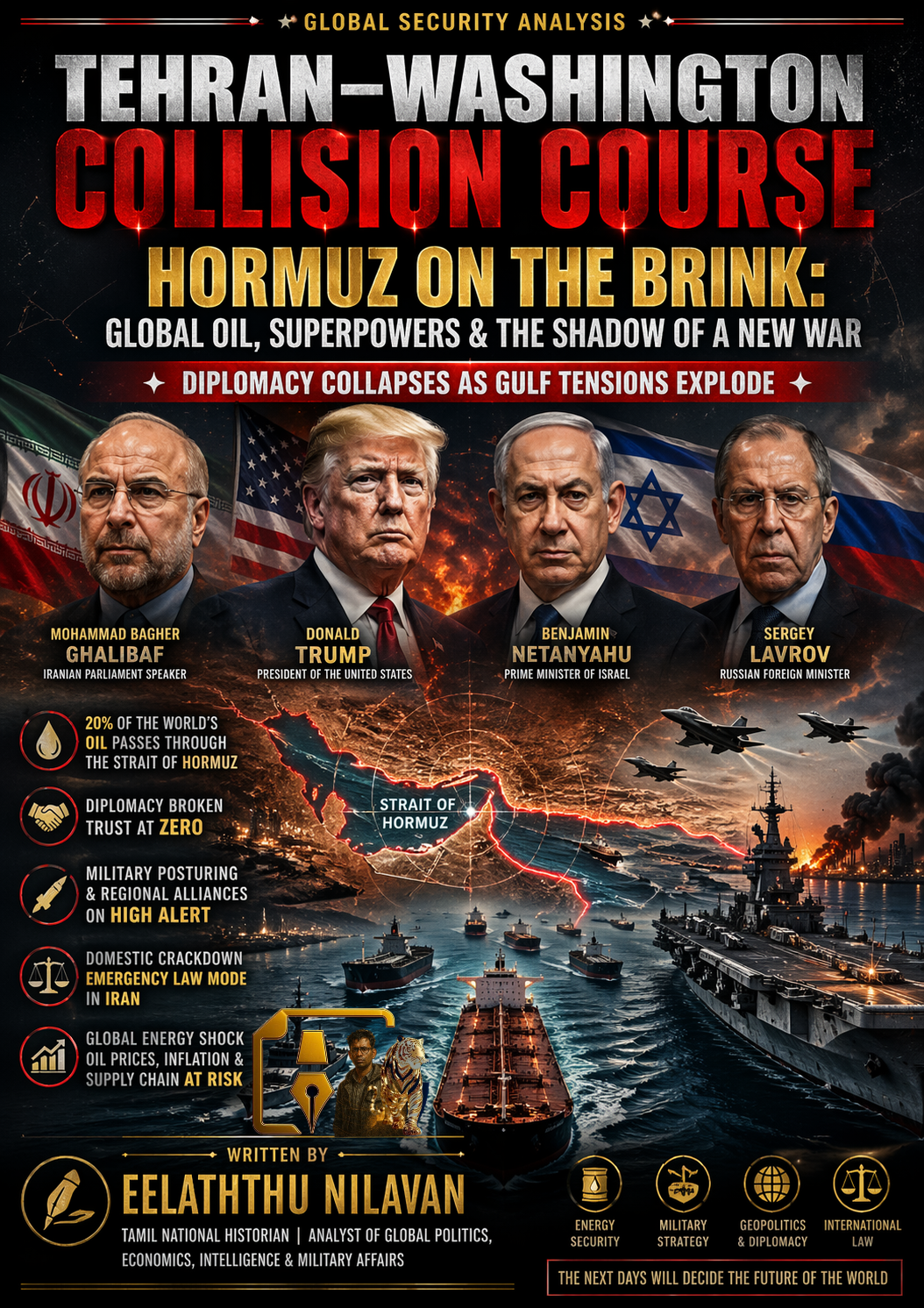

𝗛𝗢𝗥𝗠𝗨𝗭 𝗢𝗡 𝗧𝗛𝗘 𝗕𝗥𝗜𝗡𝗞: 𝗚𝗟𝗢𝗕𝗔𝗟 𝗢𝗜𝗟, 𝗦𝗨𝗣𝗘𝗥𝗣𝗢𝗪𝗘𝗥𝗦 & 𝗧𝗛𝗘 𝗥𝗜𝗦𝗞 𝗢𝗙 𝗔 𝗡𝗘𝗪 𝗪𝗔𝗥
𝗗𝗶𝗽𝗹𝗼𝗺𝗮𝗰𝘆 𝗖𝗼𝗹𝗹𝗮𝗽𝘀𝗲𝘀 𝗔𝘀 𝗧𝗲𝗻𝘀𝗶𝗼𝗻𝘀 𝗘𝘅𝗽𝗹𝗼𝗱𝗲 𝗔𝗰𝗿𝗼𝘀𝘀 𝘁𝗵𝗲 𝗚𝘂𝗹𝗳
THE STRAIT OF HORMUZ: A GLOBAL PRESSURE POINT
At the heart of the crisis lies the Strait of Hormuz, a maritime chokepoint through which nearly 20% of the world’s oil supply flows daily.
Iran’s Parliament Speaker, Mohammad Bagher Ghalibaf, has issued one of the most explicit warnings yet:
If Iran’s energy infrastructure is targeted, no other country’s oil will flow freely either.
While Tehran claims it supports open trade, it has made clear that “hostile actors” may face restrictions—effectively signaling a potential selective blockade strategy rather than a total closure.
This doctrine—often described as “oil for oil” retaliation—marks a dangerous escalation, transforming the strait from a commercial artery into a geopolitical weapon.
DIPLOMATIC BREAKDOWN: TRUST AT ZERO
Negotiations between Iran and the United States have effectively collapsed. Iranian Foreign Ministry spokesperson Esmail Baghaei rejected Washington’s framework as:
• “Excessive”
• “Unbalanced”
• “Incompatible with fair diplomacy.”
Tehran has also formally labeled U.S. naval deployments near its ports as acts of aggression, invoking interpretations aligned with UN frameworks.
Meanwhile, U.S. President Donald Trump has set a looming ceasefire deadline, raising the stakes as both sides prepare for escalation while publicly leaving the door open for talks.
The core issue is no longer just nuclear policy—it is now mutual distrust at a structural level.
MILITARY POSTURING & THE “UPPER HAND” NARRATIVE
Iranian leadership has adopted a tone of strategic confidence, asserting dominance across multiple fronts:
• Claims of “upper hand in the field.”
• Assertion that Hezbollah entered the conflict to support Iran
• Statements suggesting U.S. forces have been forced into defensive repositioning
Iran’s military doctrine now emphasizes:
• Asymmetric warfare
• Regional proxy leverage
• Maritime control operations in the Gulf
This posture is designed not just for deterrence, but for psychological signaling to both allies and adversaries.
RUSSIA ENTERS THE FRAY: A NEW GEOPOLITICAL AXIS
The crisis has expanded beyond the Middle East following remarks by Russian Foreign Minister Sergey Lavrov.
At a high-level meeting in Moscow, Lavrov:
• Accused the U.S. and Israel of “unprovoked aggression.”
• Linked Iran strikes to broader instability across Lebanon, Syria, and Palestine
• Warned that Israeli actions threaten Central Asia and the South Caucasus
This signals a major shift:
Russia is no longer a distant observer
It is actively shaping a Global South counter-narrative
ISRAEL’S DOCTRINE: PREEMPTIVE WAR FOR SURVIVAL
Israeli Prime Minister Benjamin Netanyahu has framed the conflict in existential terms:
• Comparing Iranian threats to the Holocaust
• Declaring preemptive strikes as a “non-negotiable obligation.”
• Positioning Israel as a defender of Western civilization
This doctrine fundamentally clashes with Russia’s framing, creating a direct ideological and strategic confrontation between:
• Eurasian security narratives (Russia)
• Western-aligned defense frameworks (Israel & U.S.)
EUROPE-IRAN CLASH: THE LEGAL WARFARE FRONT
Tensions have also escalated with Europe, particularly involving Kaja Kallas.
Iran has accused European leaders of:
• “Peak hypocrisy” in applying international law
• Ignoring alleged U.S.–Israeli violations
• Using legal frameworks selectively as political tools
Tehran’s response signals a shift toward legal counter-offensives, where international law itself becomes a battlefield.
INTERNAL SHIFT: IRAN’S “WAR-STATE” LEGAL DOCTRINE
Iran’s judiciary, led by Gholam-Hossein Mohseni-Ejei, has moved into what officials describe as an “extraordinary mode.”
Key measures include:
• Rapid trials within hours instead of days
• Zero-leniency asset confiscation
• Direct prison interrogations
• War-crime framing of adversaries
This reflects a transition toward a centralized wartime legal system, designed to:
• Suppress dissent
• Accelerate enforcement
• Consolidate internal control
THE GLOBAL ENERGY SHOCK SCENARIO
If tensions escalate further, the consequences could be immediate and severe:
• Oil supply disruptions via Hormuz
• Spike in global energy prices
• Shockwaves across Europe and Asia’s energy-dependent economies
• Increased risk of naval confrontation in the Gulf
Even a partial disruption could trigger:
Global inflation
Supply chain instability
Strategic Petroleum Reserve releases
THE BIGGER PICTURE: FROM REGIONAL CRISIS TO GLOBAL CONFRONTATION
What began as a U.S.–Iran dispute is rapidly transforming into a multi-layered global crisis involving:
• Military escalation (Middle East)
• Superpower rivalry (U.S.–Russia)
• Ideological conflict (West vs Global South narratives)
• Economic warfare (energy & sanctions)
The convergence of these dynamics suggests a shift toward a new geopolitical era, where:
Energy chokepoints, proxy conflicts, and narrative warfare define global power.
CONCLUSION: A WORLD AT THE EDGE
The warning from Tehran is not just rhetorical—it is strategic signaling backed by capability.
With diplomacy stalled, military forces on alert, and global powers taking sides, the Strait of Hormuz has become the epicenter of a potential systemic shock.
The coming days—especially around the ceasefire deadline—could determine whether the world moves toward:
• De-escalation and renewed diplomacy
or
• A cascading conflict with global consequences

Written by 𝐄𝐞𝐥𝐚𝐭𝐡𝐭𝐡𝐮 𝐍𝐢𝐥𝐚𝐯𝐚𝐧
Tamil National Historian | Analyst of Global Politics, Economics, Intelligence & Military Affairs
21/04/2026
The views expressed in this article are the author’s own and do not necessarily reflect Amizhthu’s editorial stance.