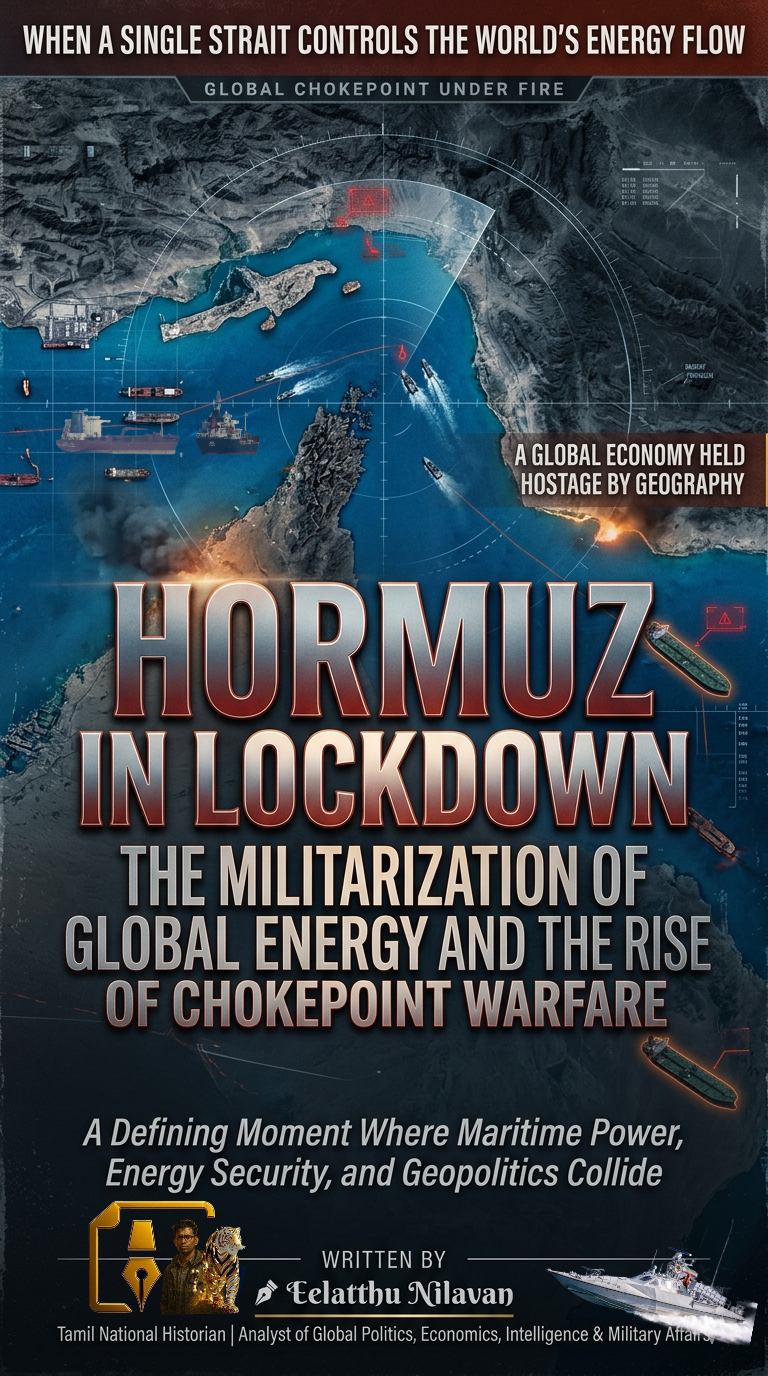

A Defining Moment Where Maritime Power, Energy Security, and Geopolitics Collide
The Strait of Hormuz—a narrow maritime corridor that underpins the modern global economy—has entered a phase of overt military confrontation. No longer confined to covert harassment or symbolic escalation, the situation has evolved into direct military engagement, enforced restrictions, and strategic economic disruption.
What is unfolding is not merely a regional crisis—it is a systemic shock to the structure of global trade and energy security. The transformation of the Strait into an active conflict zone signals a deeper shift in how power is exercised in the modern world—through control of geography as much as control of territory.
LIVE FIRE IN INTERNATIONAL WATERS: A NEW RULESET OF ENGAGEMENT
From Shadow Deterrence to Open Confrontation
The involvement of the Islamic Revolutionary Guard Corps (IRGC) marks a decisive escalation in both tone and method.
Recent verified incidents illustrate a dangerous operational shift. Armed IRGC fast-attack craft have reportedly opened fire on commercial vessels without warning, abandoning long-standing maritime norms that typically require identification and communication before escalation. In one case, a tanker captain described being approached and fired upon without any prior radio contact. In another, a container vessel near the coast of Oman was struck by an unidentified projectile, damaging cargo and forcing emergency response measures.
These actions reflect a deliberate strategy of shock enforcement, where unpredictability itself becomes a tool of control. The reduction of engagement thresholds increases the likelihood of miscalculation, placing civilian shipping directly within the range of military risk.
THE DECLARATION OF CLOSURE: CAN A STRAIT BE SEALED?
Law vs Power in Strategic Waterways
Iran’s declaration that the Strait is “closed to all traffic” represents one of the most consequential claims in modern maritime geopolitics.
Under international maritime law, particularly the principle of transit passage, the Strait of Hormuz is recognized as an international waterway through which vessels of all nations have the right to pass without obstruction. No single state is legally empowered to suspend that right unilaterally.
However, the current situation demonstrates a critical reality: legal frameworks depend on enforcement conditions. Where one actor possesses the capability to control access through force, legal norms can be effectively overridden in practice.
Iran is therefore not merely issuing a political statement—it is attempting to establish practical control over one of the world’s most vital shipping corridors.
All of this applies to America’s transgressions as well.
THE GLOBAL ENERGY LIFELINE UNDER THREAT
Why Hormuz Matters More Than Any Other Waterway
The strategic importance of the Strait of Hormuz cannot be overstated. It functions as a central route for global energy distribution.
Approximately one-fifth of the world’s oil consumption passes through this narrow passage each day. In addition, a substantial portion of global liquefied natural gas exports relies on uninterrupted transit through these waters. Major economies in Asia remain highly dependent on this flow, making any disruption immediately global in impact.
The current crisis has already triggered significant economic reactions. Oil markets are experiencing sharp volatility as traders respond to the risk of sustained disruption. Maritime insurance premiums have surged, with some routes effectively categorized as high-risk zones. Shipping companies are beginning to suspend or reroute voyages entirely, increasing transit times and logistical costs.
Even partial disruption introduces cascading consequences: rising inflation, industrial slowdowns, and potential strain on national strategic reserves. A prolonged closure would represent a serious shock to the global economy.
THE STRATEGIC DEADLOCK: WASHINGTON VS TEHRAN
Mutual Economic Pressure as Strategy
At the core of the situation lies an intensifying confrontation between Iran and the United States under Donald Trump.
The United States has maintained a strategy of economic pressure, combining sanctions with naval presence to restrict Iranian oil exports and limit its regional influence. Iran, in response, has adopted a counter-strategy rooted in its geographic advantage—using its position to threaten the wider global energy system.
This has created a condition of mutual economic pressure. The United States seeks to limit Iran’s access to global markets, while Iran signals its ability to disrupt access to energy supplies for the rest of the world.
Such a dynamic transforms what might otherwise remain a bilateral dispute into a global economic crisis risk, where the consequences extend far beyond the immediate parties involved.
THE “IRGC MARITIME REGIME”: CONTROL, CLEARANCE, AND TOLLS
Rewriting the Rules of Global Shipping
One of the most significant developments is Iran’s introduction of a new maritime control framework enforced by the IRGC Navy.
Under this system, commercial vessels are required to obtain authorization before entering the Strait, follow designated navigation routes, and potentially pay transit fees. This represents a shift from open access to conditional passage.
The implications are far-reaching. An international waterway is being redefined as a controlled zone under national authority. Iran is effectively positioning itself as the gatekeeper of a critical global trade route, using geography for both strategic and economic purposes.
If sustained, such a model could set a precedent for other strategic chokepoints, altering long-standing principles that have governed maritime trade.
Important note: This narrow sea route belongs to Iran and Oman, but the countries that benefit from it and the United States now define it as an international sea route.
CASCADING GLOBAL DISRUPTION: FROM SHIPPING LANES TO SUPPLY CHAINS
The immediate operational disruption is already visible across global shipping networks.
Commercial vessels are turning back mid-journey to avoid the conflict zone. Indian-linked tankers are among those forced to reverse course following reported incidents. Shipping schedules are becoming increasingly unreliable, with ripple effects extending into port operations and supply chains worldwide.
Beyond shipping, the situation is affecting broader economic systems. Manufacturing sectors face uncertainty in energy supply, transportation costs are rising, and import-dependent economies are experiencing increased financial pressure.
What began as a localized maritime confrontation is rapidly evolving into a multi-sector global disruption.
MILITARY BUILDUP: DETERRENCE OR PRE-WAR POSTURE?
The Russian Foreign Ministry has issued warnings regarding the scale and intent of United States military deployments in the region.
Current reports indicate the presence of approximately 50,000 United States personnel, supported by elite units such as the 82nd Airborne Division and special operations forces including Delta Force. Naval assets, led by the USS George H.W. Bush, further reinforce this posture.
Interpretations of this buildup vary sharply. Russia characterizes it as preparation for direct intervention. Iran views it as preparation for possible strikes. The United States maintains that the deployments are intended to stabilize the region and prevent further escalation.
This divergence in interpretation creates a volatile environment in which misunderstanding itself can become a trigger for conflict.
A TURNING POINT IN GLOBAL ORDER
The Age of Strategic Chokepoints
The current situation in the Strait of Hormuz reflects a deeper shift in global geopolitics.
Strategic chokepoints are increasingly being used as instruments of power. Economic interdependence, once seen as a stabilizing force, is now revealing itself as a vulnerability. Regional actors, by controlling key geographic routes, can exert influence far beyond their immediate region.
This signals the emergence of a new strategic reality:
control over critical transit routes can shape the global system itself.
CONCLUSION: THE WORLD AT THE EDGE OF A MARITIME SHOCK
The Strait of Hormuz is no longer merely contested—it is actively controlled, militarized, and used as a strategic tool. The combination of direct military engagement, economic pressure, and weakening diplomacy has created a situation where escalation risks are high and unpredictable.
A single miscalculation—whether operational, technical, or political—could trigger a chain reaction extending far beyond the region.
In this narrow stretch of water, the stakes are nothing less than the stability of global energy systems, the credibility of international maritime law, and the future balance of global power.

Written by: 𝙴𝚎𝚕𝚊𝚝𝚑𝚝𝚑𝚞 𝙽𝚒𝚕𝚊𝚟𝚊𝚗
Tamil National Historian | Analyst of Global Politics, Economics, Intelligence & Military Affairs
19/04/2026
The views expressed in this article are the author’s own and do not necessarily reflect Amizhthu’s editorial stance.