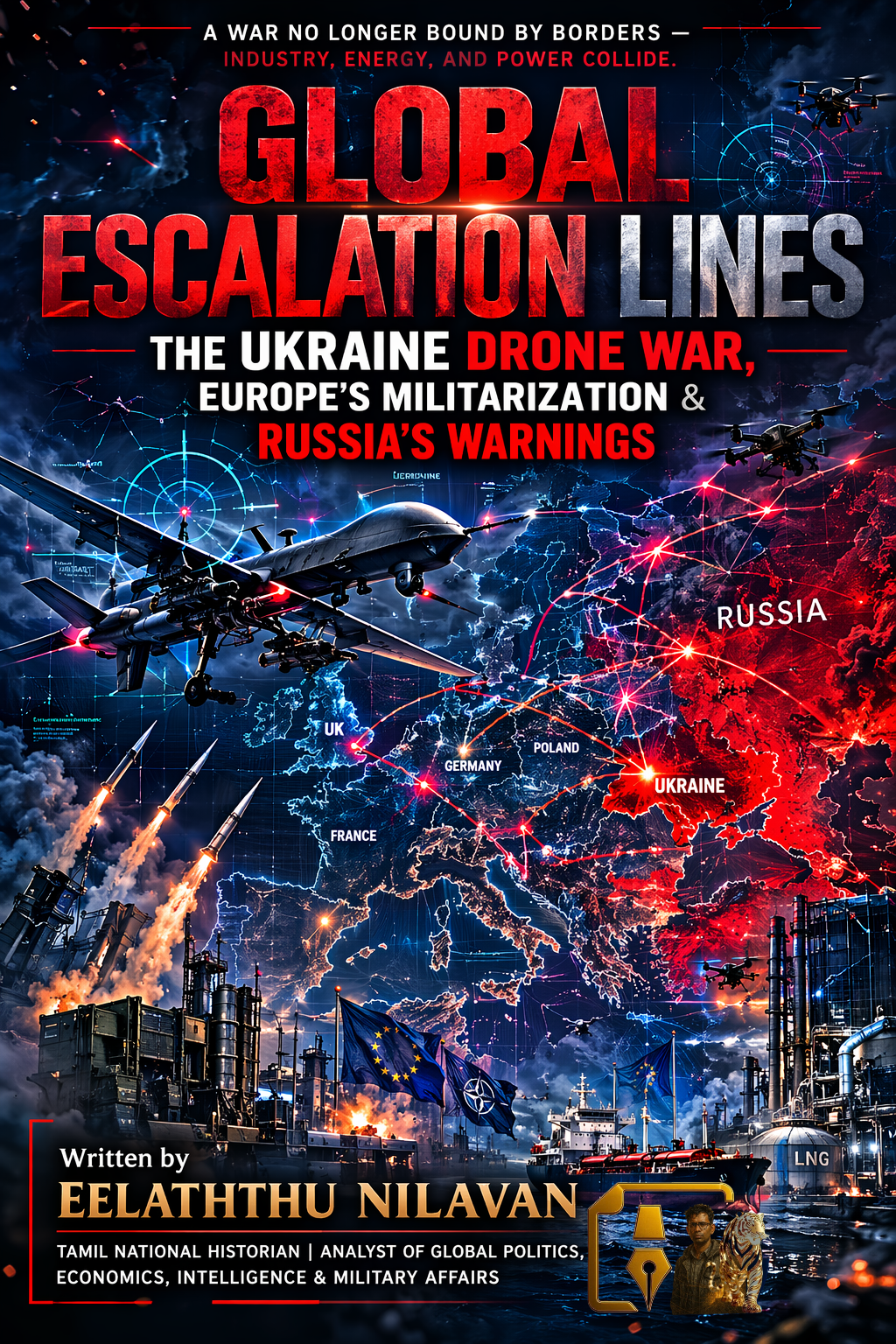

𝐓𝐇𝐄 𝐍𝐄𝐖 𝐅𝐑𝐎𝐍𝐓𝐋𝐈𝐍𝐄: 𝐃𝐑𝐎𝐍𝐄𝐒 𝐀𝐍𝐃 𝐓𝐇𝐄 𝐈𝐍𝐃𝐔𝐒𝐓𝐑𝐈𝐀𝐋𝐈𝐙𝐀𝐓𝐈𝐎𝐍 𝐎𝐅 𝐖𝐀𝐑
The conflict involving Ukraine and Russia is increasingly being defined not by traditional battlefield advances, but by industrial-scale production of unmanned systems and long-range strike capabilities.
Recent reports indicate that European Union is moving forward with large-scale financial support packages—described in some sources as reaching tens of billions of euros—part of which is expected to accelerate Ukraine’s domestic drone production capacity.
This shift signals a structural transformation:
from donor-based military aid → to continuous war-industrial integration.
The emerging “drone economy of war” is now positioned as a central pillar of Ukraine’s defense doctrine heading into 2026.
𝐑𝐔𝐒𝐒𝐈𝐀’𝐒 𝐖𝐀𝐑𝐍𝐈𝐍𝐆𝐒 𝐀𝐍𝐃 𝐓𝐇𝐄 𝐄𝐗𝐏𝐀𝐍𝐃𝐈𝐍𝐆 𝐆𝐄𝐎𝐆𝐑𝐀𝐏𝐇𝐘 𝐎𝐅 𝐓𝐇𝐑𝐄𝐀𝐓𝐒
The Russian defence establishment has issued strong warnings that Europe’s growing involvement in Ukraine’s drone ecosystem risks widening the war beyond its current boundaries.
According to statements attributed to Russian officials, including former President Dmitry Medvedev, lists of industrial sites allegedly linked to UAV production in countries such as:
• United Kingdom
• Germany
• Spain
• Italy
• Poland
• Israel
have been circulated in Russian messaging as “relevant infrastructure nodes.”
While NATO states reject these allegations, the rhetoric has raised alarm across European security circles due to its implicit suggestion that war-relevant infrastructure may no longer be geographically confined to Ukraine.
This represents a shift from deterrence messaging toward strategic signalling with expanded geographic ambiguity.
𝐓𝐇𝐄 𝐈𝐍𝐃𝐔𝐒𝐓𝐑𝐈𝐀𝐋 𝐖𝐀𝐑 𝐏𝐇𝐀𝐒𝐄 𝐎𝐅 𝐄𝐔𝐑𝐎𝐏𝐄
European defence planning is increasingly being framed around sustained production capacity rather than short-term aid cycles.
Key developments include:
• Long-term NATO commitments to Ukraine’s defence structure
• Expanded European missile defence cooperation
• Joint industrial production agreements with Germany as a central hub
• Large-scale procurement of air defence systems and interceptors
In particular, Germany and Ukraine have reportedly accelerated a joint anti-ballistic initiative referred to in some briefings as the “Freya” programme, designed to reduce reliance on external supply chains and create integrated European interception capability.
This marks a deeper evolution: Europe is no longer only supporting a war—it is building the architecture to sustain one.
𝐅𝐈𝐍𝐀𝐍𝐂𝐈𝐍𝐆 𝐖𝐀𝐑 𝐓𝐇𝐑𝐎𝐔𝐆𝐇 𝐅𝐑𝐎𝐙𝐄𝐍 𝐀𝐒𝐒𝐄𝐓𝐒
A significant financial shift has emerged through the use of immobilised Russian sovereign assets.
Under the G7 Extraordinary Revenue Acceleration framework, the United Kingdom has transferred approximately $1 billion equivalent in funds derived from frozen Russian capital profits to Ukraine.
This mechanism represents a strategic redefinition of sanctions:
• From punitive economic isolation
• To active war financing through asset yield extraction
The broader programme is valued at approximately $50 billion, signaling a long-term financial pipeline rather than short-term aid disbursement.
𝐄𝐍𝐄𝐑𝐆𝐘 𝐂𝐎𝐍𝐓𝐑𝐀𝐃𝐈𝐂𝐓𝐈𝐎𝐍𝐒 𝐀𝐂𝐑𝐎𝐒𝐒 𝐄𝐔𝐑𝐎𝐏𝐄
Despite sanctions regimes, energy dependency continues to fracture Western unity.
Reports indicate that Spain has significantly increased imports of Russian liquefied natural gas, even as broader EU policy aims to reduce dependence on Moscow.
This contradiction is largely attributed to:
• Global energy disruptions linked to Middle Eastern instability
• Shipping insecurity in strategic maritime corridors
• Price and supply pressures across European markets
The result is a dual-track reality: political sanctions vs economic survival logic
𝐍𝐀𝐓𝐎 𝐄𝐗𝐏𝐀𝐍𝐒𝐈𝐎𝐍 𝐎𝐅 𝐑𝐈𝐒𝐊 𝐏𝐄𝐑𝐂𝐄𝐏𝐓𝐈𝐎𝐍𝐒
Security tensions have intensified along NATO’s eastern frontier, particularly involving:
• Finland
• Estonia
• Latvia
• Lithuania
Russia has accused these states of indirect involvement in drone transit routes, claims which they deny.
The concern among analysts is not only the validity of these claims, but the escalation logic they enable—where cross-border drone incidents could be interpreted as collective responsibility under alliance frameworks.
This introduces a high-risk dynamic where miscalculation could rapidly escalate into broader confrontation involving NATO.
𝐓𝐇𝐄 𝐏𝐎𝐋𝐈𝐓𝐈𝐂𝐀𝐋 𝐅𝐑𝐀𝐂𝐓𝐔𝐑𝐄 𝐈𝐍𝐒𝐈𝐃𝐄 𝐄𝐔𝐑𝐎𝐏𝐄
Internal divisions within the European Union are becoming increasingly visible.
Criticism from leaders such as Slovakia’s Prime Minister Robert Fico reflects a broader tension between:
• Strategic alignment with Ukraine
• Domestic energy security pressures
• Economic exposure to sanctions blowback
This divergence highlights that Europe’s Ukraine policy is not monolithic, but structurally contested across member states.
𝐂𝐎𝐍𝐂𝐋𝐔𝐒𝐈𝐎𝐍: 𝐀 𝐖𝐀𝐑 𝐓𝐑𝐀𝐍𝐒𝐅𝐎𝐑𝐌𝐈𝐍𝐆 𝐈𝐍𝐓𝐎 𝐒𝐘𝐒𝐓𝐄𝐌𝐒 𝐂𝐎𝐍𝐅𝐋𝐈𝐂𝐓
The emerging strategic reality is no longer defined solely by territorial combat in Ukraine.
Instead, the conflict is evolving into:
• Industrial competition
• Financial warfare through sanctions re-engineering
• Energy system fragmentation
• Cross-border risk signalling
• Alliance-based escalation uncertainty
What was once a regional war is increasingly functioning as a system-wide geopolitical stress test for Europe and NATO structures.
The trajectory now depends not only on battlefield developments, but on whether political systems can contain escalation inside an increasingly interconnected security-industrial network.

Written by 𝔈𝔢𝔩𝔞𝔱𝔥𝔱𝔥𝔲 𝔑𝔦𝔩𝔞𝔳𝔞𝔫
Tamil National Historian | Analyst of Global Politics, Economics, Intelligence & Military Affairs
19/04/2026
The views expressed in this article are the author’s own and do not necessarily reflect Amizhthu’s editorial stance.