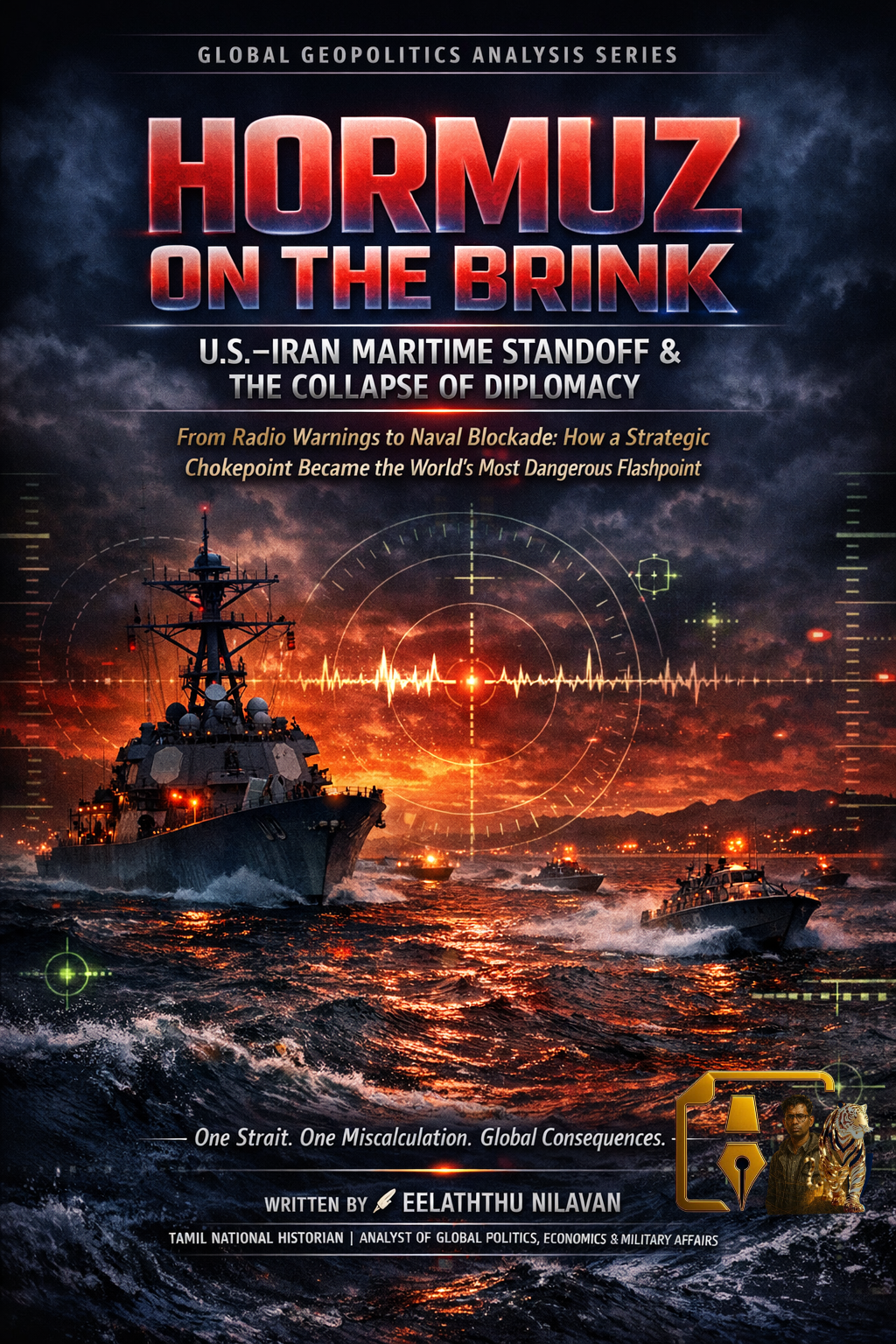

From Radio Warnings to Naval Blockade: How a Strategic Chokepoint Became the World’s Most Dangerous Flashpoint
THE MOMENT THAT CHANGED THE CALCULUS
In the narrow waters of the Strait of Hormuz, where geography compresses global trade into a vulnerable corridor, a radio transmission cut through the silence with unmistakable clarity:
“Alter course immediately… or you will be targeted.”
This warning—issued by Iranian forces to a U.S. warship transiting toward the Gulf of Oman—was not an isolated incident. It was a signal flare in an already volatile environment, marking a transition from diplomatic tension to active military brinkmanship.
The U.S. vessel’s response—that it was conducting lawful transit passage—reflects a deeper conflict: not just over territory, but over who defines the rules of movement in one of the world’s most critical waterways.
GEOSTRATEGIC SIGNIFICANCE: WHY HORMUZ MATTERS MORE THAN EVER
The importance of the Strait of Hormuz cannot be overstated:
• Nearly 20% of global oil supply passes through this corridor
• It connects the Persian Gulf to global markets via the Arabian Sea
• It serves as a lifeline for energy-dependent economies across Asia and Europe
At its narrowest navigable width, shipping lanes are only a few miles wide—making them highly vulnerable to disruption.
Strategic Reality
Control over Hormuz is not just about naval dominance—it is about:
• Economic leverage
• Energy security
• Geopolitical influence
For Iran, proximity equals power. For the United States, access equals stability.
THE U.S. BLOCKADE: COERCIVE DIPLOMACY OR ESCALATORY GAMBIT?
Following the breakdown of negotiations in Islamabad, Donald Trump authorized a sweeping naval blockade targeting Iranian maritime activity.
Strategic Objectives
• Sever Iran’s oil export capacity
• Undermine its toll-based control of maritime traffic
• Force compliance on nuclear restrictions
Military Execution
• Interdiction of vessels linked to Iranian ports
• Surveillance and control of shipping lanes
• Deployment of additional naval and air assets
Critical Assessment
While framed as economic pressure, a blockade in such a chokepoint:
• Risks violating international maritime norms
• Can be interpreted as a declaration of war
• Places U.S. forces in constant proximity to Iranian assets, increasing collision risk
This is not a distant containment strategy—it is direct confrontation in constrained space.
IRAN’S ASYMMETRIC DOCTRINE: THE TAKAVARAN EDGE
Iran’s response has been swift and calculated, centered on asymmetric warfare.
Deployment of Takavaran Units
Elite maritime commandos—known as Takavaran—have been positioned along Iran’s southern coastline.
Capabilities
• Stealth Diving Operations: Closed-circuit systems allow undetected underwater approach
• Fast Assault Craft Tactics: Swarm attacks on larger vessels
• Amphibious Raids: Rapid insertion and extraction along coastlines
• Ship Seizure Operations: Boarding and disabling enemy vessels
Strategic Logic
Iran cannot match U.S. naval power conventionally—but it doesn’t need to.
Instead, it leverages:
• Geography (narrow waters)
• Speed (fast attack craft)
• Surprise (covert insertion)
This transforms Hormuz into a denied environment, where even superior forces operate under constant threat.
THE LEGAL BATTLEFIELD: TRANSIT RIGHTS VS SOVEREIGN CONTROL
At the heart of the standoff lies a legal dispute with global implications.
International Law (UNCLOS Framework)
• Guarantees transit passage through international straits
• Prohibits coastal states from obstructing navigation
The U.S. position aligns with this interpretation.
Iran’s Position
• Frames restrictions as security measures
• Seeks to regulate passage via tolls and oversight
Why It Matters
If Iran successfully enforces restrictions:
• It could rewrite norms governing global chokepoints
• Other states may follow suit, fragmenting maritime law
This is not just a regional dispute—it is a test case for the future of global navigation rights.
FRACTURED ALLIANCES: THE WESTERN SPLIT
One of the most striking developments is the lack of unified Western support.
Diverging Positions
• Keir Starmer rejects participation in the blockade
• European states warn of economic destabilization
• Australia distances itself from U.S. unilateral action
Implications
• Weakens deterrence credibility
• Signals strategic divergence within NATO and AUKUS
• Encourages adversaries to exploit divisions
This is not just a military crisis—it is a crisis of alliance cohesion.
GLOBAL POWERS AND THE EXPANDING CRISIS ARC
The Hormuz crisis is rapidly becoming a multi-actor geopolitical confrontation.
Russia
• Warns of global economic fallout
• Positions itself as a potential mediator
China
• Emphasizes stability in energy routes
• Rejects U.S. pressure on Iranian trade
Regional Actors
• Houthi threats to disrupt the Bab al-Mandab Strait
• Risk of linked chokepoint crises affecting global shipping
Systemic Risk
What begins in Hormuz may cascade into:
• Multi-theater maritime disruption
• Global trade paralysis
• Strategic realignment among major powers
THE ISLAMABAD TALKS: DIPLOMACY UNRAVELED
The diplomatic collapse in Islamabad marked the turning point.
Negotiation Breakdown
• U.S. presented a “final” nuclear proposal
• Iran rejected it as maximalist and inflexible
Controversial Claim
Iran alleges that:
• Benjamin Netanyahu contacted
• JD Vance during negotiations
This, Tehran claims, shifted the U.S. stance at a decisive moment.
(This allegation remains unverified but politically significant.)
Deeper Reality
The talks failed due to:
• Structural mistrust
• Irreconcilable demands
• External geopolitical pressures
Diplomacy did not just fail—it collapsed under competing strategic imperatives.
THE ENERGY SHOCK SCENARIO
The global economy now sits atop a potential explosion.
Immediate Risks
• Oil price spikes
• Shipping insurance surges
• Supply chain disruptions
Secondary Effects
Inflation in energy-importing nations
Economic slowdown
Political instability in vulnerable regions
Even without full-scale war, uncertainty alone can destabilize markets.
ESCALATION DYNAMICS: HOW WAR COULD IGNITE
The current environment is defined by compressed decision timelines.
Potential Triggers
• Misinterpreted radar lock
• Accidental collision
• Warning shot escalation
• Drone or mine incident
Escalation Ladder
• Tactical incident
• Limited retaliation
• Regional naval conflict
• Multi-domain warfare involving air and missile strikes
In such an environment, intent matters less than perception.
CONCLUSION: A SYSTEM UNDER STRAIN
The Hormuz crisis is not an isolated event—it is a convergence point for:
• Strategic rivalry
• Legal ambiguity
• Energy dependence
• Alliance fragmentation
• Regional instability
The world is witnessing a shift from:
Managed tension → Uncontrolled confrontation
The ultimate danger lies not in deliberate war—but in unintended escalation within a system already under extreme stress.
Written by


Eelaththu Nilavan
Tamil National Historian | Analyst of Global Politics, Economics, Intelligence & Military Affairs
14/04/2026
The views expressed in this article are the author’s own and do not necessarily reflect Amizhthu’s editorial stance.