A $105 BILLION LIFELINE UNLOCKED — BUT AT WHAT COST?
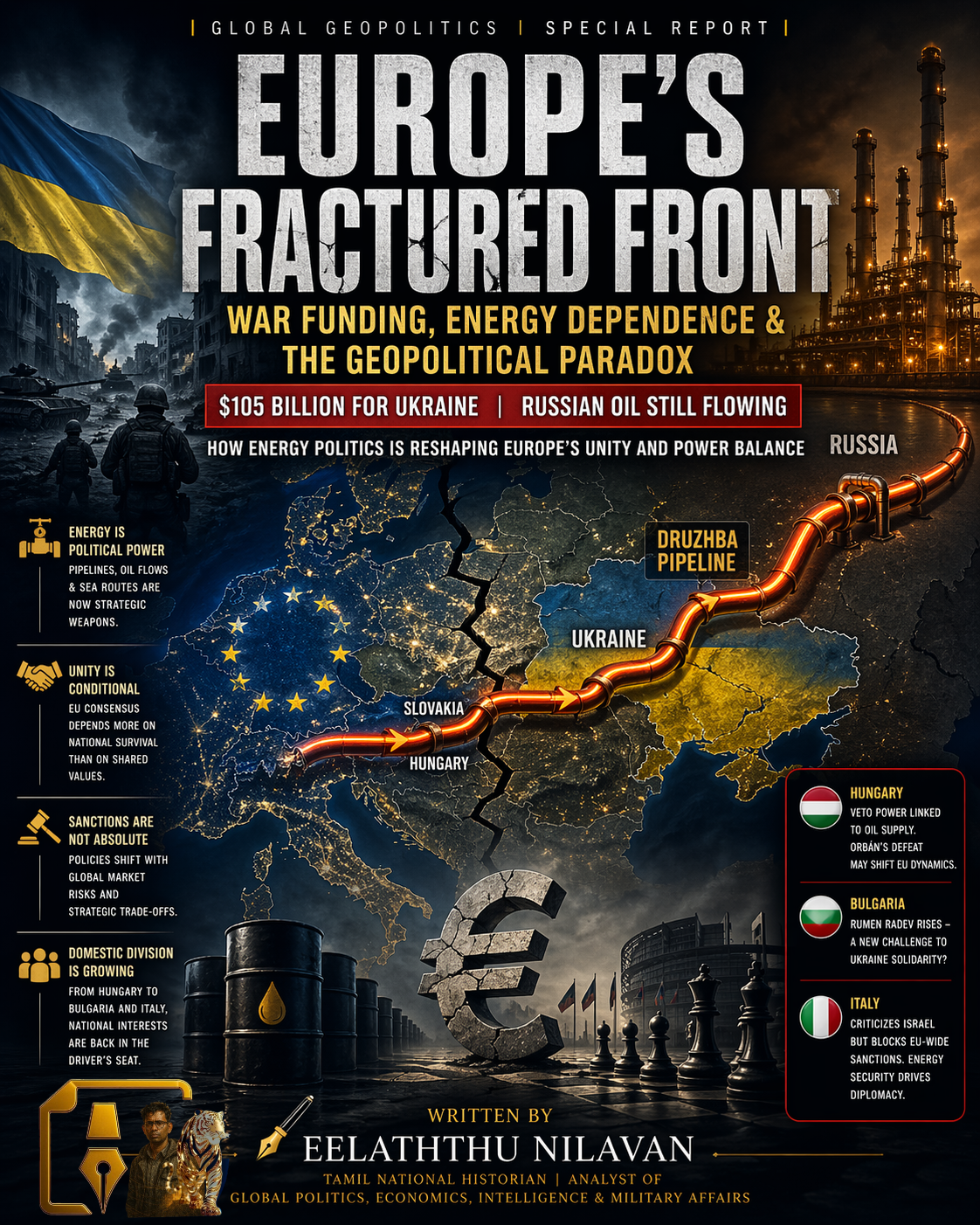
The European Union has finally approved a massive $105 billion financial package for Ukraine, ending months of political paralysis that exposed deep internal divisions. This funding is intended to stabilize Kyiv’s economy and sustain its war effort against Russia over the next two years.
However, the breakthrough was not driven purely by diplomatic consensus—it was forced by energy leverage, strategic concessions, and shifting political power within Europe.
THE DRUZHBA PIPELINE: ENERGY AS A GEOPOLITICAL WEAPON
At the heart of the deadlock was the Druzhba pipeline, one of Europe’s most critical oil arteries, transporting Russian crude through Ukraine into Central Europe.
• The pipeline’s southern branch had been damaged, halting supplies to countries like Hungary and Slovakia
• These nations remain structurally dependent on Russian oil
• The outage created immediate economic and political pressure within the EU
Hungary, under Viktor Orbán, used its veto power to block the Ukraine aid package, effectively tying its approval to the restoration of oil flows.
In simple terms:
No oil → No EU unity → No Ukraine funding
THE BREAKTHROUGH: OIL FLOWS RESTORED, VETO LIFTED
The deadlock broke only after Ukraine completed urgent repairs and resumed oil transit.
• Slovakia confirmed shipments had restarted under Robert Fico
• Hungary subsequently lifted its veto
• EU ambassadors quickly approved:
• The $105 billion loan
• A new round of sanctions against Russia
This sequence reveals a critical reality:
Energy security dictated political decision-making—not the other way around
THE EU’S CORE CONTRADICTION
The situation exposes a striking paradox within the European Union:
Funding Ukraine’s War…
• Massive financial and military support to Kyiv
• Continued sanctions targeting Russia
While Relying on Russian Energy…
• Ongoing imports via pipelines like Druzhba
• Political compromises to maintain internal unity
This creates a dual-track policy:
• Publicly confronting Russia
• Privately depending on it for stability
POLITICAL SHIFT IN HUNGARY: A TURNING POINT?
The reported electoral defeat of Viktor Orbán signals a potential shift in EU dynamics.
• A new leadership in Budapest may adopt a more EU-aligned stance
• Future veto threats could diminish
• Decision-making in Brussels may become smoother
However, underlying tensions remain unresolved.
BULGARIA’S EARTHQUAKE: THE RISE OF “ORBÁN 2.0”?
A new challenge to EU unity is emerging in Bulgaria under Rumen Radev.
Key Concerns:
• Calls to halt aid to Ukraine
• Advocacy for a “pragmatic” relationship with Russia
• Strong domestic support driven by economic fatigue
Moscow has openly welcomed this shift, seeing it as an opportunity to fracture EU cohesion from within.
The risk:
Hungary may not be the last internal roadblock—just the first.
THE GLOBAL DIMENSION: SANCTIONS, OIL & STRATEGIC TRADE-OFFS
Across the Atlantic, a heated confrontation in the U.S. highlights the same dilemma.
During a Senate exchange, Chris Coons challenged Treasury Secretary Scott Bessent over claims that:
• Iran received $14 billion in sanctions relief
• Russia gained $150 million per day from oil-related policy adjustments
The Treasury’s Defense:
• Preventing oil prices from reaching $150 per barrel
• Protecting global markets and consumers
• Avoiding economic shockwaves for vulnerable nations
This mirrors Europe’s dilemma:
Strategic compromises are being made to stabilize energy markets—even if adversaries benefit indirectly.
ITALY’S “GEOPOLITICAL TIGHTROPE” IN THE MIDDLE EAST
Meanwhile, Europe faces another fracture point in its approach to Israel and regional instability.
Under Foreign Minister Antonio Tajani, Italy has:
• Strongly criticized Israeli actions (civilian harm, settler violence)
• Yet blocked broad EU sanctions, alongside Germany
• Advocated targeted measures instead of sweeping economic penalties
Why the hesitation?
• Fear of destabilizing the region
• Concerns over energy routes like the Strait of Hormuz
• Efforts to mediate with Iran and prevent escalation
Again, energy security shapes diplomacy.
A NEW ERA: WAR, ENERGY & POWER INTERTWINED
The current geopolitical landscape reveals a profound transformation:
1. Energy = Political Leverage
Pipelines, oil flows, and shipping routes are now strategic weapons
2. Unity Is Conditional
EU consensus depends on national economic survival, not just shared values
3. Sanctions Are No Longer Absolute
They are being calibrated against global market risks
4. Internal Fragmentation Is Growing
From Hungary to Bulgaria to Italy, national interests are reasserting themselves
CONCLUSION: A FRAGILE BALANCE OF POWER
The approval of the $105 billion Ukraine package is not a sign of strength—it is a carefully negotiated compromise shaped by necessity.
Europe—and its allies—are now operating in a world where:
• War funding depends on energy flows
• Sanctions coexist with strategic concessions
• Unity is constantly tested by domestic pressures
The defining question ahead is not whether support for Ukraine will continue—
but whether the fragile balance holding this coalition together can endure.

Written by 𝐄𝐞𝐥𝐚𝐭𝐡𝐭𝐡𝐮 𝐍𝐢𝐥𝐚𝐯𝐚𝐧
Tamil National Historian | Analyst of Global Politics, Economics, Intelligence & Military Affairs
24/04/2026
The views expressed in this article are the author’s own and do not necessarily reflect Amizhthu’s editorial stance.