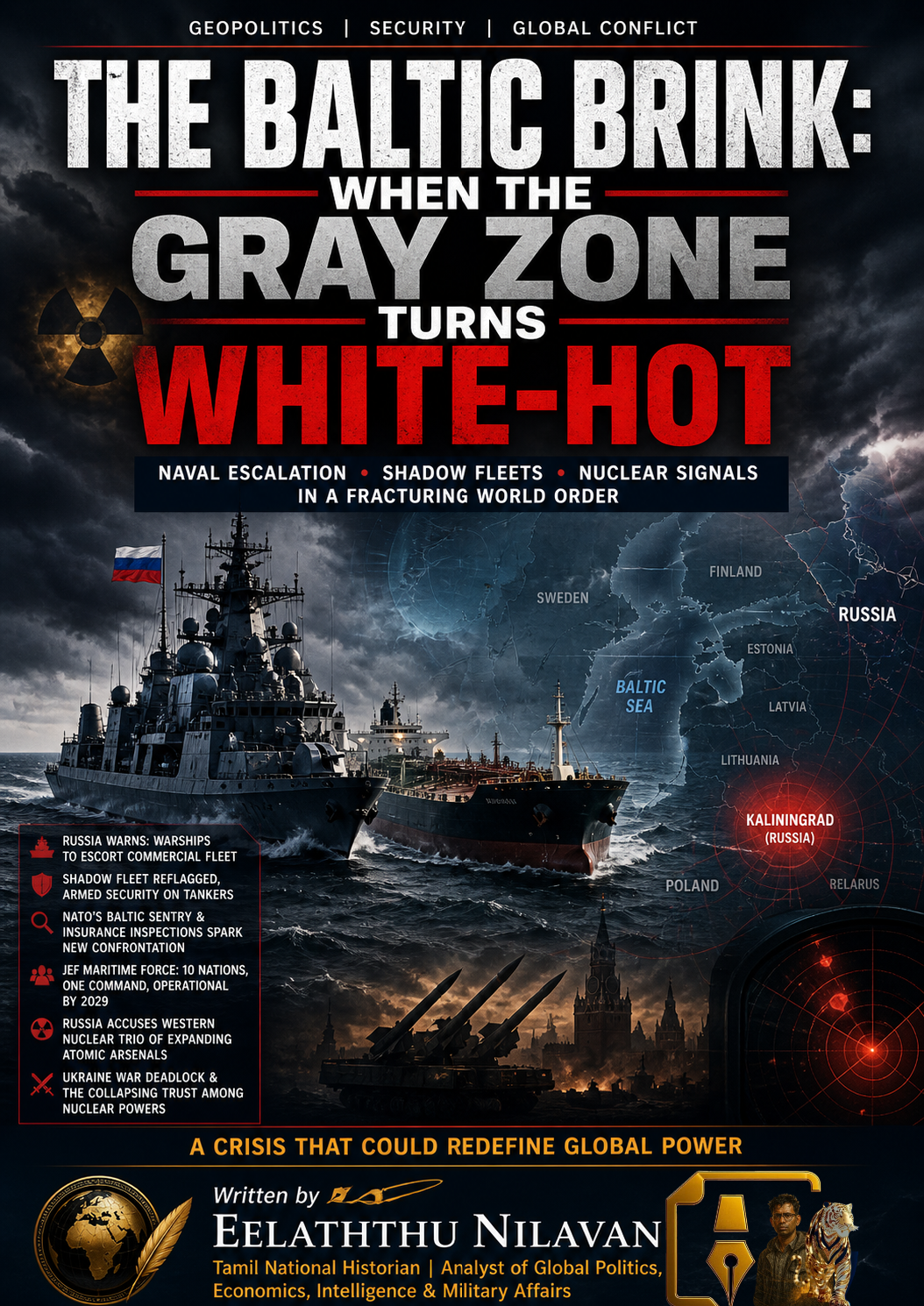

Maritime Escalation, Nuclear Signaling, and the Fragmenting Global Order
𝑨 𝑺𝑬𝑨 𝑶𝑵 𝑻𝑯𝑬 𝑬𝑫𝑮𝑬
The Baltic Sea, long regarded as a strategic but stable maritime corridor in Northern Europe, is rapidly transforming into one of the most volatile flashpoints in contemporary geopolitics. What was once a zone of controlled tension is now sliding toward open confrontation, as Russia and Western powers intensify their military and economic maneuvers in overlapping spheres of influence. The escalation is not accidental—it is the product of layered mistrust, competing legal interpretations of maritime authority, and the growing use of “gray zone” tactics that blur the line between peace and war.
At the heart of this crisis lies Russia’s increasingly assertive posture. Moscow’s warning that it may deploy naval warships to escort its commercial vessels marks a significant shift from passive resistance to active military protection of economic interests. This move is framed by the Kremlin as a necessary response to what it calls unlawful interference by NATO-aligned states, particularly through insurance inspections and maritime monitoring operations.
𝑹𝑼𝑺𝑺𝑰𝑨’𝑺 𝑴𝑨𝑹𝑰𝑻𝑰𝑴𝑬 𝑮𝑨𝑴𝑩𝑰𝑻
Russia’s evolving tactics in the Baltic Sea illustrate a deliberate strategy to challenge Western enforcement mechanisms without crossing into outright war—at least not yet. By reflagging its so-called “shadow fleet” under the Russian registry, Moscow is attempting to extend sovereign immunity to vessels that would otherwise be vulnerable to inspection, detention, or sanction enforcement.
The addition of armed security personnel aboard high-value tankers further complicates the situation. These are not conventional naval deployments, but they introduce an element of force into what would typically be civilian maritime operations. If NATO forces attempt to board or inspect such vessels, the presence of armed guards could trigger a direct confrontation, escalating a legal dispute into a military incident within minutes.
The potential deployment of Russian naval escorts raises the stakes even higher. Warships operating alongside commercial tankers effectively militarize trade routes, creating a dangerous precedent. Any miscalculation—whether a warning shot, a collision, or a misinterpreted maneuver—could spiral into a broader conflict involving multiple states.
𝑵𝑨𝑻𝑶, 𝑱𝑬𝑭, 𝑨𝑵𝑫 𝑻𝑯𝑬 𝑹𝑰𝑺𝑬 𝑶𝑭 𝑴𝑼𝑳𝑻𝑰𝑵𝑨𝑻𝑰𝑶𝑵𝑨𝑳 𝑭𝑶𝑹𝑪𝑬𝑺
In response to increased Russian activity, Western nations are reinforcing their presence in the Baltic through both NATO frameworks and parallel initiatives. The Joint Expeditionary Force (JEF), led by the United Kingdom, represents a flexible coalition of northern European states designed to respond rapidly to regional threats.
Unlike NATO, which operates through broader consensus mechanisms, the JEF offers a more agile structure, enabling quicker deployment and coordination. Its planned maritime force—expected to reach full operational capability by 2029—signals a long-term commitment to countering Russian influence in the region.
This dual-track approach—combining NATO operations with JEF initiatives—reflects a deeper concern among European states: that traditional deterrence structures may no longer be sufficient in an era of hybrid warfare. Reports of increased Russian incursions into allied waters reinforce the perception that Moscow is testing the limits of Western resolve.
𝑻𝑯𝑬 𝑮𝑹𝑨𝒀 𝒁𝑶𝑵𝑬: 𝑾𝑯𝑬𝑹𝑬 𝑳𝑨𝑾 𝑴𝑬𝑬𝑻𝑺 𝑭𝑶𝑹𝑪𝑬
The Baltic crisis exemplifies the concept of “gray zone” conflict—actions that fall below the threshold of conventional war but are designed to achieve strategic objectives through ambiguity and incremental escalation. Russia’s use of reflagged tankers, legal arguments about sovereign immunity, and selective militarization of civilian assets fits squarely within this framework.
For NATO and its partners, responding to such tactics presents a dilemma. Overreaction risks triggering the very conflict they seek to avoid, while underreaction may embolden further aggression. The introduction of warships into these ambiguous encounters threatens to collapse the gray zone entirely, transforming it into a “white-hot” conflict space where the margin for error disappears.
𝑵𝑼𝑪𝑳𝑬𝑨𝑹 𝑬𝑪𝑯𝑶𝑬𝑺 𝑰𝑵 𝑨 𝑴𝑨𝑹𝑰𝑻𝑰𝑴𝑬 𝑪𝑹𝑰𝑺𝑰𝑺
Overlaying the maritime tensions is a far more dangerous layer of strategic competition: nuclear signaling. Statements from Russian Defence Minister Andrei Belousov at the NPT Review Conference reflect a deepening breakdown in trust between nuclear powers.
Moscow’s accusations that the United States, United Kingdom, and France are expanding their nuclear arsenals point to a broader narrative of encirclement and existential threat. The claim that France is developing a “nuclear fist” aimed at Russia, alongside discussions of greater involvement by non-nuclear European states in deterrence structures, signals a shift toward more integrated and potentially more aggressive nuclear postures.
In this context, the Baltic Sea is not merely a regional flashpoint—it is a frontline in a wider strategic confrontation that includes nuclear doctrine, alliance cohesion, and global power balances. The erosion of arms control frameworks and the dismissal of disarmament prospects as “negligible” suggest that the world may be entering a new era of nuclear competition.
𝑻𝑯𝑬 𝑼𝑲𝑹𝑨𝑰𝑵𝑬 𝑾𝑨𝑹: 𝑻𝑯𝑬 𝑺𝑯𝑨𝑫𝑶𝑾 𝑶𝑽𝑬𝑹 𝑻𝑯𝑬 𝑩𝑨𝑳𝑻𝑰𝑪
The ongoing war in Ukraine remains the central driver of East-West tensions. For the Kremlin, the conflict is not an isolated theater but part of a broader struggle against NATO expansion and Western influence. Russia’s insistence that a settlement is impossible without abandoning the goal of its “strategic defeat” highlights the depth of this confrontation.
From a Western perspective, continued support for Ukraine is framed as essential to maintaining international norms and deterring future aggression. However, the prolonged nature of the conflict, combined with uncertainties over military outcomes and economic costs, has introduced new debates within Western societies about sustainability and end goals.
The Baltic escalation must therefore be understood as both a consequence and an extension of the Ukraine war—a secondary front where strategic pressure is applied through different means but with similar objectives.
𝑬𝑪𝑶𝑵𝑶𝑴𝑰𝑪 𝑹𝑬𝑨𝑳𝑰𝑮𝑵𝑴𝑬𝑵𝑻𝑺 𝑨𝑵𝑫 𝑮𝑳𝑶𝑩𝑨𝑳 𝑺𝑯𝑰𝑭𝑻𝑺
Beyond the immediate security concerns, the crisis reflects deeper transformations in the global economic landscape. Russia’s pivot toward markets in Asia, Africa, and Central Asia indicates an attempt to reduce dependence on Western systems and sanctions-sensitive trade routes.
This realignment is not unique to Russia; it mirrors a broader trend of fragmentation in the global economy, where geopolitical considerations increasingly shape trade, investment, and technological cooperation. The Baltic Sea, as a key energy and shipping corridor, becomes a critical node in this evolving network of alliances and rivalries.
𝑨 𝑭𝑹𝑨𝑮𝑰𝑳𝑬 𝑭𝑼𝑻𝑼𝑹𝑬
The convergence of maritime tensions, nuclear rhetoric, and geopolitical realignment creates a highly unstable environment in which the risk of miscalculation is dangerously high. The Baltic Sea crisis is not defined by a single event but by a series of interconnected developments that collectively push the region closer to confrontation.
What makes this situation particularly perilous is its ambiguity. There is no formal declaration of conflict, no clear red lines that all parties agree upon, and no effective mechanisms for de-escalation that command universal trust. In such an environment, even minor incidents can have disproportionate consequences.
The world is thus confronted with a stark reality: the structures that once managed great power competition are weakening, while new forms of conflict are emerging faster than they can be understood or controlled. Whether the Baltic Sea becomes a catalyst for broader war or a cautionary example of restrained escalation will depend on decisions made in the coming months—decisions that carry implications far beyond the waters of Northern Europe.

Written by 𝐄𝐞𝐥𝐚𝐭𝐡𝐭𝐡𝐮 𝐍𝐢𝐥𝐚𝐯𝐚𝐧
Tamil National Historian | Analyst of Global Politics, Economics, Intelligence & Military Affairs
03/05/2026