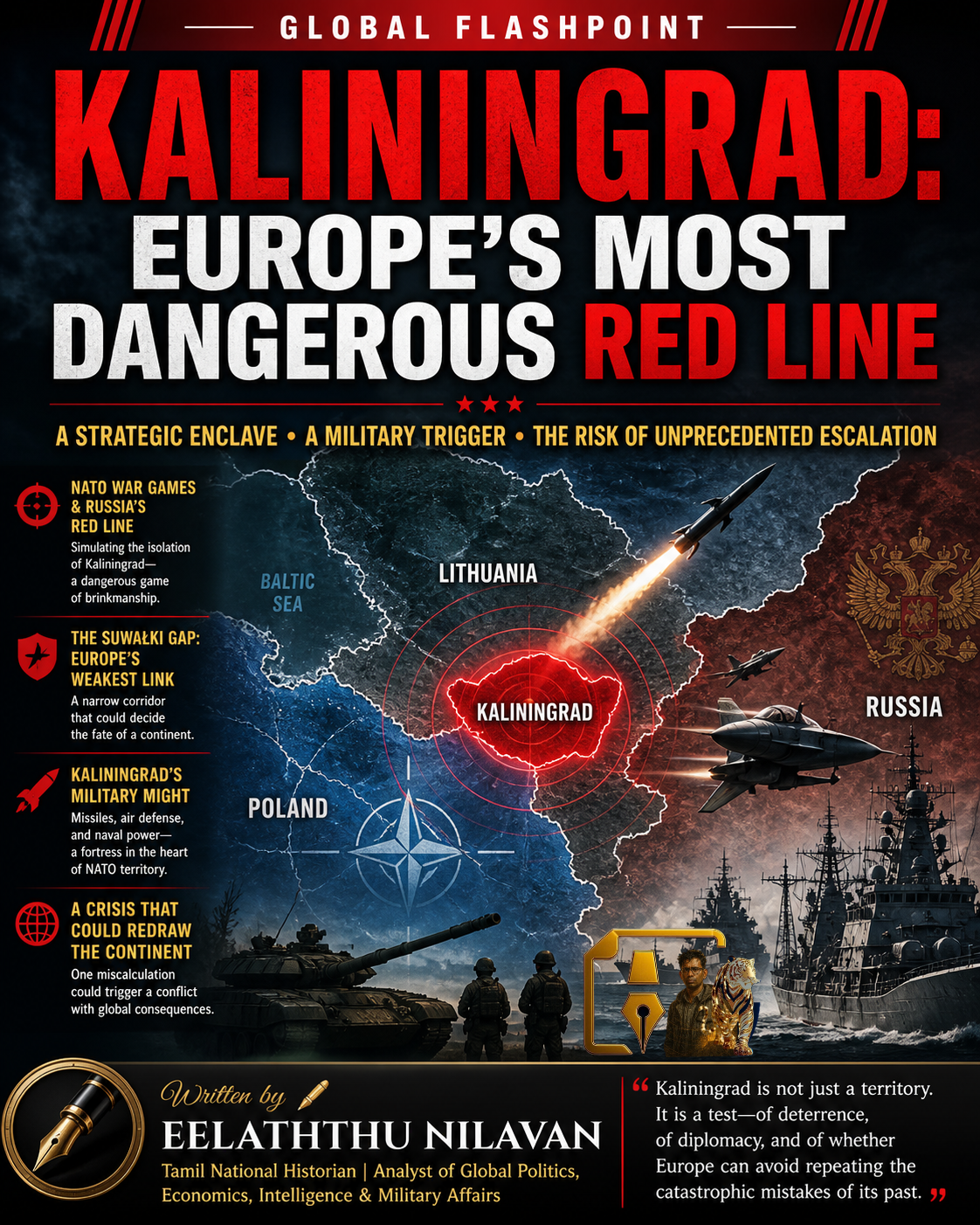

A Strategic Enclave, A Military Trigger, and the Risk of Unprecedented Escalation
𝙏𝙃𝙀 𝙂𝙀𝙊𝙋𝙊𝙇𝙄𝙏𝙄𝘾𝘼𝙇 𝙀𝙉𝙄𝙂𝙈𝘼 𝙊𝙁 𝙆𝘼𝙇𝙄𝙉𝙄𝙉𝙂𝙍𝘼𝘿
At the heart of Europe’s escalating security dilemma lies Kaliningrad, a heavily fortified Russian exclave wedged between Poland and Lithuania, both members of NATO and the European Union. Once part of East Prussia and historically tied to Germany, Kaliningrad today represents Moscow’s most forward-positioned military outpost in Europe.
This small but highly strategic territory is not merely symbolic. It functions as a critical node in Russia’s anti-access/area denial (A2/AD) network, enabling Moscow to project power deep into the Baltic region. Its geographic isolation from mainland Russia makes it uniquely vulnerable—and simultaneously, dangerously sensitive to any perceived encirclement or blockade.
𝙈𝙊𝙎𝘾𝙊𝙒’𝙎 𝙍𝙀𝘿 𝙇𝙄𝙉𝙀: 𝙏𝙍𝘼𝙉𝙎𝙄𝙏, 𝘽𝙇𝙊𝘾𝙆𝘼𝘿𝙀 & 𝙀𝙎𝘾𝘼𝙇𝘼𝙏𝙄𝙊𝙉
Russian leadership, including President Vladimir Putin, has issued stark warnings that any attempt to restrict transit routes to Kaliningrad—whether by land through Lithuania or via the Baltic Sea—would be interpreted as an act of aggression. Russian Foreign Ministry envoy Artyom Bulatov has reinforced this position, emphasizing that interference with logistical access would cross a “red line” for Moscow.
Transit to Kaliningrad is governed by complex agreements between Russia and the EU, particularly through Lithuanian rail corridors. Any disruption—intentional or incidental—could trigger rapid escalation. Moscow has framed such actions not as economic pressure, but as strategic strangulation, warranting a decisive military response.
The language used by the Kremlin—“unprecedented escalation”—is not rhetorical exaggeration. It signals a willingness to consider a wide spectrum of retaliatory options, ranging from hybrid warfare to conventional military engagement.
𝙉𝘼𝙏𝙊’𝙎 𝙎𝙏𝙍𝘼𝙏𝙀𝙂𝙄𝘾 𝘾𝘼𝙇𝘾𝙐𝙇𝙐𝙎 𝘼𝙉𝘿 𝙒𝘼𝙍 𝙂𝘼𝙈𝙄𝙉𝙂
On the other side of the divide, NATO has been intensifying its military preparedness in Eastern Europe. Reports of war games simulating the isolation of Kaliningrad underscore the alliance’s concern over Russian capabilities in the region.
From NATO’s perspective, Kaliningrad represents a potential launchpad for offensive operations, particularly against the so-called Suwałki Gap—a narrow corridor between Poland and Lithuania that connects the Baltic states to the rest of NATO territory. In a conflict scenario, control of this corridor would be decisive.
These exercises are officially defensive in nature, aimed at ensuring readiness and deterrence. However, in Moscow’s strategic culture, such simulations are often interpreted as rehearsals for real operations. This mutual suspicion creates a classic security dilemma, where defensive measures by one side are perceived as offensive threats by the other.
𝙏𝙃𝙀 𝙈𝙄𝙇𝙄𝙏𝘼𝙍𝙄𝙕𝘼𝙏𝙄𝙊𝙉 𝙊𝙁 𝙆𝘼𝙇𝙄𝙉𝙄𝙉𝙂𝙍𝘼𝘿
Kaliningrad is one of the most militarized regions in Europe. It is widely believed to host advanced missile systems, including Iskander ballistic missiles, as well as sophisticated air defense platforms such as the S-400 system. These assets allow Russia to cover large parts of the Baltic Sea and even reach into Central Europe.
The enclave also hosts elements of the Baltic Fleet, further enhancing its strategic significance. In military terms, Kaliningrad serves as both a shield and a sword—capable of denying access to adversaries while projecting force outward.
This militarization is a core reason why NATO views the enclave as a threat, while Russia considers it an indispensable component of its national defense architecture.
𝙍𝙄𝙎𝙆 𝙊𝙁 𝘿𝙄𝙍𝙀𝘾𝙏 𝘾𝙊𝙉𝙁𝙍𝙊𝙉𝙏𝘼𝙏𝙄𝙊𝙉
The current trajectory of events suggests that the risk of direct confrontation between Russia and NATO is no longer hypothetical. Even a minor incident—such as a disruption in transit, a misinterpreted სამხედრო exercise, or an accidental military encounter—could escalate rapidly.
The involvement of global powers, including the United States under President Donald Trump, adds another layer of complexity. Washington’s commitment to NATO’s collective defense clause means that any conflict involving member states could quickly expand into a broader war.
Unlike previous Cold War standoffs, today’s geopolitical environment is more fragmented, with fewer established communication channels and greater reliance on rapid-response military doctrines. This increases the probability of miscalculation.
𝘼 𝙁𝙍𝘼𝙂𝙄𝙇𝙀 𝙀𝙐𝙍𝙊𝙋𝙀𝘼𝙉 𝙎𝙀𝘾𝙐𝙍𝙄𝙏𝙔 𝙊𝙍𝘿𝙀𝙍
The Kaliningrad crisis is not an isolated issue—it is a manifestation of a broader breakdown in European security architecture. The post-Cold War assumptions of cooperation and stability are being replaced by renewed great power competition.
For the European Union, the challenge lies in balancing economic pressure against Russia with the need to avoid military escalation. For NATO, the dilemma is how to deter aggression without provoking it. For Russia, Kaliningrad represents both a strategic necessity and a vulnerability that cannot be compromised.
𝘾𝙊𝙉𝘾𝙇𝙐𝙎𝙄𝙊𝙉: 𝘼 𝘾𝙊𝙉𝙏𝙄𝙉𝙀𝙉𝙏 𝙊𝙉 𝙏𝙃𝙀 𝘽𝙍𝙄𝙉𝙆
Kaliningrad has emerged as one of the most dangerous flashpoints in the modern geopolitical landscape. The convergence of military build-up, strategic mistrust, and political signaling has created a volatile environment where the margin for error is extremely thin.
If the current trajectory continues, the region could become the epicenter of a confrontation that reshapes the balance of power in Europe. Avoiding such an outcome will require not only military restraint but also renewed diplomatic engagement—something that appears increasingly elusive in the present climate.
In this unfolding crisis, Kaliningrad is no longer just a territory. It is a test of deterrence, of diplomacy, and of whether Europe can avoid repeating the catastrophic mistakes of its past.

Written by 𝔈𝔢𝔩𝔞𝔱𝔥𝔱𝔥𝔲 𝔑𝔦𝔩𝔞𝔳𝔞𝔫
Tamil National Historian | Analyst of Global Politics, Economics, Intelligence & Military Affairs
02/05/2026
The views expressed in this article are the author’s own and do not necessarily reflect Amizhthu’s editorial stance.